Related Research Articles
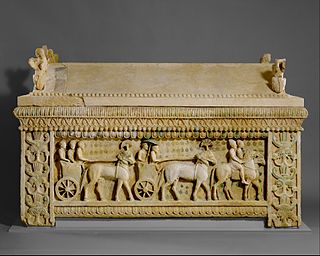
Amathus or Amathous was an ancient city and one of the ancient royal cities of Cyprus until about 300 BC. Some of its impressive remains can be seen today on the southern coast in front of Agios Tychonas, about 24 miles (39 km) west of Larnaca and 6 miles (9.7 km) east of Limassol. Its ancient cult sanctuary of Aphrodite was the second most important in Cyprus, her homeland, after Paphos.
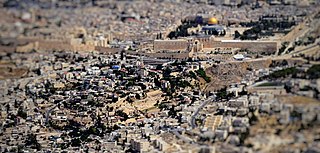
The City of David, called in Arabic: وادي حلوه, Wadi Hilweh, a neighborhood of Silwan, is a Palestinian Arab village intertwined with an Israeli settlement, and the archaeological site which is speculated to constitute the original settlement core of Bronze and Iron Age Jerusalem.

Salamis is an ancient Greek city-state on the east coast of Cyprus, at the mouth of the river Pedieos, 6 km north of modern Famagusta. According to tradition, the founder of Salamis was Teucer, son of Telamon, who could not return home after the Trojan war because he had failed to avenge his brother Ajax.

Agrinio is the largest city of the Aetolia-Acarnania regional unit of Greece and its largest municipality, with 106,053 inhabitants. It is the economical center of Aetolia-Acarnania, although its capital is the town of Mesolonghi. The settlement dates back to ancient times. Ancient Agrinion was 3 kilometres northeast of the present city; some walls and foundations of which have been excavated. In medieval times and until 1836, the city was known as Vrachori (Βραχώρι).
Agios Georgios may refer to the following places:
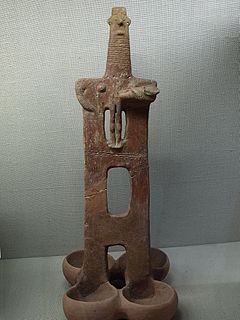
The Prehistoric Period is the oldest part of Cypriot history. This article covers the period 10,000 to 800 BC and ends immediately before any written records of civilizations, such as the first mention of Cyprus by the Romans.
The year 1921 in archaeology involved some significant events.

Mochlos is a modern island in the Gulf of Mirabello in eastern Crete, and the archaeological site of an ancient Minoan settlement. There is evidence that Mochlos was not an island in Minoan times, but was attached to the mainland and acted as an eastern harbor.

Tamassos or Tamasos – names Latinized as Tamassus or Tamasus – was a city-kingdom in Cyprus, one of the 10 Kingdoms of Cyprus. It was situated in the great central plain of the island, south-east of Soli, on the road from Soli to Tremithus. It is an archaeological site bordering the village of Politiko, about 21 kilometres southwest of Nicosia.

Hala Sultan Tekke or the Mosque of Umm Haram is a Muslim mosque on the west bank of Larnaca Salt Lake, in Larnaca, Cyprus. Umm Haram was the wife of Ubada bin al-Samit, a companion of Muhammed.

Tell el-Dab'a is an archaeological site in the Nile Delta region of Egypt where Avaris, the capital city of the Hyksos, once stood. Avaris was occupied by Asiatics from the end of the 12th through the 13th Dynasty. The site is known primarily for its Minoan frescoes.
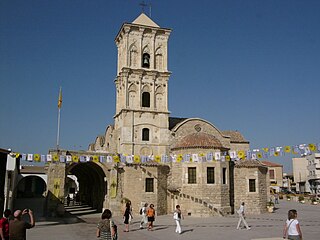
The Church of Saint Lazarus, is a late-9th century church in Larnaca, Cyprus. It belongs to the Church of Cyprus, an autocephalous Greek Orthodox Church.

Kition, also known by its Latin name Citium, was a city-kingdom on the southern coast of Cyprus. It was established in the 13th century BC by the Greek (Achaean) settlers, after the Trojan war. According to the text on the plaque closest to the excavation pit of the Kathari site.
Larnaca District Museum is a museum in Larnaca, Cyprus that has displays that show the "historical development of the city of Kition and the District of Larnaka in general." It was inaugurated in 1969. and was formerly named Larnaca District Archaeological Museum. It is controlled by the Department of Antiquities.
The Lefkaritis Tomb is a hypogeum—a type of tomb—in Larnaca, Cyprus.
Mnemata is a locality in Larnaca, Cyprus. An archaeological site named the Mnemata Site is located here. Over the site a supermarket now stands.
The Mnemata Site is an archaeological excavation site at the Mnemata locality of Larnaca, Cyprus. A tomb was discovered in 1979—during the construction of a refugee settlement.
The Saint George Monastery cemetery in Larnaca, Cyprus is an ancient cemetery.
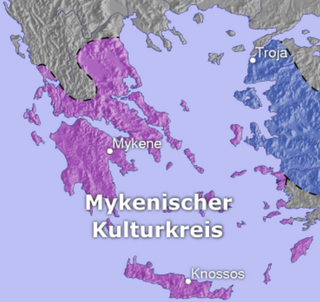
Among the first archaeological sites discovered in Mount Olympus was the excavation site Spathes. It is a necropolis from the Late Bronze Age. The oldest tombs are from the 14th century BC, the last traces of the use were found from the end of the 13th century, the beginning of the 12th century BC. The settlement, associated with the necropolis, has not been found. Many of the burial offerings were made in the Mycenaean style, so that the Mycenaean cultural circle probably also extended over the border of Thessaly to Pieria.
The archaeology of Cyprus involves the analysis of human activity derived from Cypriot artefacts and architecture from the Neolithic through to the British period. The earliest archaeological discoveries in Cyprus are attributed to European amateur collectors or “treasure hunters” during the early 19th century. By the mid 19th century, systematic fieldwork and excavations were conducted on various sites involving studying the remains of Cypriot cemeteries and tombs, maritime artefacts, architecture, pottery as well as a range of other individual artefacts. Subsequent findings and analysis detail the social and physical landscapes of ancient Cyprus as well as their evolving culture, religious beliefs and technology throughout antiquity.
References
- 1 2 3 Hadjisavvas, Sophocles (2013). The Phoenician Period Necropolis of Kition, Volume I. Shelby White and Leon Levy Program for Archaeological Publications. p. 3. Archived from the original on 2016-03-04. Retrieved 2013-02-20.