Related Research Articles

Amathus or Amathous was an ancient city and one of the ancient royal cities of Cyprus until about 300 BC. Some of its remains can be seen today on the southern coast in front of Agios Tychonas, about 24 miles (39 km) west of Larnaca and 6 miles (9.7 km) east of Limassol. Its ancient cult sanctuary of Aphrodite was the second most important in Cyprus, her homeland, after Paphos.

Salamis was an ancient Greek city-state on the east coast of Cyprus, at the mouth of the river Pedieos, 6 km north of modern Famagusta. According to tradition, the founder of Salamis was Teucer, son of Telamon, king of the Greek island of Salamis, who could not return home after the Trojan War because he had failed to avenge his brother Ajax.
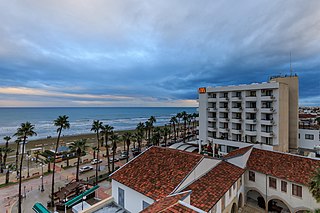
Larnaca is a city on the south east coast of Cyprus and the capital of the district of the same name. It is the third-largest city in the country, after Nicosia and Limassol, with a metro population of 144,200 in 2015.

A hypogeum or hypogaeum is an underground temple or tomb.

Tamassos or Tamasos – names Latinized as Tamassus or Tamasus – was a city-kingdom in ancient Cyprus, one of the ten kingdoms of Cyprus. It was situated in the great central plain of the island, south-east of Soli, on the road from Soli to Tremithus. It is an archaeological site bordering the village of Politiko, about 21 kilometres southwest of Nicosia.

Shatby is a neighborhood in Alexandria, Egypt.

The Swedish Cyprus Expedition was assembled to systematically investigate Cyprus’s early archaeological history. The expedition occurred between September 1927 and March 1931 and was led by the three archaeologists Einar Gjerstad, Erik Sjöqvist and Alfred Westholm together with the architect John Lindros who photographed during their time in Cyprus. The excavation constitutes the foundation of modern archaeology in Cyprus. The results of the excavations revealed that the distinctive culture of early Cyprus had been created in close contact with various cultures from the Middle East and the western Mediterranean areas.
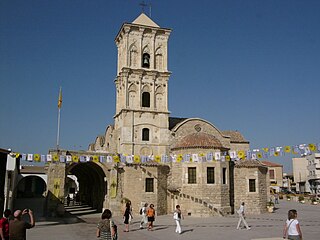
The Church of Saint Lazarus is a late-9th century church in Larnaca, Cyprus. It belongs to the Church of Cyprus, an autocephalous Greek Orthodox Church.

Kition was an Ancient Greek city-kingdom on the southern coast of Cyprus, one of the Ten city-kingdoms of Cyprus. According to the text on the plaque closest to the excavation pit of the Kathari site, it was established in the 13th century BC by Greek (Achaean) settlers, after the Trojan War.

A rock-cut tomb is a burial chamber that is cut into an existing, naturally occurring rock formation, so a type of rock-cut architecture. They are usually cut into a cliff or sloping rock face, but may go downward in fairly flat ground. It was a common form of burial for the wealthy in ancient times in several parts of the world.

Larnaca District Museum is a museum in Larnaca, Cyprus that has displays that show the "historical development of the city of Kition and the District of Larnaka in general." It was inaugurated in 1969. and was formerly named Larnaca District Archaeological Museum. It is controlled by the Department of Antiquities.
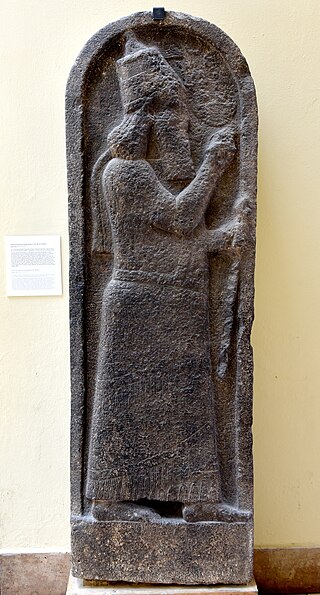
The Sargon Stele was found in the autumn of 1845 in Cyprus on the site of the former city-kingdom of Kition, in present-day Larnaca to the west of the old harbour of Kition on the archaeological site of Bamboula. The language on the stele is Assyrian Akkadian.
Prodromos is a neighborhood in Larnaca, Cyprus.
The Lefkaritis Tomb is a hypogeum—a type of tomb—in Larnaca, Cyprus.
The Chrysosotiros church, also known as the Cathedral of the Holy Transfiguration of the Saviour is a church in Larnaca, Cyprus.
Agios Georgios is a refugee settlement in Larnaca, Cyprus, established as a consequence of the 1974 Turkish invasion of Cyprus.
The Mnemata Site is an archaeological excavation site at the Mnemata locality of Larnaca, Cyprus. A tomb was discovered in 1979—during the construction of a refugee settlement.
Vassos Karageorghis FBA was a Cypriot archaeologist and director of the Department of Antiquities, Cyprus.

The Kition Necropolis Phoenician inscriptions are four Phoenician inscriptions discovered in the necropolis of Tourapi at Kition in 1894 by British archaeologist John Myres on behalf of the Cyprus Exploration Fund.
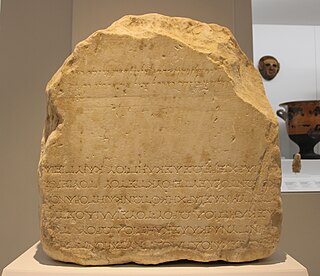
Pumayyaton and Pnytarion's inscriptions are two separated inscriptions, Phoenician and Greek, engraved on the same marble base which was found in Gdhi or Gai locality near Dromolaxia. About 3 hundred years after the first inscription, the Phoenician, was engraved, the base was turned upside down and the second inscription, in Greek, was engraved; the inscriptions have no connection and are not a bilingual inscription. Eventualy, it was used as a press. It is now exhibited in Larnaca District Archaeological Museum.
References
- 1 2 3 Hadjisavvas, Sophocles (2013). The Phoenician Period Necropolis of Kition, Volume I. Shelby White and Leon Levy Program for Archaeological Publications. p. 3. Archived from the original on 2016-03-04.
- ↑ Heltzer, M. Epigraphic Evidence Concerning a Jewish Settlement in Kition (Larnaca, Cyprus) in the Achaemenid period (IV cent B.C.E.) (PDF). Aula Orientalis 7 (1989). p. 189.