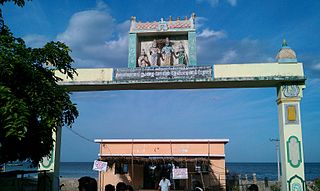
Agni Tirtham is one of the Tirthas of Rameswaram, Tamil Nadu, India. The beach east of Ramanathaswamy Temple is known by this name. This Tirtham is one of the most visited Tirthams of Rameswaram for a holy bath. [1]
Contents

Agni Tirtham is one of the Tirthas of Rameswaram, Tamil Nadu, India. The beach east of Ramanathaswamy Temple is known by this name. This Tirtham is one of the most visited Tirthams of Rameswaram for a holy bath. [1]
The faith among pilgrims is that child-less couples bathing in this Tirtham and offering prayers to Lord Shiva at the temple would be blessed with children. [1]
New moon days and Full moon days are considered to be the most auspicious bathing days here. [1]
References to this Tirtha is made in Sethu Puranam, Skanda Puranam, Narada Puranam. [1]

Rameswaram is a municipality in the Ramanathapuram district of the Indian state of Tamil Nadu. It is on Pamban Island separated from mainland India by the Pamban channel and is about 40 kilometres (25 mi) from Mannar Island, Sri Lanka. It is in the Gulf of Mannar, at the tip of the Indian peninsula. Pamban Island, also known as Rameswaram Island, is connected to mainland India by the Pamban Bridge. Rameswaram is the terminus of the railway line from Chennai and Madurai. Together with Varanasi, it is considered to be one of the holiest places in India to Hindus and is part of the Char Dham pilgrimage.

Somnath temple or Deo Patan, is a Hindu temple, located in Prabhas Patan, Veraval in Gujarat, India. It is one of the most sacred pilgrimage sites the Tirtha Kshetra for Hindus and is the first among the twelve jyotirlinga shrines of Shiva. It is unclear when the first version of the Somnath temple was built, with estimates varying between the early centuries of the 1st millennium and about the 9th century CE. The temple is not mentioned in the ancient Sanskrit texts of Hinduism; while various texts, including the Mahabharata and Bhagavata Purana, mention a tirtha at Prabhas Patan on the coastline of Saurashtra, where the temple is presently located, there is no evidence that a temple existed at the site in ancient times.
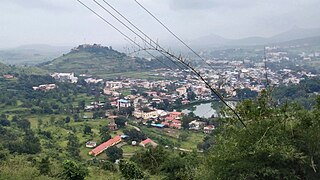
Trimbak is a city and a municipal council in Nashik District in the Indian state of Maharashtra. The Trimbakeshwar Shiva Temple is located here, one of the twelve Jyotirlingas, where the Hindu genealogy registers at Trimbakeshwar, Maharashtra are kept. The origin of the sacred Godavari River is near Trimbak.

The Nellaiappar Temple is a Hindu temple dedicated to the deity Shiva, located in Tirunelveli, a city in the South Indian state of Tamil Nadu. Shiva is worshipped as Nellaiappar represented by the lingam and his consort Parvati is depicted as Kanthimathi Amman. The deity Vishnu is also worshipped here, having witnessed their wedding according to legend. Hence, this temple is regarded as an abhimana kshetram of Vaishnavism. The temple is located on the northern banks of Thamirabarani River in Tirunelveli district. The presiding deity is revered in the 7th century Tamil Saiva canonical work, the Tevaram, written by Tamil saint poets known as the nayanmars and classified as Paadal Petra Sthalam.

The Srivilliputhur Andal Temple in Srivilliputhur, a town in Virudhunagar district in the South Indian state of Tamil Nadu, is dedicated to the Hindu god Vishnu. It is located 80 km from Madurai. Constructed in the Dravidian style of architecture, the temple is glorified in the Nalayira Divya Prabandham, the early medieval Tamil canon of the Alvar saints from the 6th–9th centuries CE. It is one of the 108 Divya Desams dedicated to Vishnu, who is worshipped as Vatapatrasayi and his consort Lakshmi as Andal. It is believed to be the birthplace of two of the Alvars, namely Periyalvar and his foster-daughter, Andal.
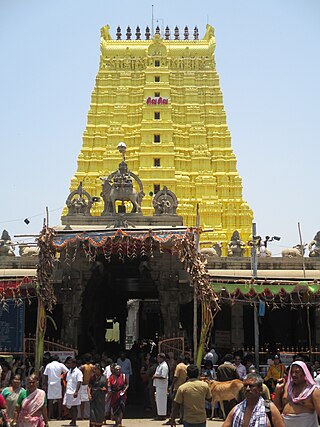
The Ramanathaswamy Temple is a Hindu temple dedicated to the Hindu god Shiva located on Rameswaram island in the state of Tamil Nadu, India. It is one of the twelve Jyotirlinga temples. It is one of the 275 Paadal Petra Sthalams, the sacred sites glorified by the Nayanars, Appar, Sundarar, and Sambandar, with their songs. According to tradition, the lingam of the Ramanathaswamy Temple was established and worshipped by Lord Ram before he crossed the bridge called Rama Setu to the island kingdom of Lanka, identified with Sri Lanka. It is one of the Char Dham pilgrimage sites. The temple was expanded during the 12th century by the Pandya Dynasty, and its principal shrine’s sanctum was renovated by Jeyaveera Cinkaiariyan and his successor Gunaveera Cinkaiariyan, monarchs of the Jaffna kingdom. The temple has the longest corridor among all the Hindu temples of India. It was built by King Muthuramalinga Sethupathy. The temple is considered a pilgrimage site for Shaivites, Vaishnavites, and Smartas.
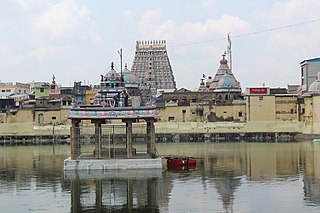
Adi Kumbeswarar Temple, Kumbakonam is a Hindu temple dedicated to Shiva, located in the town of Kumbakonam in Thanjavur District Tamil Nadu, India. Shiva is worshiped as Adi Kumbeswarar, and is represented by the lingam. His consort Parvati is depicted as Mangalambigai Amman. The presiding deity is revered in the 7th century Tamil Saiva canonical, greatest work, the Tevaram, written by Tamil saint poets known as the Nayanmars and classified as Paadal Petra Sthalam.

Pamban Island, also known as Rameswaram Island, is an island located between peninsular India and Sri Lanka. It forms part of the Rameswaram taluk in the Ramanathapuram district of the Indian state of Tamil Nadu. It is the largest island in Tamil Nadu by area and the principal town in the island is the pilgrimage centre of Rameswaram.

Yatra, in Indian-origin religions, Hinduism, Buddhism, Jainism and Sikhism, generally means a pilgrimage to holy places such as confluences of sacred rivers, sacred mountains, places associated with Hindu epics such as the Mahabharata and Ramayana, and other sacred pilgrimage sites. Visiting a sacred place is believed by the pilgrim to purify the self and bring one closer to the divine. The journey itself is as important as the destination, and the hardships of travel serve as an act of devotion in themselves.
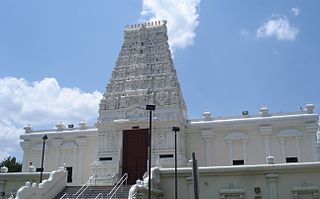
Sri Siva Vishnu Temple (SSVT) is a Hindu temple located in Lanham, Maryland, right outside of Washington D.C. It is one of the largest temples in the United States.
There are sixty-four Tīrthas in and around the island of Rameswaram, Tamil Nadu, India. According to Skānda Purāṇa, twenty-four of them are important. Bathing in these Tīrthas is a major aspect of the pilgrimage to Rameswaram and is considered equivalent to penance. Twenty-two of the Tīrthas are within the Rāmanāthasvāmī Temple.
Dhanushkodi Tirtham is one of the Tirthas in the island of Rameswaram, Tamil Nadu, India. This is located beside the ghost town of Dhanushkodi at the easternmost tip of Rameswaram Island. Rama used his bow's (Dhanush) end (Kodi) to break the bridge - Rama Setu(hence the name). This bridge was used for his army to cross over to Lanka for the victorious war against Ravana.

The Char Dham, or the Chatur Dhama, is a set of four Hindu pilgrimage sites in India, consisting of Badrinath, Dwarka, Puri and Rameswaram. Badrinath, Dwarka, and Puri are shrines of Vishnu, whereas Rameswaram is a shrine of Shiva.

The Sapta Puri are a group of seven Hindu tirtha, or holy pilgrimage sites, located in India. Pilgrimage to these sites is said to bless the pilgrim with moksha.
Spatika Lingam or Crystal Lingam is a type of Lingam made from quartz. Spatika Lingam is called sphatika Sivalingam, ,, . Sphatikam in Sanskrit means "made of crystal, crystalline", referring to quartz and alum.
The Pancha Ishwarams are five coastal ancient kovils (temples) built in dedication to the Hindu supreme being Ishwara in the form of the god Shiva, located along the circumference of Sri Lanka.
Idangazhi (Idangali), also known as Idangazhi Nayanar, Idangaliyar (Idankaliyar) was a Nayanar saint, venerated in the Hindu sect of Shaivism. He is generally counted as the fifty-fourth in the list of 63 Nayanars. He was an Irukku Velir chieftain, who is described to not only have pardoned a devotee of the god Shiva, who stole from the royal granaries, but also distributed rice to devotees of Shiva.

Sirappuli Nayanar, also known as Sirappuli, Sirapuli Nayanar, Sirappuliyar (Chirappuliyar), was a Nayanar saint, venerated in the Hindu sect of Shaivism. He is generally counted as the thirty-fifth in the list of 63 Nayanars. Sirappuli Nayanar is described to have served the devotees of the god Shiva and worshipped the god with various ritual practices.
Navapashanam temple is a Hindu temple dedicated to Navagrahas, the nine planetary deities, located in Devipattinam, the South Indian state of Tamil Nadu. It is a Hindu pilgrimage centre located in the Bay of Bengal. As per Hindu legend, the nine mud images of the planetary deities, have been believed to have built by Rama, an avatar of Vishnu.

Kasi Viswanathar Temple in Tenkasi, a city in Tenkasi district in the South Indian state of Tamil Nadu, is dedicated to the Hindu god Shiva. Constructed in the Tamil style of architecture, the temple is believed to have been built by Pandyan ruler Parakrama Pandyan during the 13th century, with later additions from Madurai Nayaks. Shiva is worshipped as Kasi Viswanathar and his consort Parvathi as Ulagamman.