
The Curtiss JN-4 "Jenny" was one of a series of "JN" biplanes built by the Curtiss Aeroplane Company of Hammondsport, New York, later the Curtiss Aeroplane and Motor Company. Although the Curtiss JN series was originally produced as a training aircraft for the U.S. Army, the "Jenny" continued after World War I as a civil aircraft, as it became the "backbone of American postwar [civil] aviation." Thousands of surplus Jennys were sold at bargain prices to private owners in the years after the war and became central to the barnstorming era that helped awaken the U.S. to civil aviation through much of the 1920s.
The Lockheed Model 10 Electra is an American twin-engined, all-metal monoplane airliner developed by the Lockheed Aircraft Corporation in the 1930s to compete with the Boeing 247 and Douglas DC-2. The type gained considerable fame as one was flown by Amelia Earhart on her ill-fated around-the-world expedition in 1937.

The Sikorsky H-19 Chickasaw was a multi-purpose helicopter used by the United States Army and United States Air Force. It was also license-built by Westland Aircraft as the Westland Whirlwind in the United Kingdom. United States Navy and United States Coast Guard models were designated HO4S, while those of the U.S. Marine Corps were designated HRS. In 1962, the U.S. Navy, U.S. Coast Guard and U.S. Marine Corps versions were all redesignated as H-19s like their U.S. Army and U.S. Air Force counterparts.

The Vultee BT-13 Valiant was an American World War II-era basic trainer aircraft built by Vultee Aircraft for the United States Army Air Corps, and later US Army Air Forces. A subsequent variant of the BT-13 in USAAC/USAAF service was known as the BT-15 Valiant, while an identical version for the US Navy was known as the SNV and was used to train naval aviators for the US Navy and its sister services, the US Marine Corps and US Coast Guard.

The Curtiss Robin, introduced in 1928, was a high-wing monoplane built by the Curtiss-Robertson Airplane Manufacturing Company. The J-1 version was flown by Wrongway Corrigan who crossed the Atlantic after being refused permission.

The Grumman OV-1 Mohawk was an armed military observation and attack aircraft, designed for battlefield surveillance and light strike capabilities. It was a twin turboprop configuration, and carried two crew members in side-by-side seating. The Mohawk was intended to operate from short, unimproved runways in support of United States Army maneuver forces.

The Piasecki H-21 Workhorse/Shawnee is an American helicopter, the fourth of a line of tandem rotor helicopters designed and built by Piasecki Helicopter. Commonly called "the flying banana", it was a multi-mission helicopter, utilizing wheels, skis, or floats.

The Yankee Air Museum is an aviation museum located at Willow Run Airport in Van Buren Township, Michigan. The museum has a small fleet of flying aircraft and a collection of static display aircraft outdoors.

The Lone Star Flight Museum, located in Houston, Texas, is an aerospace museum that displays more than 24 historically significant aircraft, and many artifacts related to the history of flight. The museum's collection is rare because most of the aircraft are flyable. Located at Ellington Airport, the museum is housed on about 100,000 ft2 of property, including its own airport ramp. The museum, formerly located in Galveston, moved to Houston to avoid a repeat of the devastation suffered during Hurricane Ike.

The Ryan PT-22 Recruit, the main military version of the Ryan ST, is a military trainer aircraft used by the United States Army Air Corps during WWII for primary pilot training.

The Aeronca L-3 group of observation and liaison aircraft were used by the United States Army Air Corps in World War II. The L-3 series were adapted from Aeronca's pre-war Tandem Trainer and Chief models.
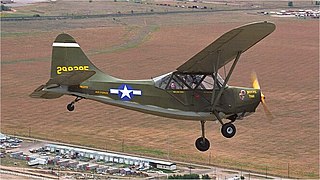
The Stinson L-5 Sentinel was a World War II era liaison aircraft used by all branches of the U.S. military and by the British Royal Air Force. It was produced by the Stinson Aircraft Company. Along with the Stinson L-1 Vigilant, the L-5 was the only other American liaison aircraft of World War II that was purpose-built for military use and had no civilian counterpart. All other military liaison airplanes adopted during World War II were lightly modified "off-the-shelf" civilian models.

The Patuxent River Naval Air Museum (PRNAM) preserves and interprets the Patuxent River Naval Air Base history and heritage of advancing US Naval aviation technology. This museum is the repository of artifacts, photographs and film, documents, and related heritage memorabilia from Patuxent River and other stations, such as Warminster, PA, and Trenton, NJ, that have been consolidated at Patuxent River. The museum is dedicated to those who have employed their talents in advancing Naval aviation research, development, testing, and evaluation.

The Stinson L-1 Vigilant was a 1940s American light observation aircraft built by the Stinson Aircraft Company at Wayne, Michigan. The aircraft was operated by the United States Army Air Corps as the O-49 until 1942.
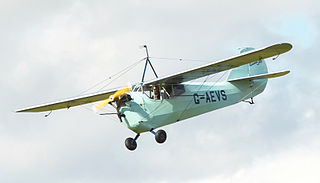
The Aeronca C-3 was a light plane built by the Aeronautical Corporation of America in the United States during the 1930s.
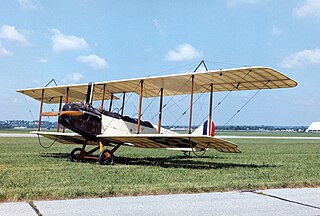
The Standard J was a two-seat basic trainer two-bay biplane produced in the United States from 1916 to 1918, powered by a four-cylinder inline Hall-Scott A-7a engine. It was constructed from wood with wire bracing and fabric covering. The J-1 was built as a stopgap to supplement the Curtiss JN-4 in production.

The Liberty Aviation Museum is located in Port Clinton, Ohio, United States, adjacent to the Erie–Ottawa International Airport.


