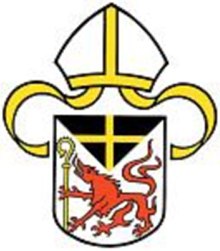
Albert II of Saxony-Wittenberg (* around 1285, - 19 May 1342 in Passau) was from 1320 to 1342 Bishop of Passau. [1] [2]
Albert II of Saxony-Wittenberg (* around 1285, - 19 May 1342 in Passau) was from 1320 to 1342 Bishop of Passau. [1] [2]
Albert was the third son of Elector Albrecht II of Saxony and the Agnes of Habsburg, a daughter of King Rudolf von Habsburg. For a spiritual career, he was canon of Mainz and minister of St. Stephen's Cathedral, Vienna. Pope John XXII made Albert the Bishop of Passau in 1320. [3] In the battle for the throne between Ludwig the Bavarian and Frederick the Beautiful, he stood on the side of his Habsburg cousin Friedrick, whom he also supported in 1322 in the Battle of Mühldorf. In Passau he rebuilt the Neumarkt, destroyed in 1298, and city hall, which had been forfeited to the Bishop after the rebellion against Bernhard of Prambach, was sold back to the citizens of Passau.
He is buried in Passau Cathedral.
The House of Ascania was a dynasty of German rulers. It is also known as the House of Anhalt, which refers to its longest-held possession, Anhalt.

The Duchy of Saxony was originally the area settled by the Saxons in the late Early Middle Ages, when they were subdued by Charlemagne during the Saxon Wars from 772 AD and incorporated into the Carolingian Empire (Francia) by 804. Upon the 843 Treaty of Verdun, Saxony was one of the five German stem duchies of East Francia; Duke Henry the Fowler was elected German king in 919.
Albert I was a Duke of Saxony, Angria, and Westphalia; Lord of Nordalbingia; Count of Anhalt; and Prince-elector and Archmarshal of the Holy Roman Empire. Even though his grandfather Albert the Bear had held the Saxon dukedom between 1138 and 1142, this Albert is counted as the first.
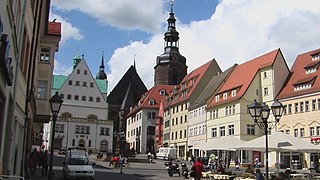
Eisleben is a town in Saxony-Anhalt, Germany. It is famous as both the hometown of the influential theologian Martin Luther and the place where he died; hence, its official name is Lutherstadt Eisleben.

The Diocese of Passau is a Latin diocese of the Catholic Church in Germany that is a suffragan of the Archdiocese of Munich and Freising. The Prince-Bishopric of Passau was an ecclesiastical principality that existed for centuries until it was secularized in 1803. The diocese covers an area of 5,442 km².

Albert II, known as the Wise or the Lame, a member of the House of Habsburg, was duke of Austria and Styria from 1330, as well as duke of Carinthia and margrave of Carniola from 1335 until his death.
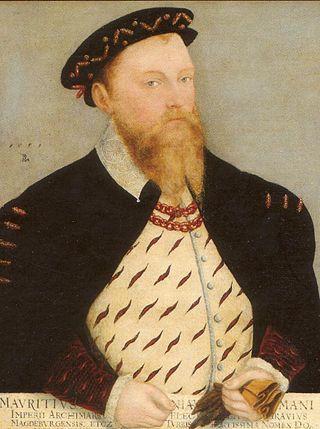
Maurice was Duke (1541–47) and later Elector (1547–53) of Saxony. His clever manipulation of alliances and disputes gained the Albertine branch of the Wettin dynasty extensive lands and the electoral dignity.

The Duchy of Saxe-Lauenburg, was a reichsfrei duchy that existed from 1296 to 1803 and again from 1814 to 1876 in the extreme southeast region of what is now Schleswig-Holstein. Its territorial center was in the modern district of Herzogtum Lauenburg and originally its eponymous capital was Lauenburg upon Elbe, though the capital moved to Ratzeburg in 1619.

Saxe-Weimar was one of the Saxon duchies held by the Ernestine branch of the Wettin dynasty in present-day Thuringia. The chief town and capital was Weimar. The Weimar branch was the most genealogically senior extant branch of the House of Wettin.

The Electorate of Saxony, also known as Electoral Saxony, was a territory of the Holy Roman Empire from 1356 to 1806 initially centred on Wittenberg that came to include areas around the cities of Dresden, Leipzig and Chemnitz. It was a major Holy Roman state, being an electorate and the original protecting power of Protestant principalities until that role was later taken by its neighbor, Brandenburg-Prussia.

The Duchy of Saxe-Wittenberg was a medieval duchy of the Holy Roman Empire centered at Wittenberg, which emerged after the dissolution of the stem duchy of Saxony. The Ascanian dukes prevailed in obtaining the Saxon electoral dignity until their duchy was finally elevated to the Electorate of Saxony by the Golden Bull of 1356.
Albert II of Saxony was a son of Duke Albert I of Saxony and his third wife Helen of Brunswick and Lunenburg, a daughter of Otto the Child. He supported Rudolph I of Germany at his election as Roman king and became his son-in-law. After the death of their father Albert I in 1260 Albert II jointly ruled the Duchy of Saxony with his elder brother John I, and thereafter with the latter's sons.
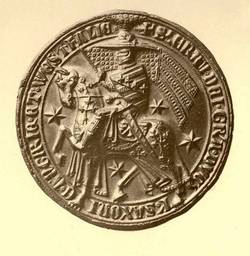
Eric I of Saxe-Lauenburg (c.1280–1360) was a member of the House of Ascania who ruled as one of the dukes of Saxony from 1282 until 1338.
John II of Saxe-Lauenburg was the eldest son of John I of Saxony and Ingeborg, a daughter or grandchild of Birger Jarl. He ruled the Saxony jointly with his uncle Albert II and his brothers Albert III and Eric I, first fostered by Albert II until coming of age. In 1296, John II, his brothers, and their uncle divided Saxony into Saxe-Wittenberg, ruled by Albert II, and Saxe-Lauenburg, jointly ruled by the brothers between 1296 and 1303 and thereafter partitioned among them. John II then ruled the branch duchy of Saxe-Mölln, later extended to become Saxe-Bergedorf-Mölln. In 1314, he officiated as Saxon Prince-elector in an election of a German king.
Albert III (1281–1308) was a member of the House of Ascania who ruled as one of the dukes of Saxony from 1282 until his death in 1308.
Albert of Saxe-Wittenberg may refer to:

Albert of Saxe-Wittenberg was born as the son of Otto, a younger son of the prince-elector Rudolf I of Saxe-Wittenberg, and his (Otto's) wife Elisabeth, daughter of Duke William II of Brunswick-Lüneburg. In 1370 he succeeded his (maternal) grandfather as the Duke or Prince of Lüneburg.

Rudolf I, a member of the House of Ascania, was Duke of Saxe-Wittenberg from 1298 until his death. By the Golden Bull of 1356 he was acknowledged as Elector of Saxony.
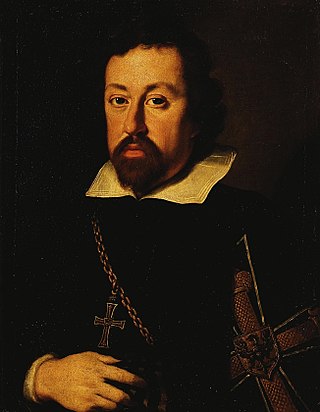
Charles of Austria, nicknamed the Posthumous, a member of the Imperial House of Habsburg, was Prince-Bishop of Breslau (Wrocław) from 1608, Prince-Bishop of Brixen from 1613, and Grand Master of the Teutonic Order from 1618 until his death. In 1621 he also received the Bohemian County of Kladsko as a fief from the hands of his brother, Emperor Ferdinand II.
| International | |
|---|---|
| National | |
| People | |


