Related Research Articles

James V was King of Scotland from 9 September 1513 until his death in 1542. He was crowned on 21 September 1513 at the age of seventeen months. James was the son of King James IV and Margaret Tudor, daughter of Henry VII of England. During his childhood Scotland was governed by regents, firstly by his mother until she remarried, and then by his second cousin, John Stewart, Duke of Albany. James's personal rule began in 1528 when he finally escaped the custody of his stepfather, Archibald Douglas, 6th Earl of Angus. His first action was to exile Angus and confiscate the lands of the Douglases.

James I was King of Scots from 1406 until his assassination in 1437. The youngest of three sons, he was born in Dunfermline Abbey to King Robert III and Annabella Drummond. His older brother David, Duke of Rothesay, died under suspicious circumstances during detention by their uncle, Robert, Duke of Albany. James' other brother, Robert, died young. Fears surrounding James's safety grew through the winter of 1405/06 and plans were made to send him to France. In February 1406, James was forced to take refuge in the castle of the Bass Rock in the Firth of Forth after his escort was attacked by supporters of Archibald, 4th Earl of Douglas. He remained at the castle until mid-March, when he boarded a vessel bound for France. On 22 March, English pirates captured the ship and delivered the prince to Henry IV of England. The ailing Robert III died on 4 April and the 11-year-old James, now the uncrowned King of Scots, would not regain his freedom for another eighteen years.

Margaret Tudor was Queen of Scotland from 1503 until 1513 by marriage to King James IV. She then served as regent of Scotland during her son's minority, and fought to extend her regency. Margaret was the eldest daughter and second child of King Henry VII of England and Elizabeth of York, and the elder sister of King Henry VIII of England. By her line, the House of Stuart eventually acceded to the throne of England, in addition to Scotland.
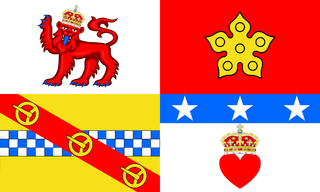
The Mormaer or Earl of Angus was the ruler of the medieval Scottish province of Angus. The title, in the Peerage of Scotland, is held by the Duke of Hamilton, and is used as a courtesy title for the eldest son of the Duke's eldest son.

Archibald Douglas, 5th Earl of Angus was a Scottish nobleman, peer, politician, and magnate. Tradition has accorded him the nickname Archibald 'Bell-the-Cat' due to his association with the 1482 rebellion against James III of Scotland. He became one of the most powerful nobleman in Scotland through his influential position on the Scottish Marches, and a willingness to be involved in multiple rebellions in the reigns of James III and James IV of Scotland.

Archibald Douglas, 6th Earl of Angus was a Scottish nobleman active during the reigns of James V and Mary, Queen of Scots. He was the son of George, Master of Angus, who was killed at the Battle of Flodden, and succeeded as Earl of Angus on the death of his grandfather, Archibald.

Clan Mackintosh is a Scottish clan from Inverness in the Scottish Highlands. The chiefs of the clan are the Mackintoshes of Mackintosh. Another branch of the clan, the Mackintoshes of Torcastle, are the chiefs of Clan Chattan, a historic confederation of clans.
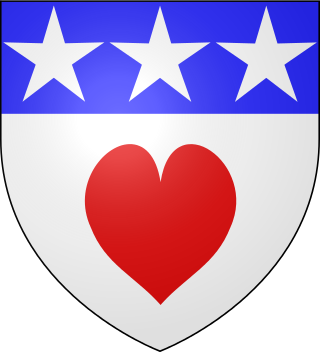
This page is concerned with the holders of the forfeit title Earl of Douglas and the preceding feudal barons of Douglas, South Lanarkshire. The title was created in the Peerage of Scotland in 1358 for William Douglas, 1st Earl of Douglas, son of Sir Archibald Douglas, Guardian of Scotland. The Earldom was forfeited by James Douglas, 9th Earl of Douglas, in 1455.
The Lord Chancellor of Scotland, formally the Lord High Chancellor, was a Great Officer of State in the Kingdom of Scotland.
Robert Cairncross was a Scottish bishop.

Tantallon Castle is a ruined mid-14th-century fortress, located 5 kilometres (3.1 mi) east of North Berwick, in East Lothian, Scotland. It sits atop a promontory opposite the Bass Rock, looking out onto the Firth of Forth. The last medieval curtain wall castle to be constructed in Scotland, Tantallon comprises a single wall blocking off the headland, with the other three sides naturally protected by sea cliffs.

Clan Douglas is an ancient clan or noble house from the Scottish Lowlands.

Alexander Stewart was an illegitimate son of King James IV of Scotland by his mistress Marion Boyd. He was the King's eldest illegitimate child. He was an elder brother of Catherine Stewart, his only full sibling, and was an older half-brother of the future James V. He was installed as Archbishop of St Andrews at the age of eleven and was killed beside his father the King at the Battle of Flodden aged twenty.
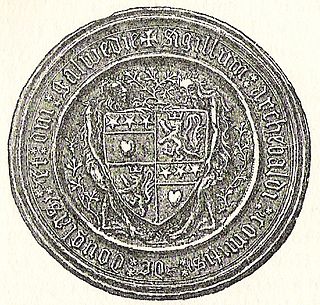
Archibald Douglas, 4th Earl of Douglas, Duke of Touraine, was a Scottish nobleman and warlord. He is sometimes given the epithet "Tyneman", but this may be a reference to his great-uncle Sir Archibald Douglas.

Henry Stewart, 1st Lord Methven was Master of the Scottish Artillery and third, and last husband, of Margaret Tudor, eldest daughter of Henry VII of England and Elizabeth of York.
George Douglas, 1st Earl of Angus (1380–1403) was a Scottish nobleman and peer.
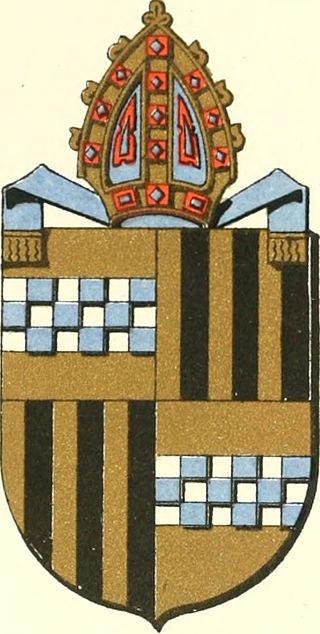
Andrew Stewart was a 16th-century Scottish noble and cleric. He was a legitimate son of John Stewart, 1st Earl of Atholl and Eleanor Sinclair, daughter of William Sinclair, Earl of Orkney. His paternal grandmother was Joan Beaufort, former queen-consort of Scotland. Andrew chose an ecclesiastical career, held a canonry in Dunkeld Cathedral and was rector of Blair parish church, a church under the control of the earls of Atholl.
Janet Douglas, Lady Glamis was a Scottish noblewoman accused of attempted murder, who was executed by burning during the reign of James V of Scotland. Janet was accused of trying to poison James V, implicated by a spurned suitor. James hated the Douglas family and swore revenge after mistreatment by his stepfather Archibald Douglas.
The Battle of Linlithgow Bridge is a battle that took place on 4 September 1526 in the village of Linlithgow Bridge, outside the Scottish town of Linlithgow. It was fought between a force of 10,000 men led by the Earl of Lennox and a force of 2,500 led by James Hamilton, 1st Earl of Arran. The battle was part of a power struggle in Scotland for control of the young Scottish king, James V. The battlefield was added to the national Inventory of Historic Battlefields in Scotland prepared by Historic Scotland under the Scottish Historical Environment Policy of 2009.
Robert Maxwell, 5th Lord Maxwell was a member of the Council of Regency (1536) of the Kingdom of Scotland, Regent of the Isle of Arran and like his father before him patriarch of the House of Maxwell/Clan Maxwell. A distinguished Scottish nobleman, politician, soldier and in 1513 Lord High Admiral, Lord Maxwell was a member of James V of Scotland's royal council and served as Lord Provost of Edinburgh in 1524, 1527 and 1535. He was also an Extraordinary Lord of Session in 1533. In 1537, he was one of the ambassadors sent to the French Court to negotiate the marriage of James to Mary of Guise, whom he espoused as proxy for the King.
References
- Watt, D.E.R., Fasti Ecclesiae Scotinanae Medii Aevi ad annum 1638, 2nd Draft, (St Andrews, 1969)
 | This biography of a Scottish peer or noble is a stub. You can help Wikipedia by expanding it. |
  | This article about a United Kingdom bishop is a stub. You can help Wikipedia by expanding it. |