Synopsis

Prologue: Oxford, 1862
In Oxford, on the 4th of July 1862, Alice Liddell (aged 10) her sisters Lorina (aged 13) and Edith (aged 6) and Canon Robinson Duckworth, drift down the river Thames on a "Golden afternoon" The boating crew sit for a river picnic, to listen to the stories told by their friend, writer Charles Dodgson (AKA Lewis Carroll) until the evening. Alice Liddell in particular listens intently. She imagines the other fictional "Alice" and all her adventures and dreams as Dodgson tells them.
Act 1: Alice in Wonderland

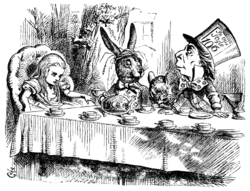
The imaginary Alice, aged 7 and a half, is bored with sitting on a riverbank during a sleepy, hot day. She follows an unusually dressed, late rabbit down a rabbit hole into Wonderland. She falls very slowly through a deep well packed with furniture and cupboards, and has time to think eccentrically about lessons and work out where she will land. Landing in a hall of endless doors, Alice tries adjusting her size with food and a drink, to fit a tiny door leading to a beautiful garden. As she fails, she cries an entire sea of tears. Shrinking her size again after being given a fan by the White Rabbit, Alice swims with an irritated Mouse in the pool of tears, who she annoys with talk about her beloved cat Dinah. At the shore, Alice and the Mouse run a caucus race with absurd animals and birds (all played by the same actors as the prologue boating party sisters and friends). Now a very small size, Alice seeks advice from a precise Caterpillar who gives her the secret of size changing. The correct size, Alice goes into a mysterious house. She defends a baby from an alarming Duchess and her Cook in the house's kitchen, whilst being fascinated by a grinning cat, called a Cheshire Cat, who sits on the rug. Alice takes the Duchess's baby away from the house, alarmed for its safety. Outside, it turns into a piglet and trots away, to her great surprise. Alice turns around and sees the Cheshire Cat sitting in a tree. The Cat reveals that everyone in Wonderland is bizarre and that Alice must be mad too, or else she wouldn't have stumbled into the world. The cat directs her to the March Hare's house and leaves Alice in wonder at its famous vanishing trick, leaving its grin only to be seen in the trees. Alice follows the cat's advice and sits down to take tea with the strange Hatter, March Hare, and Dormouse. The riddles, rhymes and nonsense they tell infuriates her as much as it amuses her. When the Hatter insults her, Alice decides she must leave the party. Finding a way into the garden she had glimpsed at the bottom of the rabbit hole, Alice is dismayed to find it is the realm of the bad tempered Queen of Hearts, who loves beheading her subjects. Alice, along with the Queen's subjects, who turn out to be everyone Alice has met so far, plays croquet with hedgehogs and flamingos. Alice talks with the Duchess, before the Queen spoils the fun through ordering the Duchess to leave or be executed. Alice meets again with the Cheshire cat, who offends the King, but avoids execution by the Queen via vanishing. Alice goes to Wonderland's seashore, and meets with a sad Mock Turtle and his friend the Gryphon, who teach her the Lobster Quadrille dance. Alice's adventures in Wonderland end at a surreal trial for the Knave of Hearts, where the Hatter's evidence is puns and rhymes, and the Duchess's Cook's is making everyone sneeze with pepper. Growing suddenly after eating a tart from the evidence, Alice comes to blows with the Queen of Hearts. A pack of cards attack her and she falls, awaking in an armchair, in her drawing room at home. Her sisters look across the room at Alice in some surprise. Alice talks to the sisters (who also happen to be called Lorina and Edith, a reference to Alice Liddell's sisters) about her dream of Wonderland. Snow begins to come down outside, to the children's delight.
Act 2 : Through the Looking-Glass

Act 2 continues with the fictional Alice unwittingly annoying her sisters by attempting to play a chess game with them. Lorina, cold and alienated, goes to bed. Edith, too young to understand the game, leaves as she fears she will lose. Alice is left with her three cats, Kitty, Snowdrop, and old cat Dinah. The night grows later. Alice drifts into a daydream before being drawn to the mirror above the fireplace, which she magically traverses. On the other side, she reads a nonsense poem, Jabberwocky , by holding a book up to the glass so the words can be read. The poem is a nonsense epic about a monster's death. Outside the mirror house is the Looking-Glass World, another world which turns out to be just as strange as Wonderland was. Alice meets the Red Queen, who is governess like and sharp. She explains that Alice has become a pawn in the game, and must now adventure to get to the 8th square. After a surreal train ride, Alice meets childish Tweedle-Dum and Tweedle-Dee who argue over a rattle and tell Alice she is only the dream of the sleeping Red King. In the forest further Alice meets a White Queen who remembers things before they happen. In a magical shop, she buys an egg from an old Sheep, remembering she must meet Humpty Dumpty in the next square. As Alice suspects, the egg turns into arrogant egg Humpty Dumpty. Alice finds she is standing by his wall in the 6th square. Alice and Humpty argue about names, cravats, and meaning, before he falls off his wall. Alice sees the White King' s soldiers fall over as they try to put Humpty back together. The White King and his messengers, a Hare and a Hatter, take Alice to a small village to meet the Lion and the Unicorn from the famous rhyme, who are fighting for the White King's crown. Alice discovers the Lion considers her a monster. Drums close in and Alice jumps to the 7th square to shield herself from the noise. In the 7th Square, the kindly White Knight (played by the same actor who plays Charles Dodgson) saves Alice from a bizarre battle with the Red Knight. He helps Alice through the thick forest. He keeps falling off his horse so Alice helps him back. He tells her about useless inventions he has made, that Alice finds very funny. Before leaving, the Knight tenderly sings Alice a nonsense song and sees her to the 8th Square, but not before falling off his horse one final time. Alice runs across the brook and realises she suddenly has a beautiful but very heavy golden crown on her head. At Alice's coronation banquet in the 8th square, the Red and White Queens "test" Alice on knowledge with questions that make no sense. Alice enjoys the guests and party, but suddenly, the Jabberwock monster from the poem descends on the crowd. Alice wakes with a start at home, on the rug, on the right side of the mirror. She is holding her cats Kitty and Snowdrop in her hands. She muses on the meaning of her second dream adventure and concludes her kitten Kitty was the Red Queen, and Snowdrop was the White Queen. Alice wonders if the dream of Looking-Glass World was hers or the Red King's.
Epilogue: Oxford, 1862

In Oxford on the bank of the Thames, it is evening. Alice Liddell hears Dodgson's voice calling her, as she is so immersed in his storytelling she has forgotten all track of time. Alice Liddell gets into the boat with her sisters and the two grown up friends to leave for the day. She has been so mesmerised by Mr Dodgson's stories about the fictional Alice that she implores him to "Write down Alice's adventures." Charles Dodgson promises he will try. The boating crew row home.


#/media/File:Peter_Newell_-_Through_the_looking_glass_and_what_Alice_found_there_1902_-_page_10.jpg)
