American Domestic Show Flight

Last updated
American Domestic Show Flight
Domestic Flight.jpg
American Domestic Show Flight
Conservation statusCommon
Other namesDomestic Show Flight
Country of originUnited States
Traits
Crest typeoptional
Classification
Australian Breed Group Domestic Show Flight: Group 6
US Breed Group American Domestic Show Flight: Tumblers, Rollers and High Flyers
EE Breed Group Domestic Show Flight: Tümmlertauben
Notes
Originated in New York

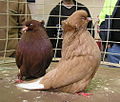
The American Domestic Show Flight is a breed of fancy pigeon developed over many years of selective breeding. Domestic Show Flights, along with other varieties of domestic pigeons, are all descendants from the rock pigeon (Columba livia). [1] The Domestic Show Flight is a relatively recent American creation which was developed in the state of New York. [2] it became quite a popular breed and The American Pigeon Journal published several special issue devoted to the breed. [3] [4] [5]
Contents

History

The American Domestic Flight in name and in fact is an all American creation. This beautiful pigeon was created well over hundred years ago in New York State, specifically in Yorkville and the Brooklyn section of New York City proper. Its inception is traced back to 1880 when a Long Faced Hollander, from Germany, was crossed with the small English Magpie, forming the basic foundation of our present day American Domestic Flight. Alex Rawson, a prominent breeder in the 50's has a slightly different twist stating they were originally developed in Germany, called the Hanover. [6] Which ever the case, U.S. Breeders Quickly and drastically morphed these birds, into what is without doubt an American breeder's creation. Early breeders around 1900's were thriving all through Long Island and New Jersey and soon began breeding it to become as a show specimen as well as a flier. [7] As a flier they were flew competitively in the sport of triganorio, originating in Modena Italy. [8]

The original breeds used in their development are present today but have taken entirely different courses. The Magpie is often seen at the larger shows, while the Long Faced Hollander and Hanover have been lost in obscurity. The Domestic Flight of the 1930's retains very little of its original appearance, but the changes to come were drastic indeed. A standard was adopted during 1953, which would greatly modify the breeds characteristics. And changed again in 1970 and yet again in 1988 [9]

See also

References

  1. Levi, Wendell (1977). The Pigeon. Sumter, S.C.: Levi Publishing Co, Inc. ISBN   0-85390-013-2.
  2. Seymour, Rev. Colin (Ed)(2006) Australian Fancy Pigeons National Book of Standards.
  3. American Pigeon Journal October 1971
  4. American Pigeon Journal July 1990
  5. American Pigeon Journal July 1991
  6. APJ May 1953 pp132-133: H. P. Macklin PD-icon.svg This article incorporates text from this source, which is in the public domain .
  7. American Pigeon Keeper; Dec. 1939 p14: R.W.Donady
  8. Levi, Wendell (1977). The Pigeon. Sumter, S.C.: Levi Publishing Co, Inc. ISBN 0-85390-013-2.
  9. American Pigeon Journal July 1990: Sal Gigante