
In education, a curriculum is broadly defined as the totality of student experiences that occur in the educational process. The term often refers specifically to a planned sequence of instruction, or to a view of the student's experiences in terms of the educator's or school's instructional goals. A curriculum may incorporate the planned interaction of pupils with instructional content, materials, resources, and processes for evaluating the attainment of educational objectives. Curricula are split into several categories: the explicit, the implicit, the excluded, and the extracurricular.

The No Child Left Behind Act of 2001 (NCLB) was a U.S. Act of Congress promoted by the Presidency of George W. Bush. It reauthorized the Elementary and Secondary Education Act and included Title I provisions applying to disadvantaged students. It mandated standards-based education reform based on the premise that setting high standards and establishing measurable goals could improve individual outcomes in education. To receive federal school funding, states had to create and give assessments to all students at select grade levels.

A field trip or excursion is a journey by a group of associated peers, such as co-workers or school students, to a place away from their normal environment for the purpose of education or leisure, either within their country or abroad.

Open educational resources (OER) are teaching, learning, and research materials intentionally created and licensed to be free for the end user to own, share, and in most cases, modify. The term "OER" describes publicly accessible materials and resources for any user to use, re-mix, improve, and redistribute under some licenses. These are designed to reduce accessibility barriers by implementing best practices in teaching and to be adapted for local unique contexts.
BrainPop is a group of children's educational websites based in New York City. It hosts over 1,000 short animated movies for students in grades K–8, together with quizzes and related materials, covering the subjects of science, social studies, English, math, engineering and technology, health, arts and music. In 2022, Kirkbi A/S, the private investment and holding company that owns a controlling stake in Lego, acquired BrainPop.
Educational evaluation is the evaluation process of characterizing and appraising some aspect/s of an educational process.

The American Educational Research Association is a professional organization representing education researchers in the United States and around the world. AERA's mission is to advance knowledge about education and promote the use of research in educational practice.
The Joint Committee on Standards for Educational Evaluation is an American/Canadian based Standards Developer Organization (SDO). The Joint Committee, created in 1975, represents a coalition of major professional associations formed in 1975 to develop evaluation standards and improve the quality of standardized evaluation. The Committee has thus far published three sets of standards for evaluations. The Personnel Evaluation Standards was published in 1988 and updated in 2008, The Program Evaluation Standards was published in 1994, and The Student Evaluation Standards was published in 2003.
Advance HE is a British charity and professional membership scheme promoting excellence in higher education. It advocates evidence-based teaching methods and awards fellowships as professional recognition for university teachers. Founded in 2003, the Higher Education Academy was responsible for the UK Professional Standards Framework for higher education practitioners and merged to form Advance HE on 21 March 2018.
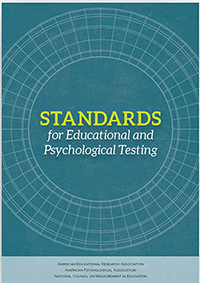
The Standards for Educational and Psychological Testing is a set of testing standards developed jointly by the American Educational Research Association (AERA), American Psychological Association (APA), and the National Council on Measurement in Education (NCME).
AERA or Aera may refer to:
Literacy in the United States was categorized by the National Center for Education Statistics into different literacy levels, with 92% of American adults having at least "Level 1" literacy in 2014. Nationally, over 20% of adult Americans have a literacy proficiency at or below Level 1. Adults in this range have difficulty using or understanding print materials. Those on the higher end of this category can perform simple tasks based on the information they read, but adults below Level 1 may only understand very basic vocabulary or be functionally illiterate. According to a 2020 report by the U.S. Department of Education, 54% of adults in the United States have English prose literacy below the 6th-grade level.

Deborah Loewenberg Ball is an educational researcher noted for her work in mathematics instruction and the mathematical preparation of teachers. From 2017 to 2018 she served as president of the American Educational Research Association. She served as dean of the School of Education at the University of Michigan from 2005 to 2016, and she currently works as William H. Payne Collegiate Professor of education. Ball directs TeachingWorks, a major project at the University of Michigan to redesign the way that teachers are prepared for practice, and to build materials and tools that will serve the field of teacher education broadly. In a sometimes divisive field, Ball has a reputation of being respected by both mathematicians and educators. She is also an extremely well-respected mentor to junior faculty members and graduate students.

Evidence-based education (EBE) is the principle that education practices should be based on the best available scientific evidence, with randomised trials as the gold standard of evidence, rather than tradition, personal judgement, or other influences. Evidence-based education is related to evidence-based teaching, evidence-based learning, and school effectiveness research.
The Common Core State Standards Initiative, also known as simply Common Core, was a multi-state educational initiative begun in 2010 with the goal of increasing consistency across state standards, or what K–12 students throughout the United States should know in English language arts and mathematics at the conclusion of each school grade. The initiative was sponsored by the National Governors Association and the Council of Chief State School Officers.

Common Sense Media (CSM) is an American nonprofit organization that reviews and provides ratings for media and technology with the goal of providing information on their suitability for children. It also funds research on the role of media in the lives of children and advocates publicly for child-friendly policies and laws regarding media.
Educational equity, also known as equity in education, is a measure of achievement, fairness, and opportunity in education. The study of education equity is often linked with the study of excellence and equity.
A virtual learning environment (VLE) in educational technology is a web-based platform for the digital aspects of courses of study, usually within educational institutions. They present resources, activities, and interactions within a course structure and provide for the different stages of assessment. VLEs also usually report on participation and have some level of integration with other institutional systems. In North America, VLEs are often referred to as Learning Management Systems (LMS).

Alan Henry Schoenfeld is an American mathematics education researcher and designer. He is the Elizabeth and Edward Conner Professor of Education and Affiliated Professor of Mathematics at the University of California, Berkeley.

Okhee Lee is an American education scholar and professor of childhood education.

