The Arctic Archipelago, also known as the Canadian Arctic Archipelago, is a group of islands north of the Canadian mainland.
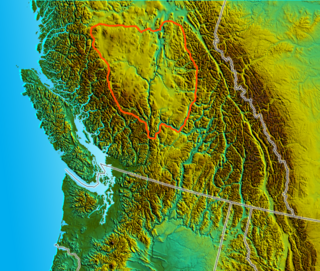
The Cariboo is an intermontane region of British Columbia along a plateau stretching from the Fraser Canyon to the Cariboo Mountains. The name is a reference to the caribou that were once abundant in the region. The Cariboo was the first region of the Interior north of the lower Fraser and its canyon to be settled by non-indigenous people, and played an important part in the early history of the colony and province. The boundaries of the Cariboo proper in its historical sense are debatable, but its original meaning was the region north of the forks of the Quesnel River and the low mountainous basins between the mouth of that river on the Fraser at the city of Quesnel and the northward end of the Cariboo Mountains - an area that is mostly in the Quesnel Highland and focused on several now-famous gold-bearing creeks near the head of the Willow River, the richest of them all, Williams Creek, the location of Barkerville, which was the capital of the Cariboo Gold Rush and also of government officialdom for decades afterwards. This area, the Cariboo goldfields, is underpopulated today but was once the most settled and most powerful of the regions of the province's Interior. As settlement spread southwards of this area, flanking the route of the Cariboo Road and spreading out through the rolling plateaus and benchlands of the Cariboo Plateau and lands adjoining it along the Fraser and Thompson, the meaning changed to include a wider area than the goldfields.

Palmer Land is the portion of the Antarctic Peninsula, Antarctica that lies south of a line joining Cape Jeremy and Cape Agassiz. This application of Palmer Land is consistent with the 1964 agreement between US-ACAN and UK-APC, in which the name Antarctic Peninsula was approved for the major peninsula of Antarctica, and the names Graham Land and Palmer Land for the northern and southern portions, respectively. The line dividing them is roughly 69 degrees south.

The Hollywood & Highland Center is a shopping mall and entertainment complex at Hollywood Boulevard and Highland Avenue in the Hollywood district in Los Angeles. The 387,000-square-foot (36,000 m2) center also includes TCL Chinese Theatre and the Dolby Theatre, home to the Academy Awards. The historic site was once the home of the famed Hollywood Hotel. Located in the heart of Hollywood, along the Hollywood Walk of Fame, it is among the most visited tourist destinations in Los Angeles.

The Prince Charles Mountains are a major group of mountains in Mac. Robertson Land in Antarctica, including the Athos Range, the Porthos Range, and the Aramis Range. The highest peak is Mount Menzies. Other prominent peaks are Mount Izabelle and Mount Stinear. These mountains together with other scattered peaks form an arc about 260 miles long, extending from the vicinity of Mount Starlight in the north to Goodspeed Nunataks in the south.
The Grove Mountains are a large, scattered group of mountains and nunataks extending over an area of approximately 40 by 20 miles, located 100 miles (160 km) east of the Mawson Escarpment in American Highland, Antarctica. They were first photographed from the air by aircraft of U.S. Navy Operation Highjump, 1946–47, and named by the Antarctic Names Committee of Australia for Squadron Leader I.L. Grove, a Royal Australian Air Force pilot with the Australian National Antarctic Research Expeditions, who made a November 1958 landing in these mountains.

The Serrano are an indigenous people of California. They use the autonyms of Taaqtam, meaning "people"; Maarenga'yam, "people from Morongo"; and Yuhaviatam, "people of the pines." Today the Maarenga'yam are enrolled in the Morongo Band of Mission Indians, and the Yuhaviatam are enrolled in the San Manuel Band of Mission Indians. Additionally, some Serrano people are enrolled in the Soboba Band of Luiseno Indians.
The 78th Regiment, (Highland) Regiment of Foot also known as the 78th Fraser Highlanders was a British infantry regiment of the line raised in Scotland in 1757, to fight in the Seven Years' War. The 78th Regiment was one of the first three Highland Regiments to fight in North America.
Alpine School District is the primary school district in northern Utah County, Utah, United States, including the cities of Alpine, American Fork, Cedar Fort, Cedar Hills, Eagle Mountain, Fairfield, Highland, Lehi, Lindon, Orem, Pleasant Grove, Saratoga Springs, and Vineyard. It includes all grades from kindergarten all through high school (K-12). As of 2017, there were 57 elementary schools, 12 junior high schools, nine high schools, and eight special purpose schools serving approximately 78,659 students, making it the largest school district in Utah.
The Sør Rondane Mountains are a group of mountains about 100 miles long with main peaks rising to 3400 m, between the Queen Fabiola Mountains and Wohlthat Mountains in Queen Maud Land. They were discovered and photographed from the air by members of the Lars Christensen Expedition on February 6, 1937, and named after Rondane, a mountain massif in southern Norway. The mountains were mapped in greater detail in 1957 by Norwegian cartographers working with air photos taken by U.S. Navy Operation Highjump, 1946-47.
Weyprecht Mountains is a small group of mountains about 15 km (9 mi) west of the Payer Mountains, forming the western half of the Hoel Mountains in Queen Maud Land. They were discovered by the Third German Antarctic Expedition (1938–1939), led by Capt. Alfred Ritscher, and named for Karl Weyprecht, Austrian polar explorer who in company with Julius Payer discovered Franz Josef Land in 1873, and who initiated the first International Polar Year expedition in 1882–83.

Outback Nunataks is a series of bare rock nunataks and mountains which are distributed over an area about 40 miles (60 km) long by 20 miles (32 km) wide. The group lies south of Emlen Peaks of the Usarp Mountains and west of Monument Nunataks and upper Rennick Glacier, adjacent to the featureless interior plateau. They were discovered by the U.S. Victoria Land Traverse party, 1959–60, and mapped by United States Geological Survey (USGS) from surveys and U.S. Navy air photos, 1959-64. They were so named by Advisory Committee on Antarctic Names (US-ACAN) for their remote position at the posterior side of the large mountain belt that extends from the Ross Sea to the interior ice plateau.

The Sierra de los Cuchumatanes is the highest non-volcanic mountain range in Central America. Its elevations range from 500 m (1,600 ft) to over 3,800 m (12,500 ft), and it covers a total area of c. 16,350 km2 (6,310 sq mi). With an area of 1,500 km2 (580 sq mi) situated above 3,000 m (9,800 ft), it is also the most extensive highland region in Central America. The Sierra de los Cuchumatanes is located in western Guatemala in the departments of Huehuetenango and El Quiché. Its western and south-western borders are marked by the Seleguá River, which separates it from the Sierra Madre volcanic chain. Its southern border is defined by the Río Negro, which flows into the Chixoy River, which turns northwards and separates the Cuchumatanes from the mountains in the Alta Verapaz region. The highest peaks, which reach up to 3,837 m (12,589 ft), are located in the department of Huehuetenango.

The Dry Andes is a climatic and glaciological subregion of the Andes. Together with the Wet Andes it is one of the two subregions of the Argentine and Chilean Andes. The Dry Andes runs from the Atacama Desert in northern Chile and Northwest Argentina south to a latitude of 35°S in Chile. In Argentina the Dry Andes reaches 40°S due to the leeward effect of the Andes. According to Luis Lliboutry the Dry Andes can be defined by the distribution of penitentes. The southernmost well developed penitentes are found on Lanín Volcano.
The Bode Nunataks are two partly snow-covered nunataks lying 23 miles (37 km) north of Mount Harding in the Grove Mountains. Mapped from air photos, 1956–60, by Australian National Antarctic Research Expeditions, they were named by the Antarctic Names Committee of Australia for O. Bode, weather observer at Mawson Station, 1962.
Deming Glacier is a tributary glacier flowing along the north side of Novasio Ridge to enter Man-o-War Glacier, in the Admiralty Mountains, Victoria Land. It was mapped by the United States Geological Survey from surveys and U.S. Navy air photos, 1960–63, and was named by the Advisory Committee on Antarctic Names for Ralph A. Deming, U.S. Navy, Squadron VX-6 Aviation Electrician at McMurdo Station, 1967.
Mount Harding is the largest mountain in the Grove Mountains of Antarctica, in the south-central part of the range and about 4 nautical miles (7 km) west of Gale Escarpment. It was mapped by the Australian National Antarctic Research Expeditions (1956–60) from aerial photographs, and was named by the Antarctic Names Committee of Australia for N.E. Harding, a topographic draftsman with the Division of National Mapping, Australian Department of National Development, who contributed substantially to the production of Antarctic maps.

Long Glacier is a glacier about 8 nautical miles long in the southeastern part of Thurston Island, Antarctica. It flows south to the Abbot Ice Shelf, 14 nautical miles (26 km) west of Harrison Nunatak. The glacier was mapped by the United States Geological Survey from surveys and U.S. Navy air photos, 1960–66, and was named by the Advisory Committee on Antarctic Names (US-ACAN) for Fred A. Long, Jr., an aviation machinist of U.S. Navy Squadron VX-6, who wintered at Little America V in 1957 and was in Antarctica in the 1960–61 and 1962–63 seasons.
The Hess Mountains are a group of mountains rising to about 1,500 metres (5,000 ft) at the head of Hilton Inlet on the Black Coast of Antarctica, to the west of Dietz Bluff and bounded to the north by Gruening Glacier, to the west by Runcorn Glacier and to the south by Beaumont Glacier. The mountains were first photographed from the air by the United States Antarctic Service, 1940, and were mapped by the United States Geological Survey from aerial photographs taken by the U.S. Navy, 1966–69. They were surveyed by the British Antarctic Survey, 1972–73, and, in association with the names of continental drift scientists grouped in this area, named by the Advisory Committee on Antarctic Names, 1978, after the American Harry H. Hess, Professor of Geology at Princeton University, 1948–69.

Donnellan Glacier is a steep valley glacier fed by highland ice adjacent to Opalchenie Peak and Fukushima Peak on Vinson Plateau, the summit plateau of Vinson Massif, in the Sentinel Range of the Ellsworth Mountains, Antarctica. The glacier flows west-southwestward from Opalchenie Peak along the northwest side of Mount Slaughter into Nimitz Glacier.