
Look up Amida in Wiktionary, the free dictionary.
Amida can mean :
Amida can mean :


Amitābha is the principal Buddha of Pure Land Buddhism. He is also known as Amitāyus, which is understood to be his enjoyment body (Saṃbhogakāya). In Vajrayana Buddhism, Amitābha is known for his longevity, discernment, pure perception, and the purification of aggregates with deep awareness of the emptiness of all phenomena. The name Amitābha means "Infinite Light", and the name Amitāyus means "Infinite Life".
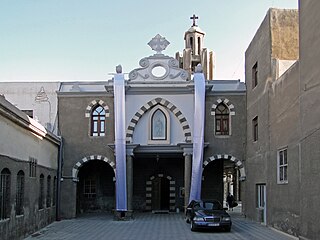
The Syriac Catholic Church is an Eastern Catholic Christian jurisdiction originating in the Levant that uses the West Syriac Rite liturgy and has many practices and rites in common with the Syriac Orthodox Church. Being one of the twenty-three Eastern Catholic Churches, the Syriac Catholic Church is a self-governed sui iuris particular church, while it is in full communion with the Holy See and with the entirety of the Roman Catholic Church.

Sukhavati is the pure land of Amitābha in Mahayana Buddhism. It is also called the Land of Bliss or Western Pure Land and is the most well-known of Buddhist pure lands due to the popularity of Pure Land Buddhism in East Asia.

Shinran was a Japanese Buddhist monk, who was born in Hino at the turbulent close of the Heian Period and lived during the Kamakura Period. Shinran was a pupil of Hōnen and the founder of what ultimately became the Jōdo Shinshū sect of Japanese Buddhism.

The Nianfo, alternatively in Japanese as 念仏, Korean: 염불; RR: yeombul, or in Vietnamese: niệm Phật, is a Buddhist practice central to the tradition of Pure Land Buddhism, though not exclusive to it. In the context of Pure Land practice, it typically refers to the repetition of the name of Amitābha in a ritualized form, though in some contexts it can refer instead to a more meditative practice. It is a translation of Sanskrit buddhānusmṛti.
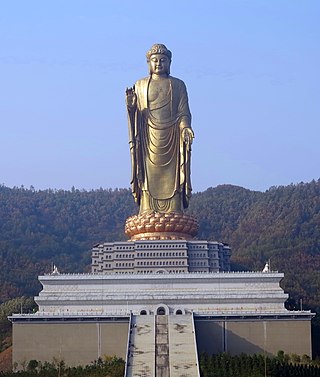
Vairocana is a cosmic buddha from Mahayana and Vajrayana Buddhism. Vairocana is often interpreted, in texts like the Avatamsaka Sutra, as the dharmakāya of the historical Gautama Buddha. In East Asian Buddhism, Vairocana is also seen as the embodiment of the Buddhist concept of śūnyatā. In the conception of the 5 Jinas of Mahayana and Vajrayana Buddhism, Vairocana is at the centre and is considered a Primordial Buddha.
Sion may refer to
Amasia may refer:
Sebaste was a common placename in classical Antiquity. Sebaste was the Greek equivalent (feminine) of the Latin Augusta. Ancient towns by the name sought to honor Augustus or a later Roman emperor.
Apamea or Apameia is the name of several Hellenistic cities in western Asia, after Apama, the Sogdian wife of Seleucus I Nicator, several of which are also former bishoprics and Catholic titular see.

Shandao was an influential writer on Pure Land Buddhism, prominent in China, Japan, Korea, and Vietnam. His writings had a strong influence on later Pure Land masters, including Hōnen and Shinran in Japan. In Jōdo Shinshū, he is considered the Fifth Patriarch, while in Chinese Pure Land Buddhism, he is considered the second patriarch after Lushan Huiyuan.
Amitabh or Amitabha may refer to:

Citharizum was a town and fortress on the south arm of the Euphrates in the Roman province of Armenia III. It was a place of great strength which was built by the emperor Justinian and was the residence of one of the five prefects whom that emperor placed over Roman Armenia with the title of “Dux.”
This is a historical list of all bishops of the Catholic Church whose sees were within the present-day boundaries of the United States, with links to the bishops who consecrated them. It includes only members of the United States Conference of Catholic Bishops and their predecessors.
Rew-Ardashir is only Metropolitan titular archbishopric of the Chaldean Catholic Church.
The Armenian Catholic Archeparchy of Baghdad is a non-metropolitan Archeparchy of the Armenian Catholic Church, covering Iraq.
The Syriac Catholic Archeparchy of Aleppo is a Syriac Catholic Church ecclesiastical territory or archeparchy of the Catholic Church in Syria. The Archeparchy of Aleppo is not a metropolitan see and is exemption directly to the Syriac Catholic Patriarch of Antioch.
The Syriac Catholic Archeparchy of Baghdad is a Syriac Catholic Church ecclesiastical territory or archeparchy of the Catholic Church in Iraq. It is not a metropolitan see and is directly exempt to the Syriac Catholic Patriarch of Antioch, though not part of his or any other ecclesiastical province, and in Rome depends on the Congregation for the Oriental Churches.
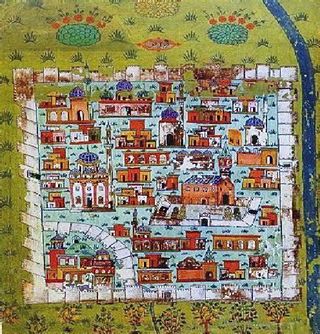
The history of Diyarbakır, one of the largest cities in southeastern Turkey and a metropolitan municipality of Turkey, spans millennia. Diyarbakır is situated on the banks of the Tigris River. The city was first mentioned by Assyrian texts as the capital of a Semitic kingdom. It was ruled by a succession of nearly every polity that controlled Upper Mesopotamia, including the Mitanni, Arameans, Assyrians, Urartu, Armenians, Achaemenid Persians, Medes, Seleucids, and Parthians. The Roman Republic gained control of the city in the first century BC, by which stage it was named "Amida". Amida was then part of the Christian Byzantine Empire until the seventh-century Muslim conquest, after which a variety of Muslim polities gave way to the Ottoman Empire in the 16th century. It has been part of the Republic of Turkey since the dissolution of the Ottoman Empire in the early 20th century.
The Armenian Catholic Eparchy of Sainte-Croix-de-Paris is an eparchy for the faithful in France of the Armenian Catholic Church sui iuris, which uses the Armenian Rite in Armenian, in full communion with the universal Pope of Rome.