
Abdur Rahman Khan also known by his epithets, The Iron Amir, was Amir of Afghanistan from 1880 to his death in 1901. He is known for perpetrating the Hazara Genocide, but also uniting the country after years of internal fighting and negotiation of the Durand Line Agreement with British India.

The Durrani Empire, colloquially known as the Afghan Empire, or the Sadozai Kingdom, was an Afghan empire founded by the Durrani tribe of Pashtuns under Ahmad Shah Durrani in 1747, which spanned parts of Central Asia, the Iranian plateau, and the Indian subcontinent. At its peak, it ruled over present-day Afghanistan, much of Pakistan, parts of northeastern and southeastern Iran, eastern Turkmenistan, and northwestern India. Next to the Ottoman Empire, the Durrani Empire is considered to be among the most significant Islamic empires of the second half of the 18th century.

Badakhshan is a historical region comprised of the Wakhan Corridor in northeast Afghanistan, eastern Tajikistan, and Taxkorgan Tajik Autonomous County in China. Badakhshan Province is one of the 34 provinces of Afghanistan. Much of historic Badakhshan lies within Tajikistan's Gorno-Badakhshan Autonomous Region in the southeastern part of the country. The music of Badakhshan is an important part of the region's cultural heritage.

Dost Mohammad Khan Barakzai, nicknamed the Amir-i Kabir, was the founder of the Barakzai dynasty and one of the prominent rulers of Afghanistan during the First Anglo-Afghan War. With the decline of the Durrani dynasty, he became the Emir of Afghanistan in 1826. An ethnic Pashtun, he belonged to the Barakzai tribe. He was the 11th son of Payinda Khan, chief of the Barakzai Pashtuns, who was killed in 1799 by King Zaman Shah Durrani.

Sher Ali Khan was Amir of Afghanistan from 1863 to 1866 and from 1868 until his death in 1879. He was one of the sons of Dost Mohammed Khan, founder of the Barakzai dynasty in Afghanistan.

The Second Anglo-Afghan War was a military conflict fought between the British Raj and the Emirate of Afghanistan from 1878 to 1880, when the latter was ruled by Sher Ali Khan of the Barakzai dynasty, the son of former Emir Dost Mohammad Khan. The war was part of the Great Game between the British and Russian empires.
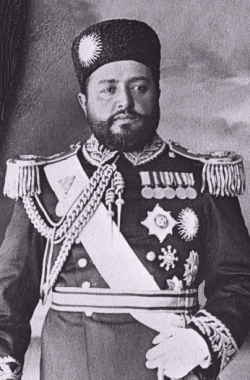
Habibullah Khan was the Emir of Afghanistan from 1901 until his assassination in 1919. He was the eldest son of the Emir Abdur Rahman Khan, whom he succeeded by right of primogeniture in October 1901. His grandfather was Mohammad Afzal Khan.

Mohammad Yaqub Khan was Emir of Afghanistan from February 21 to October 12, 1879. He was a Pashtun and the son of the previous ruler, Sher Ali Khan.
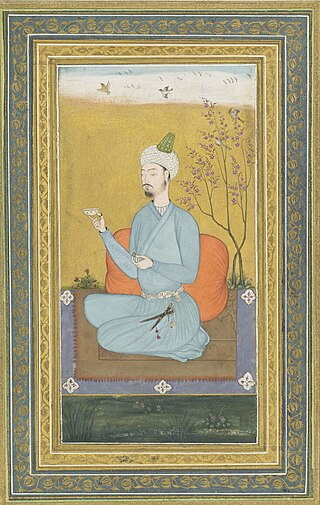
Kamran Mirza was the second son of Babur, the founder of the Mughal Empire and the first Mughal Emperor. Kamran Mirza was born in Kabul to Babur's wife Gulrukh Begum. He was half-brother to Babur's eldest son Humayun, who would go on and inherit the Mughal throne, but he was full-brother to Babur's third son, Askari. A divan written in Persian and Chagatai is attributed to him.

Faiz Muhammad Kāteb also known as Kāteb (کاتب) was a writer and historian. He was Afghan court chronicler, a skilled calligrapher and secretary to Habibullah Khan from 1901 to 1919.

Pashto literature refers to literature and poetry in Pashto language. The history of Pashto literature spreads over five thousands years having its roots in the oral tradition of Tappa. However, the first recorded period begins in 7th century with Amir Kror Suri. Later, Pir Roshan (1526–1574), who founded his own Sufi school of thoughts and began to preach his beliefs. He gave Pashto prose and poetry a new and powerful tone with a rich literary legacy. Khair-ul-Bayan, oft-quoted and bitterly criticized thesis, is most probably the first book on Sufism in Pashto literature. Among his disciples are some of the most distinguished poets, writers, scholars and sufis, like Arzani, Mukhlis, Mirza Khan Ansari, Daulat and Wasil, whose poetic works are well preserved. Akhund Darweza (1533–1615), a popular religious leader and scholar gave a powerful counterblast to Bayazid’s movement in the shape of Makhzanul Islam. He and his disciples have enriched the Pashto language and literature by writing several books of prose.

Bagh-e Babur, also known as Gardens of Babur, is a historic site in Chelsatun, Kabul, Afghanistan. It is located in the Sher Darwaza hillside of District 5, southwest of Shahr-e Naw, or a short distance south of Kabul Zoo and north of Chihil Sutun. The gardens of Babur has several terraced buildings, a small mosque, and plenty of walking space. Visited by up to one million locals and foreign tourists a year, it is also where the tomb of the first Mughal emperor Babur is located. The park is thought to have been developed around 1504, when Babur gave orders for the construction of an "avenue garden" in Kabul, described in some detail in his memoirs, the Baburnama. It has been re-developed by various Afghan rulers since then.
The following lists events that happened during 1904 in Afghanistan.
The following lists events that happened during 1919 in Afghanistan.
The following lists events that happened during 1929 in Afghanistan. The Afghan Civil War continued from the previous year.
There was a small community of Afghan Armenians (Pashto: افغان ارمینیای (Dari: ارمینیای های افغانستان centred in Kabul, Afghanistan.
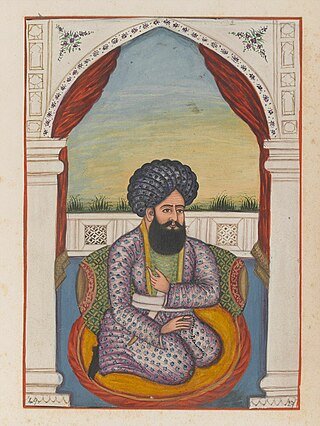
Sultan Mohammad Khan, also known as Ghazi Sardar Sultan Mohammad Talaei, and known by his epithet, Sultan Mohammad Khan the Golden was an Afghan chief minister and regent. He was a powerful brother of Emir Dost Mohammad Khan, the eventual ruler of Afghanistan who seized control of Kabul from him. Prior to and during the reign of Dost Mohammad Khan, Sultan Muhammad Khan Telai was chief minister and governor of various regions of Afghanistan, including Kabul, Peshawar and Kohat. He was the first of the Musahiban, a Mohammadzai dynasty that began with him and ruled Afghanistan for more than 150 years, in various forms such as emir, king or president from 1823 to 1978.

Amir Ali Ahmad Khan, Shaghasi was an Afghan king from the Shaghasi family of the Barakzai tribe who was declared king of Afghanistan twice in 1929. He was first declared amir of Afghanistan by an influential cleric, Naqib Sahib on 20 January 1929, in eastern Afghanistan, but was defeated by Kalakani at Jagdalak on 19 February 1929. He was also declared as the amir of Afghanistan for the second time on 23 June 1929 in Kandahar, Afghanistan, by another highly influential Mufti Abd. Wasi Kandahari, but was defeated and captured by Kalakani on 3 July 1929.
The Afghan Civil War was fought from 9 June 1863 to January 1869. It began as a result of Dost Mohammad Khan's death on 9 June 1863 and the subsequent power struggles among his sons. Dost Mohammad consolidated his power in the second half of his reign within his inner family. His sons were appointed governors of provinces and effectively acted autonomous from the central government. This would inevitably lead to his sons fighting for control after his death.


