Related Research Articles

Alexander Jannaeus was the second king of the Hasmonean dynasty, who ruled over an expanding kingdom of Judaea from 103 to 76 BCE. A son of John Hyrcanus, he inherited the throne from his brother Aristobulus I, and married his brother's widow, Queen Salome Alexandra. From his conquests to expand the kingdom to a bloody civil war, Alexander's reign has been described as cruel and oppressive with never-ending conflict. The major historical sources of Alexander's life are Josephus's Antiquities of the Jews and The Jewish War.

Ptolemy VI Philometor was a Greek king of Ptolemaic Egypt who reigned from 180 to 164 BC and from 163 to 145 BC. He is often considered the last ruler of ancient Egypt when that state was still a major power.

The Hasmonean dynasty was a ruling dynasty of Judea and surrounding regions during the Hellenistic times of the Second Temple period, from c. 140 BCE to 37 BCE. Between c. 140 and c. 116 BCE the dynasty ruled Judea semi-autonomously within the Seleucid Empire, and from roughly 110 BCE, with the empire disintegrating, gained further autonomy and expanded into the neighboring regions of Perea, Samaria, Idumea, Galilee, and Iturea. The Hasmonean rulers took the Greek title basileus ("king") and the kingdom attained regional power status for several decades. Forces of the Roman Republic intervened in the Hasmonean Civil War in 63 BCE, turning the kingdom into a client state and marking an irreversible decline of Hasmonean power; Herod the Great displaced the last reigning Hasmonean client-ruler in 37 BCE.

Salome Alexandra, or Shlomtzion, was a regnant queen of Judaea, one of only three women in Jewish historical tradition to rule over the country, the other two being Deborah and Athaliah. The wife of Aristobulus I, and afterward of Alexander Jannaeus, she was also the last ruler of Judaea to die as the sovereign of an independent kingdom. Her nine-year reign has been described as a "golden age" of Hasmonean history.

Herod Archelaus was the ethnarch of Samaria, Judea, and Idumea, including the cities Caesarea and Jaffa, for nine years. He was the son of Herod the Great and Malthace the Samaritan, brother of Herod Antipas, and half-brother of Herod II. Archelaus came to power after the death of his father Herod the Great in 4 BC, and ruled over one-half of the territorial dominion of his father. Archelaus was removed by the Roman emperor Augustus when Judaea province was formed under direct Roman rule, at the time of the Census of Quirinius.

Aristobulus II was the Jewish High Priest and King of Judea, 66 BCE to 63 BCE, from the Hasmonean dynasty.

John Hyrcanus II, a member of the Hasmonean dynasty, was for a long time the Jewish High Priest in the 1st century BCE. He was also briefly King of Judea 67–66 BCE and then the ethnarch (ruler) of Judea, probably over the period 47–40 BCE.

Jonathan Apphus was one of the sons of Mattathias and the leader of the Hasmonean dynasty of Judea from 161 to 143 BCE.
An alabarch was a traditionally Jewish official in Alexandria during the Hellenistic and Roman periods, seemingly responsible for taxation and especially customs at the harbor.
Leontopolis is the Greek name of a city that may correspond to either the modern area of Tell el Yehudiye or Tell el-Yahudiya. It was an ancient city of Egypt in the 13th nome of Lower Egypt, on the Pelusiac branch of the Nile. This site is known for its distinctive pottery known as Tell el-Yahudiyeh Ware.
Onias IV was the son of Onias III and the heir of the Zadokite line of High Priests of Israel. He built a new Jewish temple at Leontopolis in Ptolemaic Egypt where he reigned as a rival High Priest to the hierarchy in Jerusalem. While he never gained leadership in Judea, he still held influence in Egypt; the territory most heavily populated by Jews was called the Land of Onias in reference to his influence.
Jason was the High Priest of Israel from around 175 BCE to 171 BCE during the Second Temple period of Judaism. He was of the Oniad family and was brother to Onias III, his predecessor as High Priest. Josephus records that his name was originally Jesus or Joshua before he changed it.
Menelaus was High Priest in Jerusalem from about 172 BC to about 161 BC. He was high priest at the beginning of the Maccabean revolt (167-160). He was the successor of Jason, the brother of Onias III.
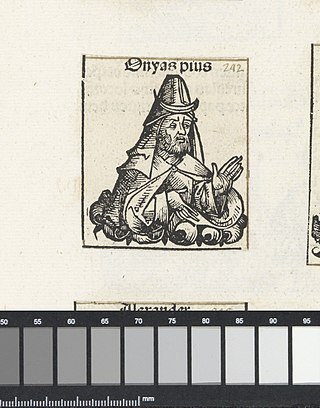
Onias III, son of Simon II, was Jewish High Priest during the Second Temple period. He is described in scriptures as a pious man who opposed the Hellenization of Judea. He was succeeded by his brother Jason in 175 BCE.
The Land of Onias is the name given in Hellenistic Egyptian, Jewish, and Roman sources to an area in ancient Egypt's Nile Delta where a large number of Jews settled. The Land of Onias, which included the city of Leontopolis, was located in the Heliopolite Nome.

Onias II was the son of Simon I. He was still a minor when his father died, so his uncle Eleazar, and whom after, the latter's uncle Manasseh, officiated as high priests before Onais himself succeeded to that dignity. According to Josephus, he was a covetous man and of limited intelligence, whose refusal to pay the twenty talents of silver which every high priest was required to pay to Ptolemy III Euergetes, the King of Egypt threatened to imperil both the high priest and the people. The impending disaster was averted by Onias’ nephew Joseph, son of Tobias, who, having friendly relations with the Egypt court, managed to conciliate Ptolemy. Onias is said to have died, almost simultaneously with his nephew Joseph, during the reign of Seleucus IV Philopator, hence about 181 BC. His son, Simon II assumed the high priestly office after the demise of his father.

Simon II was a High Priest of Israel during the Second Temple period. He was the son of Onias II, and was probably succeeded by Onias III. There are two main sources that discuss Simon II: the Book of Sirach and possibly 3 Maccabees. Based on the Book of Sirach, Simon II was active at some point in the 190s BCE. If the reference to a High Priest Simon in 3 Maccabees is to the same person, then he was also active as High Priest in the 210s BCE as well. John J. Collins estimates his reign as 219–196 BCE for example, while Elias Bickerman suggests only that he served c. 190 BCE. He was possibly the same person as Simon the Just, although the historian Josephus thought this referred to Simon I instead.
Hellenistic Palestine is the term for historic Palestine during the Hellenistic period, when Achaemenid Syria was conquered by Alexander the Great in 333 BCE and subsumed into his growing Macedonian empire. After his death in 323 BCE, Alexander's empire was divided among his generals, the Diadochi, marking the beginning of Macedonian rule over various territories, including Coele-Syria. The region came under Ptolemaic rule beginning when Ptolemy I Soter took control of Egypt in 322 BCE and subsequently Yehud Medinata in 320 BCE due to its strategic significance. This period saw numerous conflicts as former generals vied for control, leading to ongoing power struggles and territorial exchanges.
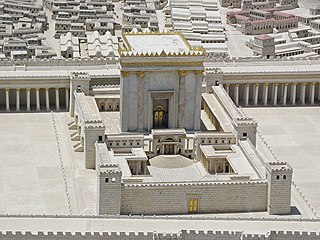
The Second Temple period in Jewish history began with the end of the Babylonian captivity and the Persian conquest of the Babylonian Empire in 539 BCE. A new temple to replace the destroyed Solomon's Temple was built in Jerusalem by the returnees, and the Second Temple was finished around 516 BCE. Second Temple Judaism was centered around the religious leadership of the Second Temple, and lasted for six centuries. The Persians were largely tolerant of Judaism. Persian rule lasted for two centuries, but came to an end with the conquests of Macedonia under Alexander the Great in 332 BCE. Judea and the Eastern Mediterranean region came under Greek influence during the resulting Hellenistic period; Hellenistic Judaism blended both Greek and Jewish traditions. Judea was ruled in this period first by the Ptolemaic Kingdom and then by the Seleucid Empire, Greek states formed after the breakup of Alexander's Macedonian empire. The Maccabean Revolt of 167–142 BCE was initially a fight for Judean autonomy against a suppression of traditional Judaism by Seleucid King Antiochus IV, and later sought outright independence from Greek rule. The revolt's success brought about the formation of an independent Hasmonean kingdom of Judea, named for the family which had led the Jewish resistance.
References
 This article incorporates text from a publication now in the public domain : Büchler, Alexander (1901). "Ananias, Son of Onias IV.". In Singer, Isidore; et al. (eds.). The Jewish Encyclopedia . Vol. 1. New York: Funk & Wagnalls. p. 558.