The Andone Castrum (French: Castrum d'Andone or d'Andonne) is a ruined fortification in Villejoubert, Charente, France. It dates from the 11th century.
The Andone[a]castrum was built in the medieval diocese of Angoulême. It is now 2 kilometres (1.2mi) to the south of the Boixe forest, but in the 10th century the forest was much larger, and began no more than 1 kilometre (0.62mi) away.[2] It is about 3 kilometres (1.9mi) to the east of Montignac on the Charente River, which meanders from north to south. It lay to the north of the great road from Saintes via Limoges to Lyon, which crossed the Charente at Montignac.[2] The castrum is in an isolated location on a natural mound known as the "butte de la Garenne". The site was occupied by an Iron Age necropolis, and then by a Gallo-Roman villa.[3] The villa was abandoned in the 4th century.[4]
History
Around 950 Angoulême went through a disturbed period as the Carolingian political structures disintegrated. Count Guillaume II Taillefer resigned his power as Count of Angoulême. around 945 and became a monk at the Abbey of Saint-Cybard. He left a bastard son, Arnaud Manzer, but was succeeded by his cousin, Count Bernard of Périgord. After Bernard's death in 962 there was a power struggle between Bernard's sons and Arnaud Manzer. Arnaud established himself of Count of Angoulême in 975.[4] It seems that he reoccupied Andone during this period of struggle.[5]
The site was most likely occupied from around 970–980 until 1028.[6] The site may have been abandoned in part due to lacks of an interior water supply or to the cramped interior. More important, the transfer of the count's residence to Montignac, on the banks of the Charente, may have been due to the count's wish to ally himself to the bishop who controlled that area. The move seems to have taken place at the same time as the move of the monastery of Saint-Amant-de-Boixe, which had been close to Andone.[7]
The site has been relatively undisturbed since being abandoned.[7] Between 1971 and 1995 André Debord undertook an investigation of the castrum. His findings were reviewed, reinterpreted and published in 2009 under the direction of Luc Bourgeois.[3] The excavation gives useful insights into daily life around the year 1000 in an aristocratic home.[7] The fort has been classified Monument historique since 13 August 1986.[8]
Structure
The fortification was surrounded by a stone wall, around which there was a 1.5 metres (4ft 11in) walkway, then a large U-shape ditch up to 11.3 metres (37ft) wide.[9] It was thought by Debord that there may have been a second moat, but this has been shown to be incorrect.[3] The surrounding woods contained oak, beech and maple, which were used indiscriminately for fuel. The woods had clearings for pasture or crops.[6]
The stone wall was jointed with mortar, and may have had a walkway on top protected by a parapet.[3] The wall was protected by an earth rampart on the outside.[10] The irregular oval outline of the wall, in 14 juxtaposed sections, conforms to the shape of the hill. The remains of the wall are about 2 metres (6ft 7in) wide but rise no more than 4 metres (13ft) above their foundations. They may have originally been 10 to 11 metres (33 to 36ft) high. There were two gates, 2 to 3 metres (6ft 7in to 9ft 10in) wide, giving access to the enclosed space from the east and the west.[9]
The enclosure was about 1,200 square metres (13,000sqft) in area and held seven stone buildings and two courts. In the northeast there was a long room connected to two others, which appears to have been the base of the ducal hall.[9] There was no fireplace on the ground floor, so there may have been a second-floor room above, about 20 by 11 metres (66 by 36ft).[3] The ground level would have been a service area.[9] In the south there were four buildings, of which three shared the same facade.[9] The function of the smaller buildings to the south is not clear, but they may have been used for workshops, storage and for housing the count's staff.[11] The stone construction is unusual, since most buildings of that period in France were of wood, other than the great royal residences.[10]
View from the east in 2004, ducal hall to the right
Findings include coins, tools, weapons, many horse fittings, small glass vessels, flat glass plates, furniture of stone, bone and wood, ceramic vessels and small earthenware objects. There is evidence of weaving and a smithy, with abundant metal objects.[6] These include ironwork from doors, furniture and chests.[3] The weapons do not include swords or lances, and suggest hunting rather than combat. Locally made chess pieces give evidence of an aristocratic lifestyle.[6]
80% of the domestic animals used for meat were pigs, the remainder being cattle and sheep. Wild game accounted for 4% of the total, including deer (63%), hare (20%), birds (10%) and wild boar (6%). The remains of four horses and seven donkeys were found, as well as a few bones of dog, squirrel, badger, cats and black rats, which were numerous.[6]
Notes
↑ The name Andone came into use in the 15th century. Older forms from the records of the abbey of Saint-Amant-de-Boixe around 1100 are Auzona and Anzona.[1]
Angoulême is a small city in the southwestern French department of Charente, of which it is the prefecture.
Angoulême (L'Angoumois) in western France was part of the Carolingian Kingdom of Aquitaine. Under Charlemagne's successors, the local count of Angoulême was independent and the county was not united with the French crown until 1308. By the terms of the Treaty of Brétigny (1360) the Angoumois, then ruled by the counts of Angoulême, was ceded to King Edward III of England. In 1371 it became a fief of Duke John of Berry and then passed to Duke Louis I of Orleans, both of whom were cadets of the French royal family. From then on it was held by cadets of the Valois House of Orleans, until Francis of Angoulême, became king of France in 1515. Angoumois was definitively incorporated into the French crown lands, as a duchy.
The Charente is a 381-kilometre (237 mi) long river in southwestern France. Its source is in the Haute-Vienne département at Chéronnac, a small village near Rochechouart. It flows through the departments of Haute-Vienne, Charente, Vienne and Charente-Maritime. The river flows into the Atlantic Ocean near Rochefort.
Aubeterre-sur-Dronne is a commune in the Charente department in the Nouvelle-Aquitaine region of Southwestern France.
The Diocese of Angoulême is a Latin diocese of the Catholic Church in France. Originally erected in the 3rd century, the episcopal see is the Angoulême Cathedral. Comprising the département of the Charente, the diocese had traditionally been suffragan to the Archbishopric of Bordeaux, under the old régime as well as under the Concordat, but since 2002 is suffragan to the Archdiocese of Poitiers.
The Château de Montignac is a ruined castle in the commune of Montignac-Charente, in the Charente département of France. The castle is the property of the commune and has been listed since 1962 as a monument historique by the French Ministry of Culture.
Agris is a commune in the Charente department in the Nouvelle-Aquitaine region of southwestern France.
Ambérac is a commune in the Charente département, region in the Nouvelle-Aquitaine region of southwestern France.
Anais is a commune in the Charente department in the Nouvelle-Aquitaine region of southwestern France.
Baignes-Sainte-Radegonde is a commune in the Charente department in the Nouvelle-Aquitaine region of south-western France.
Balzac is a commune in the Charente department in the Nouvelle-Aquitaine region of south-western France.
Villebois-Lavalette is a commune in the Charente department in southwestern France. It was the seat of the former Canton of Villebois-Lavalette, and is located on a prominent hill which has a château dating back to Roman times.
La Couronne is a commune in the Charente department in southwestern France.
William "Taillefer" I was also known as William II of Angoulême. He was the Count of Angoulême from 926 to 945. He was the son of Alduin I.
The Château de Verteuil is a historic building in Charente, France. It dates back to 1080 and has since been extensively rebuilt, although 12th-century walls remain. The château has always been in the property of the La Rochefoucauld family.
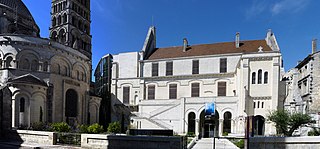
The Musée d'Angoulême, formerly the Musée des beaux-arts d'Angoulême, is a public museum in Angoulême, France. Located beside the Angoulême Cathedral in the heart of the historical center of the city, it is classified as a Musée de France, and has important archaeological, ethnographic and artistic collections. It also hosts temporary exhibitions and conferences.
Jean-Edmond Laroche-Joubert was a French industrialist and Bonapartist politician who was deputy for Charente during the Second French Empire and again during the French Third Republic. He developed his family paper manufacturing company into a major industrial enterprise. He was innovative in introducing profit sharing and encouraging his employees to acquire shares in the business.
Château de Cognac, also known as Château de Valois and Château François, is a castle in Cognac, Nouvelle-Aquitaine, France. The castle has been rebuilt many times over the centuries.
Aymar or Adémar was Count of Poitiers from 890 to 902 and Count of Angoulême from 916 to 926.
Charente is a French department that was established in 1790 based on geographic criteria, the upper and middle basin of the Charente River, and historical reasons. Its central part corresponds to the former diocese and then the county of Angoumois. Before the Revolution, this region did not have political, religious, or judicial unity. Its history has been closely associated with Aquitaine. However, the county of Angoumois, a royal birthplace, has had a distinct history and has played a significant role in the history of France.
This page is based on this Wikipedia article Text is available under the CC BY-SA 4.0 license; additional terms may apply. Images, videos and audio are available under their respective licenses.