
The Chudov Monastery was founded in the Moscow Kremlin in 1358 by Metropolitan Alexius of Moscow. The monastery was dedicated to the miracle of the Archangel Michael at Chonae. The Monastery was closed in 1918 and dismantled in 1929 by the Soviet government.

The Altes Museum is a listed building on the Museum Island in the historic centre of Berlin, Germany. Built between 1825 and 1830 by order of King Frederick William III of Prussia according to plans by Karl Friedrich Schinkel, it is considered a major work of German Neoclassical architecture. It is surrounded by the Berlin Cathedral to the east, the Berlin Palace to the south and the Zeughaus to the west. Currently, the Altes Museum houses the Antikensammlung and parts of the Münzkabinett. As part of the Museum Island complex, the Altes Museum was listed as a UNESCO World Heritage Site in 1999, in recognition of its testimony to the development of the museum as a social and architectural phenomenon.
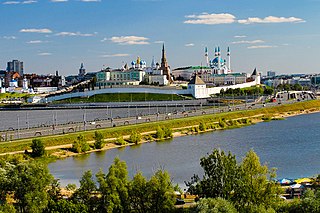
The Kazan Kremlin is the chief historic citadel of Russia, situated in the city of Kazan. It was built at the behest of Ivan the Terrible on the ruins of the former castle of Kazan khans. It was declared a World Heritage Site in 2000.

St. Michael's Golden-Domed Monastery is a monastery in Kyiv, the capital of Ukraine, dedicated to Saint Michael the Archangel. It is located on the edge of the bank of the Dnipro river, to the northeast of the St Sophia Cathedral. The site is in the historical administrative neighbourhood of Uppertown and overlooks Podil, the city's historical commercial and merchant quarter. The monastery has been the headquarters of the Orthodox Church of Ukraine since December 2018.

Affligem Abbey is a Benedictine abbey in the historic village of Hekelgem, now in the municipality of Affligem, Flemish Brabant, Belgium, 19 km (12 mi) to the north-west of Brussels. Dedicated in 1086, it was the most important monastery in the Duchy of Brabant and therefore often called Primaria Brabantiae.

Treis-Karden is an Ortsgemeinde – a municipality belonging to a Verbandsgemeinde, a kind of collective municipality – in the Cochem-Zell district in Rhineland-Palatinate, Germany. It was the seat of the former like-named Verbandsgemeinde until 1 July 2014. Since then, it is part of the Verbandsgemeinde Cochem. Treis-Karden is a state-recognized tourism resort (Fremdenverkehrsort).

St Peter's Cathedral is a Roman Catholic church and former cathedral in Worms, southern Germany.

Oberwesel is a town on the Middle Rhine in the Rhein-Hunsrück-Kreis (district) in Rhineland-Palatinate, Germany. It belongs to the Verbandsgemeinde Hunsrück-Mittelrhein, whose seat is in Emmelshausen.
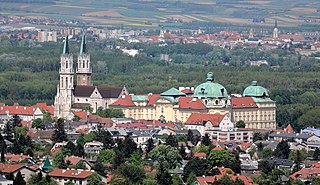
Klosterneuburg Abbey is a twelfth-century Augustinian monastery of the Catholic Church located in the town of Klosterneuburg in Lower Austria. Overlooking the Danube, just north of the Vienna city limits at the Leopoldsberg, the monastery was founded in 1114 by Saint Leopold III of Babenberg, the patron saint of Austria, and his second wife Agnes of Germany.

Essen Minster, since 1958 also Essen Cathedral is the seat of the Roman Catholic Bishop of Essen, the "Diocese of the Ruhr", founded in 1958. The church, dedicated to Saints Cosmas and Damian and the Blessed Virgin Mary, stands on the Burgplatz in the centre of the city of Essen, Germany.

Würzburg Cathedral is a Roman Catholic cathedral in Würzburg in Bavaria, Germany, dedicated to Saint Kilian. It is the seat of the Bishop of Würzburg and has served as the burial place for the Prince-Bishops of Würzburg for hundreds of years. With an overall length of 103 metres, it is the fourth largest Romanesque church building in Germany, and a masterpiece of German architecture from the Salian period. Notable later additions include work by Tilman Riemenschneider and Balthasar Neumann. The cathedral was heavily damaged by British bombs in March 1945 but rebuilt post-World War II.

Cappenberg Castle is a former Premonstratensian monastery, Cappenberg Abbey in Cappenberg, a part of Selm, North Rhine-Westphalia in Germany. It stands on an elevation, the Cappenberg, near Lünen and Werne, and is a vantage point offering views over the eastern Ruhrgebiet.
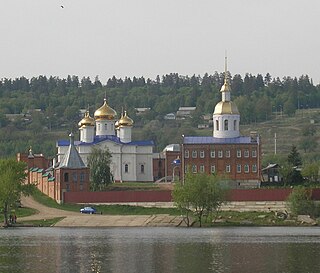
The Annunciation Monastery is a church complex in the village of Fyodorovka in the urban district of Tolyatti in Samara Oblast in Russia.

The Holy Spirit Cathedral or the Holy Ghost Cathedral is a cathedral in Minsk, Belarus. Consecrated in honour of the Holy Spirit, it the mother church of the Belarusian Orthodox Church. It was built between 1633 and 1642 as a part Bernardine monastery during the Polish–Lithuanian Commonwealth in a place of former male Orthodox monasteries. The site became Orthodox again in 1860. The cathedral is listed as a Belarusian Cultural heritage object and is considered one of the main landmarks in Minsk Upper city.

The Eisbach, locally known as die Eis, is a 38-kilometre (24 mi) long river and left or western tributary of the Rhine in the northeastern Palatinate and southeastern Rhenish Hesse, in the German state of Rhineland-Palatinate.

The Liebenau monastery was a Dominican monastery. It was located outside the city gates of Worms in today's Worms-Hochheim district.
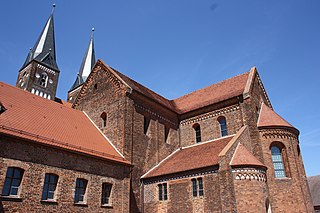
The Jerichow Monastery is a former Premonstratensian monastery located in the northern outskirts of Jerichow, near the shores of the Elbe River, in the state of Saxony-Anhalt of Germany.

The Magnuskirche is a small church in Worms, Germany, to the south of Worms Cathedral. It is the city's smallest church. Archaeological evidence and its dedication suggest it originated in the 8th century - part of that building survives in the nave's north wall.

The Bischofshof palace was a former Baroque-style palace in Worms, Germany. It was located next to the Worms Cathedral, on its northern side, on the current Schlossplatz ). It served as the main residence of the prince-bishops of Worms.

Mathilde Grünewald was a German Roman archaeologist, and museum director.


