
Worms City Museum (German - Museum der Stadt Worms or Stadtmuseum Worms) is a city museum in Worms, Germany, housed in the former Andreasstift complex. [1] Its lapidarium is housed in the former cloister.
Worms City Museum (German - Museum der Stadt Worms or Stadtmuseum Worms) is a city museum in Worms, Germany, housed in the former Andreasstift complex. [1] Its lapidarium is housed in the former cloister.

Basel or Basle is a city in northwestern Switzerland on the river Rhine. Basel is Switzerland's third-most-populous city with about 180,000 inhabitants.
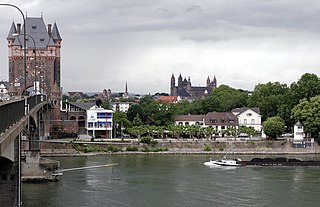
Worms is a city in Rhineland-Palatinate, Germany, situated on the Upper Rhine about 60 kilometres (40 mi) south-southwest of Frankfurt-am-Main. It had approximately 82,000 inhabitants as of 2015.

Münster is an independent city in North Rhine-Westphalia, Germany. It is in the northern part of the state and is considered to be the cultural centre of the Westphalia region. It is also capital of the local government region Münsterland. Münster was the location of the Anabaptist rebellion during the Protestant Reformation and the site of the signing of the Treaty of Westphalia ending the Thirty Years' War in 1648. Today it is known as the bicycle capital of Germany.
Alzey-Worms is a district in Rhineland-Palatinate, Germany. It is bounded by the district Groß-Gerau (Hesse), the city of Worms and the districts of Bad Dürkheim, Donnersbergkreis, Bad Kreuznach and Mainz-Bingen.
Bad Dürkheim is a district in Rhineland-Palatinate, Germany. It is bounded by the districts of Kaiserslautern, Donnersbergkreis and Alzey-Worms, the city of Worms, the Rhein-Pfalz-Kreis, the city of Neustadt/Weinstraße, the districts of Südliche Weinstraße, the city of Landau, the district Südwestpfalz, and the city of Kaiserslautern.
Groß-Gerau is a Kreis (district) in the south of Hesse, Germany. Neighboring districts are Main-Taunus, district-free Frankfurt, Darmstadt-Dieburg, Bergstraße, Alzey-Worms, Mainz-Bingen, and the district-free cities Mainz and Wiesbaden.

Durlach is a borough of the German city of Karlsruhe with a population of roughly 30,000.

The Innere Stadt is the 1st municipal District of Vienna located in the center of the Austrian capital. The Innere Stadt is the old town of Vienna. Until the city boundaries were expanded in 1850, the Innere Stadt was congruent with the city of Vienna. Traditionally it was divided into four quarters, which were designated after important town gates: Stubenviertel (northeast), Kärntner Viertel (southeast), Widmerviertel (southwest), Schottenviertel (northwest).

The Zürichberg is a wooded hill rising to 679 m, overlooking Lake Zürich and located immediately to the east of the city of Zürich, Switzerland, between the valleys of the Limmat and the Glatt rivers. Its highest point is about 270 metres above the Limmat and it is part of a chain of hills, such as Käferberg, Adlisberg, Forch and Pfannenstiel, between the Greifensee/Glattal and Lake Zürich.

Schönau Abbey in Schönau in the Odenwald, in the Rhein-Neckar-Kreis in Baden-Württemberg, was a Cistercian monastery founded in 1142 from Eberbach Abbey. The present settlement of Schönau grew up round the monastery.

The Documentation Center Nazi Party Rallying Grounds is a museum in Nuremberg. It is in the north wing of the unfinished remains of the Congress Hall of the former Nazi party rallies. Its permanent exhibition "Fascination and Terror" is concerned with the causes, connections, and consequences of Nazi Germany. Topics that have a direct reference to Nuremberg are especially taken into account. Attached to the museum is an education forum.

Affoltern is a quarter in the district 11 in Zürich, located in the Glatt Valley.

Seefeld is a quarter in the district 8 of Zürich.

The Eisbach, locally known as die Eis, is a 38-kilometre (24 mi) long river and left or western tributary of the Rhine in the northeastern Palatinate and southeastern Rhenish Hesse, in the German state of Rhineland-Palatinate.

The Regensburg Museum of History, currently resides in a former Minorite monastery, is a museum of the history, art and culture of Regensburg and eastern Bavaria from the Stone Age to the present day.

Martin Luther's Death House is the historic building in Eisleben, Germany, long regarded as the place where Martin Luther died on 18 February 1546. Since then it has become a museum and a UNESCO world heritage site. The city of Eisleben, located in Saxony-Anhalt, is also where Martin Luther was born and baptized; his birth house is also a UNESCO world heritage site and museum.
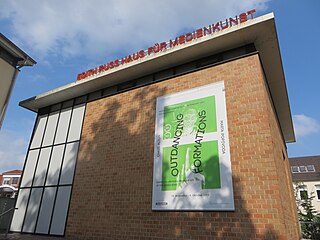
The Edith-Russ-Haus für Medienkunst is an art gallery in the city of Oldenburg, Lower Saxony, Germany, dedicated to new media art.
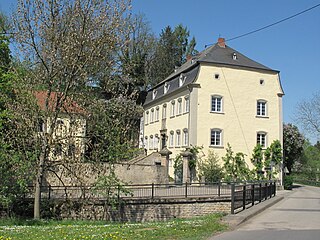
Schloss Holsthum, also called Herrenhaus Laeis, is a manor house in the municipality of Holsthum in the county of Eifelkreis Bitburg-Prüm in the German state of Rhineland-Palatinate. It is a cultural monument and listed building.

The Andreasstift was a building complex in Worms, Germany, now housing Worms City Museum. It is located near Worms Cathedral and the Magnuskirche.

The Magnuskirche is a small church in Worms, Germany, to the south of Worms Cathedral. It is the city's smallest church. Archaeological evidence and its dedication suggest it originated in the 8th century - part of that building survives in the nave's north wall.
Coordinates: 49°37′41″N8°21′26″E / 49.6281°N 8.3572°E
  | This article about a museum in Germany is a stub. You can help Wikipedia by expanding it. |
