Related Research Articles
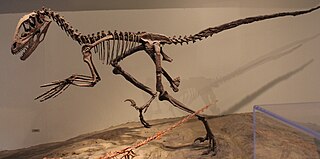
Deinonychus is a genus of dromaeosaurid theropod dinosaur with one described species, Deinonychus antirrhopus. This species, which could grow up to 3.4 meters (11 ft) long, lived during the early Cretaceous Period, about 115–108 million years ago. Fossils have been recovered from the U.S. states of Montana, Utah, Wyoming, and Oklahoma, in rocks of the Cloverly Formation and Antlers Formation, though teeth that may belong to Deinonychus have been found much farther east in Maryland.
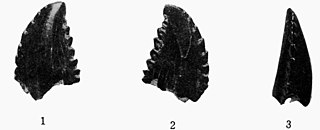
Troodon is a former wastebasket taxon and a potentially dubious genus of relatively small, bird-like theropod dinosaurs definitively known from the Campanian age of the Late Cretaceous period. It includes at least one species, Troodon formosus, known from Montana. Discovered in October 1855, T. formosus was among the first dinosaurs found in North America, although it was thought to be a lizard until 1877. Several well-known troodontid specimens from the Dinosaur Park Formation in Alberta were once believed to be members of this genus. However, recent analyses in 2017 have found this genus to be undiagnostic and referred some of these specimens to the genus Stenonychosaurus some to the genus Latenivenatrix, and some to the genus Pectinodon. The genus name is Ancient Greek for "wounding tooth", referring to the teeth, which were different from those of most other theropods known at the time of their discovery. The teeth bear prominent, apically oriented serrations. These "wounding" serrations, however, are morphometrically more similar to those of herbivorous reptiles, and suggest a possibly omnivorous diet.

Oviraptor is a genus of oviraptorid dinosaur that lived in Asia during the Late Cretaceous period. The first remains were collected from the Djadokhta Formation of Mongolia in 1923 during a paleontological expedition led by Roy Chapman Andrews, and in the following year the genus and type species Oviraptor philoceratops were named by Henry Fairfield Osborn. The genus name refers to the initial thought of egg-stealing habits, and the specific name was intended to reinforce this view indicating a preference over ceratopsian eggs. Despite the fact that numerous specimens have been referred to the genus, Oviraptor is only known from a single partial skeleton regarded as the holotype, as well as a nest of about fifteen eggs and several small fragments from a juvenile.

Oviraptoridae is a group of bird-like, herbivorous and omnivorous maniraptoran dinosaurs. Oviraptorids are characterized by their toothless, parrot-like beaks and, in some cases, elaborate crests. They were generally small, measuring between one and two metres long in most cases, though some possible oviraptorids were enormous. Oviraptorids are currently known only from the Late Cretaceous of Asia, with the most well-known species and complete specimens found only in the Gobi Desert of Mongolia and northwestern China.

Stenonychosaurus is a genus of troodontid dinosaur from the Late Cretaceous Dinosaur Park Formation of Alberta, Canada, as well as possibly the Two Medicine Formation. The type and only species, S. inequalis, was named by Charles Mortram Sternberg in 1932, based on a foot, fragments of a hand, and some caudal vertebrae from the Late Cretaceous of Alberta. S. inequalis was reassigned in 1987 by Phil Currie to the genus Troodon, which was reverted by the recognition of Stenonychosaurus as a separate genus from the possibly dubious Troodon in 2017 by Evans et al. and also later in the same year by Van der Reest and Currie.
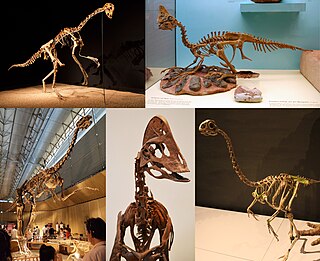
Oviraptorosaurs are a group of feathered maniraptoran dinosaurs from the Cretaceous Period of what are now Asia and North America. They are distinct for their characteristically short, beaked, parrot-like skulls, with or without bony crests atop the head. They ranged in size from Caudipteryx, which was the size of a turkey, to the 8-meter-long, 1.4-ton Gigantoraptor. The group is close to the ancestry of birds. Some researchers such as Maryanska et al (2002) and Osmólska et al. (2004) have proposed that they may represent primitive flightless birds. The most complete oviraptorosaur specimens have been found in Asia. The North American oviraptorosaur record is sparse.

Maiasaura is a large herbivorous saurolophine hadrosaurid ("duck-billed") dinosaur genus that lived in the area currently covered by the state of Montana and the province of Alberta, Canada, in the Upper Cretaceous Period, about 76.7 million years ago. Maiasaura peeblesorum is the state fossil of Montana.
Kenneth Carpenter is an American paleontologist. He is the former director of the USU Eastern Prehistoric Museum and author or co-author of books on dinosaurs and Mesozoic life. His main research interests are armored dinosaurs, as well as the Early Cretaceous dinosaurs from the Cedar Mountain Formation in eastern Utah.

Magyarosaurus is a genus of dwarf sauropod dinosaur from late Cretaceous Period in Romania. It is one of the smallest-known adult sauropods, measuring only 6 m (20 ft) in length and 750–1,000 kg (1,650–2,200 lb) in body mass. The type and only certain species is Magyarosaurus dacus. It has been found to be a close relative of Rapetosaurus in the family Saltasauridae in the sauropod clade Titanosauria in a 2005 study.
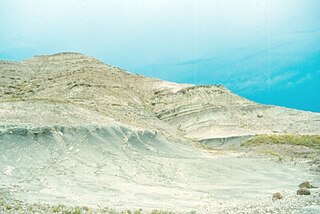
The Two Medicine Formation is a geological formation, or rock body, in northwestern Montana and southern Alberta that was deposited between 83.5 ± 0.7 Ma and 70.6 ± 3.4 Ma, during Campanian time. It crops out to the east of the Rocky Mountain Overthrust Belt, and the western portion of this formation is folded and faulted while the eastern part, which thins out into the Sweetgrass Arch, is mostly undeformed plains. Below the formation are the nearshore deposits of the Virgelle Sandstone, and above it is the marine Bearpaw Shale. Throughout the Campanian, the Two Medicine Formation was deposited between the western shoreline of the Late Cretaceous Interior Seaway and the eastward advancing margin of the Cordilleran Overthrust Belt. The Two Medicine Formation is mostly sandstone, deposited by rivers and deltas.
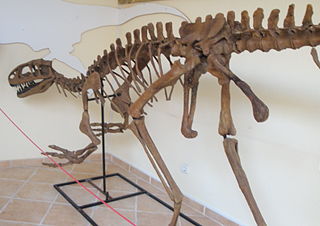
Lourinhanosaurus was a genus of carnivorous theropod dinosaur that lived during the Late Jurassic Period (Kimmeridgian/Tithonian) in Portugal. It is one of many large predators discovered at the Lourinhã Formation and probably competed with coeval Torvosaurus gurneyi, Allosaurus europaeus, and Ceratosaurus.

Nemegtomaia is a genus of oviraptorid dinosaur from what is now Mongolia that lived in the Late Cretaceous Period, about 70 million years ago. The first specimen was found in 1996, and became the basis of the new genus and species N. barsboldi in 2004. The original genus name was Nemegtia, but this was changed to Nemegtomaia in 2005, as the former name was preoccupied. The first part of the generic name refers to the Nemegt Basin, where the animal was found, and the second part means "good mother", in reference to the fact that oviraptorids are known to have brooded their eggs. The specific name honours the palaeontologist Rinchen Barsbold. Two more specimens were found in 2007, one of which was found on top of a nest with eggs, but the dinosaur had received its genus name before it was found associated with eggs.
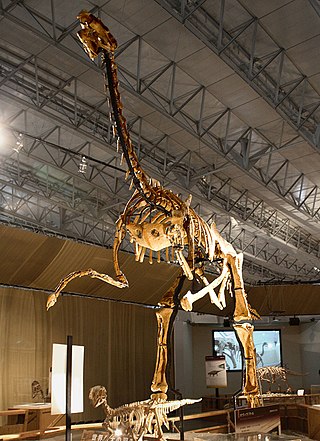
Gigantoraptor is a genus of large oviraptorosaur dinosaur that lived in Asia during the Late Cretaceous period. It is known from the Iren Dabasu Formation of Inner Mongolia, where the first remains were found in 2005.

Ovaloolithus is an oogenus of dinosaur egg. Eggs of the genus have been found in China, Mongolia and Utah.

Spheroolithus is an oogenus of dinosaur egg.
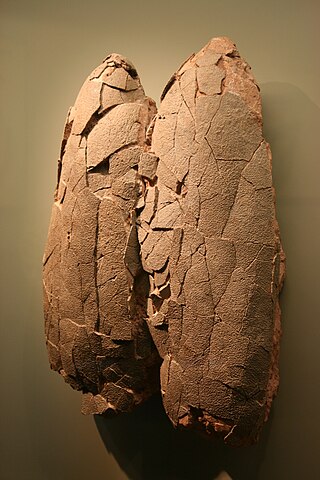
Macroelongatoolithus is an oogenus of large theropod dinosaur eggs, representing the eggs of giant caenagnathid oviraptorosaurs. They are known from Asia and from North America. Historically, several oospecies have been assigned to Macroelongatoolithus, however they are all now considered to be a single oospecies: M. carlylensis.

Macroolithus is an oogenus of dinosaur egg belonging to the oofamily Elongatoolithidae. The type oospecies, M. rugustus, was originally described under the now-defunct oogenus name Oolithes. Three other oospecies are known: M. yaotunensis, M. mutabilis, and M. lashuyuanensis. They are relatively large, elongated eggs with a two-layered eggshell. Their nests consist of large, concentric rings of paired eggs. There is evidence of blue-green pigmentation in its shell, which may have helped camouflage the nests.
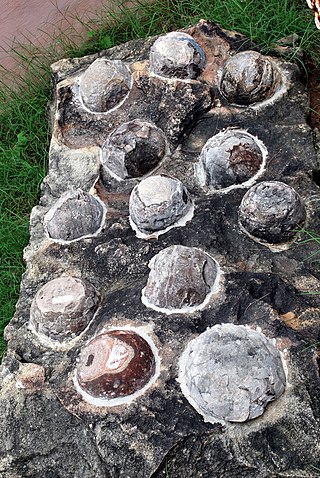
Egg fossils are the fossilized remains of eggs laid by ancient animals. As evidence of the physiological processes of an animal, egg fossils are considered a type of trace fossil. Under rare circumstances a fossil egg may preserve the remains of the once-developing embryo inside, in which case it also contains body fossils. A wide variety of different animal groups laid eggs that are now preserved in the fossil record beginning in the Paleozoic. Examples include invertebrates like ammonoids as well as vertebrates like fishes, possible amphibians, and reptiles. The latter group includes the many dinosaur eggs that have been recovered from Mesozoic strata. Since the organism responsible for laying any given egg fossil is frequently unknown, scientists classify eggs using a parallel system of taxonomy separate from but modeled after the Linnaean system. This "parataxonomy" is called veterovata.
Reptile egg fossils are the fossilized remains of eggs laid by reptiles. The fossil record of reptile eggs goes back at least as far as the Early Permian. However, since the earliest reptile eggs probably had soft shells with little preservation potential, reptilian eggs may go back significantly farther than their fossil record. Many ancient reptile groups are known from egg fossils including crocodilians, dinosaurs, and turtles. Some ancient reptiles are known to have given live birth and are therefore not anticipated to have left behind egg fossils.

Beibeilong is a genus of large caenagnathid dinosaurs that lived in Asia during the Late Cretaceous epoch, about 96 million to 88 million years ago. The genus contains a single species, Beibeilong sinensis. The species was named and described in 2017 through analysis of an embryonic skeleton and partial nest with large eggs that were discovered in the Gaogou Formation of China between 1992 and 1993.
References
- ↑ Carpenter, Kenneth; Hirsch, Karl F.; Horner, John R. (26 January 1996). Dinosaur Eggs and Babies. ISBN 9780521567237.
- ↑ Ghevariya, Z. G.; Srikarni, C. "Anjar Formation, its fossils and their bearing on the extinction of dinosaurs". Conference paper: 106–109.
 | This article about a specific stratigraphic formation is a stub. You can help Wikipedia by expanding it. |