Related Research Articles
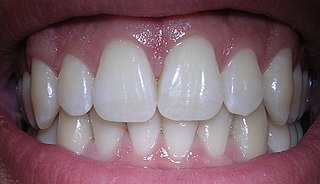
The human teeth function to mechanically break down items of food by cutting and crushing them in preparation for swallowing and digesting. Humans have four types of teeth: incisors, canines, premolars, and molars, which each have a specific function. The incisors cut the food, the canines tear the food and the molars and premolars crush the food. The roots of teeth are embedded in the maxilla or the mandible and are covered by gums. Teeth are made of multiple tissues of varying density and hardness.

Tooth enamel is one of the four major tissues that make up the tooth in humans and many other animals, including some species of fish. It makes up the normally visible part of the tooth, covering the crown. The other major tissues are dentin, cementum, and dental pulp. It is a very hard, white to off-white, highly mineralised substance that acts as a barrier to protect the tooth but can become susceptible to degradation, especially by acids from food and drink. Calcium hardens the tooth enamel. In rare circumstances enamel fails to form, leaving the underlying dentin exposed on the surface.

Dentin or dentine is a calcified tissue of the body and, along with enamel, cementum, and pulp, is one of the four major components of teeth. It is usually covered by enamel on the crown and cementum on the root and surrounds the entire pulp. By volume, 45% of dentin consists of the mineral hydroxyapatite, 33% is organic material, and 22% is water. Yellow in appearance, it greatly affects the color of a tooth due to the translucency of enamel. Dentin, which is less mineralized and less brittle than enamel, is necessary for the support of enamel. Dentin rates approximately 3 on the Mohs scale of mineral hardness. There are two main characteristics which distinguish dentin from enamel: firstly, dentin forms throughout life; secondly, dentin is sensitive and can become hypersensitive to changes in temperature due to the sensory function of odontoblasts, especially when enamel recedes and dentin channels become exposed.
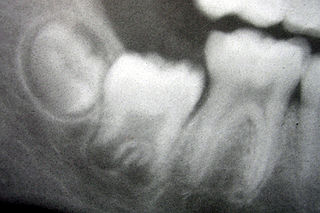
Tooth development or odontogenesis is the complex process by which teeth form from embryonic cells, grow, and erupt into the mouth. For human teeth to have a healthy oral environment, all parts of the tooth must develop during appropriate stages of fetal development. Primary (baby) teeth start to form between the sixth and eighth week of prenatal development, and permanent teeth begin to form in the twentieth week. If teeth do not start to develop at or near these times, they will not develop at all, resulting in hypodontia or anodontia.
Florence Kirsch Du Brul was a concert pianist and master piano teacher and member of Chicago society in the mid-20th century.
Thomas G.H. Diekwisch is a German dentist who is Professor and Head, Department of Oral Biology, University of Illinois at Chicago College of Dentistry; Allan G. Brodie Endowed Chair for Orthodontic Research; Director, Brodie Laboratory for Craniofacial Genetics; Professor of Anatomy, Cell Biology, Bioengineering, and Periodontics; Member, Center for Molecular Biology of Oral Diseases; and Member, Graduate Faculty, at the University of Illinois at Chicago.

The Nova Southeastern University College of Dental Medicine is the dental school of Nova Southeastern University. It is located in Fort Lauderdale, Florida, United States. When it opened in 1997, it was the first new dental school to open in the United States in 24 years. It is the largest dental school in Florida. The school is accredited by the American Dental Association.

JoAnne Stubbe is an American chemist best known for her work on ribonucleotide reductases, for which she was awarded the National Medal of Science in 2009. In 2017, she retired as a Professor of Chemistry and Biology at the Massachusetts Institute of Technology.
In dentistry, enamel matrix derivative (EMD) is an extract of porcine fetal tooth material used to biomimetically stimulate the soft and hard tissues surrounding teeth to regrow following tissue destruction.

Mineralized tissues are biological tissues that incorporate minerals into soft matrices. Typically these tissues form a protective shield or structural support. Bone, mollusc shells, deep sea sponge Euplectella species, radiolarians, diatoms, antler bone, tendon, cartilage, tooth enamel and dentin are some examples of mineralized tissues.
The family of non-collagenous proteins known as SIBLING proteins, standing for small integrin-binding ligand, N-linked glycoprotein, are components of the extracellular matrix of bone and dentin. Evidence shows that these proteins play key roles in the mineralization of these tissues.

Samuel I. Stupp, is a Board of Trustees Professor of Materials Science, Chemistry, and Medicine at Northwestern University in Chicago, IL. He is best known for his work on self-assembling materials and supramolecular chemistry. One of his most notable discoveries is a broad class of peptide amphiphiles that self-assemble into high aspect ratio nanofibers with extensive applications in regenerative medicine. He has also made significant contributions to the fields of supramolecular chemistry, nanotechnology, and organic electronic materials. He has over 300 peer-reviewed publications and was one of the 100 most cited chemists in the 2000-2010 decade.
Ana Bedran-Russo is Professor in Restorative Dentistry and Chair of the Department of General Dental Sciences in restorative dentistry at the Marquette University School of Dentistry.
Hard tissue is tissue which is mineralized and has a firm intercellular matrix. The hard tissues of humans are bone, tooth enamel, dentin, and cementum. The term is in contrast to soft tissue.

William Giannobile is a leader in the field of periodontology and an internationally recognized scholar in oral regenerative medicine, tissue engineering, and precision medicine. Giannobile currently holds the position of Dean of Harvard School of Dental Medicine (HSDM), and began serving in this role in September 2020. Giannobile was named Dean of HSDM in April 2020. Prior to HSDM, he served as the Najjar Endowed Professor and chair of the Department of Periodontics and Oral Medicine at the University of Michigan School of Dentistry. He was also a professor of biomedical engineering at the College of Engineering and Biointerfaces Institute.

Dagmar Ringe is an American biochemist, educator, and researcher. She is the Harold and Bernice Davis Professor in Aging and Neurodegenerative Disease at Brandeis University in Waltham, Massachusetts and holds appointments in the departments of Chemistry and Biochemistry.

Marie Ussing Nylen is a Danish-American biologist, dentist, microscopist, and badminton player known for her research on the morphology of tooth enamel and her contributions to refining the electron microscope as an aide in dental research at the National Institute of Dental and Craniofacial Research (NIDR). She was the first woman director of the NIDR's Intramural Research Program. Nylen became director of the NIDR extramural research program in 1984. In 1947 and 1953, she won the women's world singles event at the All England Open Badminton Championship.

Marian Frances Young is an American developmental biologist researching the function of extracellular matrix proteins in skeletal tissues. She is the deputy scientific director of the division of intramural research at the National Institute of Dental and Craniofacial Research.
Lucile Rose Hac was an American biochemist and microbiologist whose research interests included amino acids, antibiotics, and bone metabolism. She was director of research at International Minerals and Chemical Corporation and a faculty member in the biochemistry department at Northwestern University.
Laurie Kay McCauley is an American dentistry academic with expertise in skeletal biology. She is the William K. and Mary Anne Najjar Professor and Dean of the University of Michigan School of Dentistry, and Professor in the Department of Pathology at Michigan Medicine.
References
- ↑ Nanci, Antonio (2008). Ten Cate's Oral Histology: Development, Structure, and Function, 7th ed . St. Louis: Mosby Elsevier. ISBN 978-0-323-04557-5.