Related Research Articles

Spathodea is a monotypic genus in the flowering plant family Bignoniaceae. The single species it contains, Spathodea campanulata, is commonly known as the African tulip tree. The tree grows between 7–25 m (23–82 ft) tall and is native to tropical dry forests of Africa. It has been nominated as among 100 of the "World's Worst" invaders.

The ruby-topaz hummingbird , commonly referred to simply as the ruby topaz, is a species of hummingbird in the subfamily Polytminae, the mangoes. It is found in Aruba, Bolivia, Bonaire, Brazil, Colombia, Curaçao, French Guiana, Guyana, Panama, Suriname, Trinidad and Tobago, and Venezuela.

The black-throated mango is a hummingbird species native to South America and Trinidad and Tobago.

The green-breasted mango is a hummingbird from tropical America. The scientific name of this bird commemorates the French naturalist Florent Prévost.

The green-throated mango is a species of hummingbird in the subfamily Polytminae. It is found in Brazil, the Guianas, Trinidad, and Venezuela.

The violet-crowned hummingbird is a hummingbird in the "emeralds", tribe Trochilini of subfamily Trochilinae. It is found in Mexico and the southwestern United States.

The white-eared hummingbird is a species of hummingbird in the "emeralds", tribe Trochilini of subfamily Trochilinae. It is found from the southwestern U.S. to Nicaragua.

The green mango is a large species of hummingbird in the subfamily Polytminae. It is endemic to the main island of Puerto Rico.

The emerald-chinned hummingbird is a species of hummingbird in the "emeralds", tribe Trochilini of subfamily Trochilinae. It is found in El Salvador, Guatemala, Honduras, Mexico, and Nicaragua.

The green-fronted hummingbird is a species of hummingbird in the "emeralds", tribe Trochilini of subfamily Trochilinae. It is found in Mexico and possibly Guatemala.

The Hispaniolan mango is a species of hummingbird in the subfamily Polytminae. It is found on the Caribbean islands of Hispaniola
The mangos, Anthracothorax, are a genus of hummingbirds in the subfamily Trochilinae native to the Neotropics.

The Jamaican mango is a species of hummingbird in the subfamily Polytminae. It is endemic to Jamaica.

The Veraguan mango is a species of hummingbird in the family Trochilidae. It is found in Panama and recently in Costa Rica. It was considered conspecific with the Green-breasted Mango but was separated due to morphological and geographical differences in 1995.

The fiery-tailed awlbill is a species of hummingbird in the subfamily Polytminae, the mangoes. It is found in Brazil, Ecuador, French Guiana, Guyana, Suriname, and Venezuela.
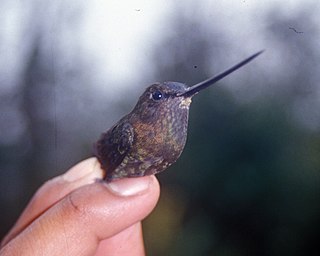
The green-fronted lancebill is a species of hummingbird in the family Trochilidae. Primarily known for its incredibly long bill and “glittering” green patch of feathers on its forehead, D. ludovicae is found in subtropical and tropical moist montane forest and prefers regions that include fast moving rivers and streams.
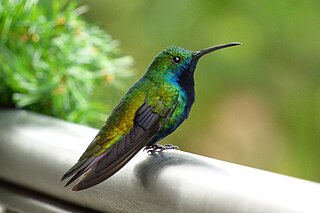
Polytminae is one of the six subfamilies of the hummingbird family Trochilidae. The subfamily contains 12 genera with a total of 29 species.

Nuevo Milenio State Forest is one of the 20 forests that make up the public forest system of Puerto Rico. The forest is located east of the University of Puerto Rico Botanical Garden in the Sabana Llana Sur district of San Juan, making it one of the two state forests located within the capital's municipal boundaries.

The Puerto Rican mango is a species of hummingbird in the subfamily Polytminae. It is found on the Caribbean islands of Puerto Rico, the British Virgin Islands, and the American Virgin Islands.
References
- ↑ Gill, F.; Donsker, D.; Rasmussen, P., eds. (August 2022). "Hummingbirds". IOC World Bird List. v 12.2. Retrieved August 8, 2022.