| This article needs additional citations for verification .(October 2013) (Learn how and when to remove this template message) |

Archibald Herman Müller (born 11 March 1878, in Cochin in the Southern Indian state of Kerala), was an artist of realistic paintings and one of India's early 20th Century great talents.

Kerala is a state on the southwestern, Malabar Coast of India. It was formed on 1 November 1956, following passage of the States Reorganisation Act, by combining Malayalam-speaking regions. Spread over 38,863 km2 (15,005 sq mi), Kerala is the twenty second largest Indian state by area. It is bordered by Karnataka to the north and northeast, Tamil Nadu to the east and south, and the Lakshadweep Sea and Arabian Sea to the west. With 33,387,677 inhabitants as per the 2011 Census, Kerala is the thirteenth-largest Indian state by population. It is divided into 14 districts with the capital being Thiruvananthapuram. Malayalam is the most widely spoken language and is also the official language of the state.
Müller was born of German parentage, and lived and worked in India. He joined[ clarification needed ] the Madras School of Art and received early recognition[ citation needed ]. He won the Gold Medal at Madras School of Art.[ citation needed ] After completing his education, he worked with his brother in his photography studio for some time.[ clarification needed ]
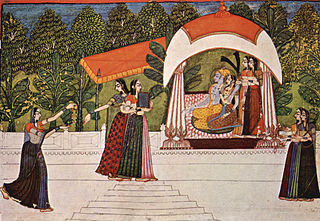
Müller went to Bombay (now Mumbai) in 1911, then considered the haven of Art in India. He won the Gold Medal from the Bombay Art Society in the same year. He travelled a lot through Maharashtra, Rajasthan, Gujarat and in the Himalayas, enjoying the patronage of various royal families of the time. His paintings included landscapes, portraits and scenes from the life of the Maharajas (Kings), historical subjects and incidents from the Indian Hindu epics - the Ramayana and the Mahabharata. His paintings have been acquired by the Buckingham Palace, London, the South Kensington Museum (now known as the Victoria and Albert Museum). Few also exist in the collections of the Museums at Sangli, Maharashtra Bikaner, Rajasthan, the Jodhpur Fort and the Royal Palace at Jaipur. His paintings are much sought after and have surfaced in various auctions in recent years.
The Bombay Art Society is a Non Profit premier art organization based in Mumbai, founded in 1888. The Bombay Art Society is a 127-year-old institution founded for encouraging and promoting art. Most of the renowned artists on India's art scene have been associated with the Bombay Art Society in some way. The society boasts of a rich past though its members and there is no denying its historical context and it is against this that the Bombay Art Society's greatness can be best understood.
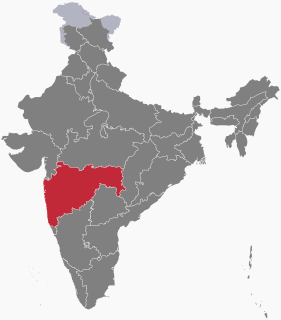
Maharashtra is a state considered to be part of western, central, and south-central India. It is the second-most populous state and third-largest state by area in India. Spread over 307,713 km2 (118,809 sq mi), it is bordered by the Arabian Sea to the west, the Indian states of Karnataka and Goa to the south, Telangana and Chhattisgarh to the east, Gujarat and Dadra and Nagar Haveli to the north west, and Madhya Pradesh to the north. It is also the world's second-most populous subnational entity. It was formed by merging the western and south-western parts of the Bombay State, Berar and Vidarbha, and the north-western parts of the Hyderabad State and splitting Saurashtra by the States Reorganisation Act. It has over 112 million inhabitants and its capital, Mumbai, has a population around 18 million making it the most populous urban area in India. Nagpur hosts the winter session of the state legislature. Pune is known as 'Oxford of the East' due to the presence of several well-known educational institutions.

Rajasthan is a state in northern India. The state covers an area of 342,239 square kilometres (132,139 sq mi) or 10.4 percent of the total geographical area of India. It is the largest Indian state by area and the seventh largest by population. Rajasthan is located on the northwestern side of India, where it comprises most of the wide and inhospitable Thar Desert and shares a border with the Pakistani provinces of Punjab to the northwest and Sindh to the west, along the Sutlej-Indus river valley. Elsewhere it is bordered by five other Indian states: Punjab to the north; Haryana and Uttar Pradesh to the northeast; Madhya Pradesh to the southeast; and Gujarat to the southwest.
Müller died in 1960 at the Gandhi Hospital in Jodhpur, Rajasthan, India.
His children moved from India in the 1950s and 1960s. Two daughters moved to the UK, Gwendalene Ellen and Winnifred Rose and his son Archibald Hermann Müller (known as Hermann), to Australia in 1967. Many individuals from succeeding generations of his family have proved to be talented artists and writers, with some exhibiting nationally and internationally. One of his daughters, Gwen Raven (deceased June 2012) lived in Prestatyn, North Wales, was an artist and auctioned many of her paintings off for charity. Winnie also in North Wales continues to paint to this day at 84 years of age. Son, Hermann, inspired by his father's paintings at an early age, expresses his creative talents as an author, and having studied the bodymind connection founded Psychosomatic Therapy and developed the Psychosomatic Therapy Process which is taught in many countries. Hermann resides on the Gold Coast, Queensland. Highly accomplished contemporary artist Charlotte Mcgowan-Griffin, born in London and based in Berlin is a great granddaughter of A H Müller.