Related Research Articles
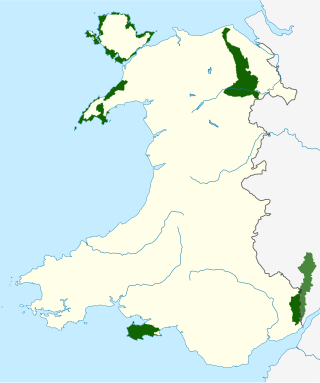
There are five Areas of Outstanding Natural Beauty (AONBs) in Wales, known from November 2023 as National Landscapes. AONBs are areas of countryside that have been designated for statutory protection, due to their significant landscape value, by initially the Government of the United Kingdom and later Welsh devolved bodies. Of the current five areas designated, four are wholly in Wales, with another spanning the Wales-England border, and in total AONBs account for 4% of Wales' land area.

In the United Kingdom, a listed building is a structure of particular architectural and/or historic interest deserving of special protection. Such buildings are placed on one of the four statutory lists maintained by Historic England in England, Historic Environment Scotland in Scotland, Cadw in Wales, and the Northern Ireland Environment Agency in Northern Ireland. The classification schemes differ between England and Wales, Scotland, and Northern Ireland. The term has also been used in the Republic of Ireland, where buildings are protected under the Planning and Development Act 2000, although the statutory term in Ireland is "protected structure."

Planning permission in the United Kingdom is the planning permission required in the United Kingdom in order to be allowed to build on land, or change the use of land or buildings. Within the UK the occupier of any land or building will need title to that land or building, but will also need "planning title" or planning permission. Planning title was granted for all pre-existing uses and buildings by the Town and Country Planning Act 1947, which came into effect on 1 July 1948. Since that date any new "development" has required planning permission.
An Article 4 direction is made by a local planning authority in the United Kingdom and exceptionally may be subject to intervention by the government. It serves to restrict permitted development rights, which means that a lot of the things people do to their land or houses without planning permission and often take for granted, are brought into the realms of planning consent. It does not in itself prohibit any action but means that a landowner is required to seek planning consent whereas without the direction this would not be necessary.
The Register of Historic Parks and Gardens of Special Historic Interest in England provides a listing and classification system for historic parks and gardens similar to that used for listed buildings. The register was set up by Historic England under the provisions of the National Heritage Act 1983. Over 1,600 sites are listed, ranging from the grounds of large stately homes to small domestic gardens, as well other designed landscapes such as town squares, public parks and cemeteries. The register is published on the National Heritage List for England alongside other national heritage designations.
Town and country planning in the United Kingdom is the part of English land law which concerns land use planning. Its goal is to ensure sustainable economic development and a better environment. Each country of the United Kingdom has its own planning system that is responsible for town and country planning, which outside of England is devolved to the Northern Ireland Assembly, the Scottish Parliament and the Senedd.

In the United Kingdom, devolved matters are the areas of public policy where the Parliament of the United Kingdom has devolved its legislative power to the national legislatures of Scotland, Wales and Northern Ireland, while reserved matters and excepted matters are the areas where the UK Parliament retains exclusive power to legislate.

The Town and Country Planning Act 1990 is an act of the Parliament of the United Kingdom regulating the development of land in England and Wales. It is a central part of English land law in that it concerns town and country planning in the United Kingdom. Repealed in parts by the Planning and Compensation Act 1991, it is now also complemented by the Planning and Compulsory Purchase Act 2004.
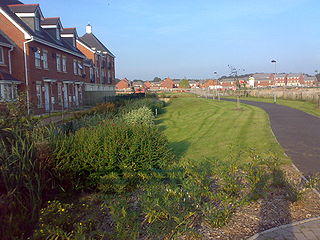
A local development framework is the spatial planning strategy introduced in England and Wales by the Planning and Compulsory Purchase Act 2004 and given detail in Planning Policy Statements 12. In most parts of the two countries, maintaining the framework is the responsibility of English district councils and Welsh principal area councils.

The Planning Inspectorate for England is an executive agency of the Ministry for Housing, Communities, and Local Government of the United Kingdom Government with responsibility for making decisions and providing recommendations and advice on a range of land use planning-related issues across England. The Planning Inspectorate deals with planning appeals, nationally significant infrastructure projects, planning permission, examinations of Local Plans and other planning-related and specialist casework.
A development plan sets out a local authority's policies and proposals for land use in their area. The term is usually used in the United Kingdom. A local plan is one type of development plan. The development plan guides and shapes day-to-day decisions as to whether or not planning permission should be granted, under the system known as development control. In order to ensure that these decisions are rational and consistent, they must be considered against the development plan adopted by the authority, after public consultation and having proper regard for other material factors.
Development Management (DM), formerly known as planning control, or development control, is the element of the United Kingdom's system of town and country planning through which local government or the Secretary of State, regulates land use and new building, i.e. development. It relies on a "plan-led system" whereby development plans are produced, involving various stages of public consultation prior to being adopted. Subsequently, development that requires planning permission, which is granted or refused with reference to the development plan as the starting point, then other material considerations are taken into account.

The Town and Country Planning (England) Order 2015 is a statutory instrument, applying in England, that grants planning permission for certain types of development without the requirement for approval from the local planning authority.
The Town and Country Planning Order 1987 is a Statutory Instrument, applying in England and Wales, that specifies various "Use Classes" for which planning permission is not required for a building or other land to change from one use within that class to another use within that same class. The UCO 1987 was made by the Secretary of State under authority granted by sections 22 and 287 of the Town and Country Planning Act 1971, which have subsequently been replaced by sections 55 and 333 of the Town and Country Planning Act 1990.
A tree preservation order (TPO) is a part of town and country planning in the United Kingdom. A TPO is made by a local planning authority to protect specific trees or a particular area, group or woodland from deliberate damage and destruction if those trees are important for the amenity of the area. In Scotland TPOs can also be used to protect trees of historic or cultural significance. TPOs make the felling, lopping, topping, uprooting or otherwise willful damaging of trees without the permission of the local planning authority a legal offence, although different TPOs have different degrees of protection.
Planning law or town and country planning is the system by which the British government seeks to maintain a balance between economic development and environmental quality in England. The primary legislation for this field of law is provided by the Town and Country Planning Act 1947 and the Town and Country Planning Act 1990.
Planning gains are ways that local authorities in the United Kingdom can secure additional public benefits from developers, during the granting of planning permission.
In the United Kingdom, the term conservation area almost always applies to an area of special architectural or historic interest, the character of which is considered worthy of preservation or enhancement. It creates a precautionary approach to the loss or alteration of buildings and/or trees, thus it has some of the legislative and policy characteristics of listed buildings and tree preservation orders. The concept was introduced in 1967, and by 2017 almost 9,800 had been designated in England.
The Commons Act 2006 is an Act of the Parliament of the United Kingdom. It implements recommendations contained in the Common Land Policy Statement 2002.
In England and Wales, an amenity society is an organisation which monitors planning and development.