The economy of Afghanistan is listed as the 124th largest in the world in terms of nominal gross domestic product (GDP), and 102nd largest in the world in terms of purchasing power parity (PPP). With a population of around 41 million people, Afghanistan's GDP (nominal) stands at $14.58 billion as of 2021, amounting to a GDP per capita of $363.7. Its annual exports exceed $2 billion, with agricultural, mineral and textile products accounting for 94% of total exports. The nation's total external debt is $1.4 billion as of 2022.

Jalalabad is the fifth-largest city of Afghanistan. It has a population of about 356,274, and serves as the capital of Nangarhar Province in the eastern part of the country, about 130 kilometres (80 mi) from the capital Kabul. Jalalabad is located at the junction of the Kabul River and the Kunar River in a plateau to the south of the Hindu Kush mountains. It is linked by the Kabul-Jalalabad Road to the west and Peshawar in Khyber Pakhtunkhwa, Pakistan, to the east through Torkham and the Khyber Pass.

Islamic Relief Worldwide describes itself as "a faith-inspired humanitarian and development agency which is working to support and empower the world's most vulnerable people".

Afghan refugees are citizens of Afghanistan who were forced to flee from their country as a result the continuous wars that the country has suffered since the Afghan-Soviet war, the Afghan civil war, the Afghanistan war (2001–2021) or either political or religious persecution. The 1978 Saur Revolution, followed by the 1979 Soviet invasion, marked the first major wave of internal displacement and international migration to neighboring Iran and Pakistan; smaller numbers also went to India or to countries of the former Soviet Union. Between 1979 and 1992, more than 20% of Afghanistan's population fled the country as refugees. Following the Soviet withdrawal in 1989, many returned to Afghanistan, however many Afghans were again forced to flee during the civil war in the 90s. Over 6 million Afghan refugees were residing in Iran and Pakistan by 2000. Most refugees returned to Afghanistan following the 2001 United States invasion and overthrow of the Taliban regime. Between 2002 and 2012, 5.7 million refugees returned to Afghanistan, increasing the country's population by 25%.

Etsy, Inc. is an American e-commerce company with an emphasis on the selling of handmade or vintage items and craft supplies. These items fall under a wide range of categories, including jewelry, bags, clothing, home decor, religious items, furniture, toys, art, as well as craft supplies and tools. Items described as vintage must be at least 20 years old. The site follows in the tradition of open craft fairs, giving sellers personal storefronts where they list their goods for a fee of US$0.20 per item. Beginning in 2013, Etsy allowed sellers to sell mass-manufactured items.

Afghanistan–India relations are the diplomatic relations between India and Afghanistan. They had been historical neighbors when India was under colonial rule and have since shared cultural ties through Bollywood and cricket.
UNICEF, originally the United Nations International Children's Emergency Fund, officially United Nations Children's Fund since 1953, is an agency of the United Nations responsible for providing humanitarian and developmental aid to children worldwide. The organization is one of the most widely known and visible social welfare entities globally, operating in 192 countries and territories. UNICEF's activities include providing immunizations and disease prevention, administering treatment for children and mothers with HIV, enhancing childhood and maternal nutrition, improving sanitation, promoting education, and providing emergency relief in response to disasters.
Pakistan and state-sponsored terrorism refers to the involvement of Pakistan in terrorism through the backing of various designated terrorist organizations. Pakistan has been frequently accused by various countries, including its neighbours Afghanistan, Iran, and India, as well as by the United States, the United Kingdom, Germany, and France, of involvement in a variety of terrorist activities in both its local region of South Asia and beyond. Pakistan's northwestern tribal regions along the Afghanistan–Pakistan border have been described as an effective safe haven for terrorists by Western media and the United States Secretary of Defense, while India has accused Pakistan of perpetuating the insurgency in Jammu and Kashmir by providing financial support and armaments to militant groups, as well as by sending state-trained terrorists across the Line of Control and de facto India–Pakistan border to launch attacks in Indian-administered Kashmir and India proper, respectively. According to an analysis published by the Saban Center for Middle East Policy at the Brookings Institution in 2008, Pakistan was reportedly, with the possible exception of Iran, perhaps the world's most active sponsor of terrorist groups; aiding these groups that pose a direct threat to the United States. Pakistan's active participation has caused thousands of deaths in the region; all these years Pakistan has been supportive to several terrorist groups despite several stern warnings from the international community. Daniel Byman, a professor and senior analyst of terrorism and security at the Center For Middle East Policy, also wrote that Pakistan is probably 2008's most active sponsor of terrorism. In 2018, the former Prime Minister of Pakistan, Nawaz Sharif, suggested that the Pakistani government played a role in the 2008 Mumbai attacks that were carried out by Lashkar-e-Taiba, a Pakistan-based Islamist terrorist group. In July 2019, Pakistani Prime Minister Imran Khan, on an official visit to the United States, acknowledged the presence of some 30,000–40,000 armed terrorists operating on Pakistani soil. He further stated that previous administrations were hiding this truth, particularly from the United States, for the last 15 years during the War on Terror.
The Institute of International Education Scholar Rescue Fund (IIE-SRF) arranges, funds, and supports fellowships for threatened and displaced scholars at partnering higher education institutions worldwide, including inside their home regions. These fellowships permit professors, researchers and other senior academics to find temporary refuge at host universities and colleges anywhere in the world, enabling them to pursue their academic work. In some cases, conditions may improve, but if the scholar is unable to return home, the scholar may use the fellowship period to identify a longer-term opportunity.

Diplomatic relations between Afghanistan and China were established in the 18th century, when Afghanistan was ruled by Ahmad Shah Durrani and China by Qianlong. But trade relations between these nations date back to at least the Han dynasty with the profitable Silk Road. Presently, China has an embassy in Kabul and Afghanistan has one in Beijing. The two countries share a 92 km (57 mi) border.
IsraAID is an Israel-based non-governmental organization that responds to emergencies all over the world with targeted humanitarian help. IsraAID was founded by Shachar Zahavi and Mully Dor. This includes disaster relief, from search and rescue to rebuilding communities and schools, to providing aid packages, medical assistance, and post-psychotrauma care. IsraAID has also been involved in emergency response and international development projects in more than 60 countries, with focuses on Water, Sanitation & Hygiene, public health and medical care education, and mental health and protection.

A delivery drone is a unmanned aerial vehicle (UAV) designed to transport items such as packages, medicines, foods, postal mails, and other light goods. Large corporations like Amazon, DHL and FedEx have started to use drone delivery services. Drones were used effectively in the fight against COVID-19, delivering millions of vaccines and medical supplies across the globe. Drone deliveries are highly efficient, significantly speeding up delivery times and avoiding challenges traditional delivery vehicles may encounter. Given their life-saving potential use cases for medical supplies in particular have become the most widely-tested type of drone delivery, with trials and pilot projects in dozens of countries such as Australia, Canada, Botswana, Ghana, Uganda, the UK, the US among others.
The COVID-19 pandemic in Afghanistan was part of the worldwide pandemic of COVID-19, caused by severe acute respiratory syndrome coronavirus 2. The virus was confirmed to have spread to Afghanistan when its index case, in Herat, was confirmed on 24 February 2020.

The Government of Canada introduced multiple temporary social security and financial aid programs in response to the economic impacts of the COVID-19 pandemic in Canada. The initial CA$82-billion aid package was announced on March 18, 2020 by Justin Trudeau.
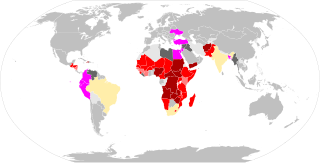
During the COVID-19 pandemic, food insecurity intensified in many places. In the second quarter of 2020, there were multiple warnings of famine later in the year. In an early report, the Nongovernmental Organization (NGO) Oxfam-International talks about "economic devastation" while the lead-author of the UNU-WIDER report compared COVID-19 to a "poverty tsunami". Others talk about "complete destitution", "unprecedented crisis", "natural disaster", "threat of catastrophic global famine". The decision of the WHO on 11 March 2020, to qualify COVID as a pandemic, that is "an epidemic occurring worldwide, or over a very wide area, crossing international boundaries and usually affecting a large number of people" also contributed to building this global-scale disaster narrative.
Events in the year 2021 in the Central African Republic.
Sam Mort is currently Chief of Communication, Advocacy and Civic Engagement for the UNICEF office in Afghanistan, based in Kabul. Afghanistan is in the midst of a Taliban offensive, where the insurgents have now taken over from the elected government. She previously announced that Unicef had made a historic deal to have girls educated in the Taliban-controlled areas of the country in 2020.
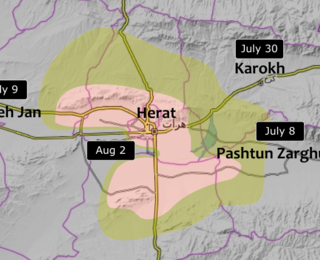
The Fall of Herat was a battle and subsequent capture of Herat by Taliban fighters. The attack on the city started around 28 July 2021, and ended in Taliban victory by 13 August of the same year. Several of the surrounding districts fell to the Taliban from June to mid-July, leaving only the city and two other districts in government hands by 10 July. The border crossings in Herat Province were captured by the Taliban on 9 July, raising prices of goods inside the city. Ismail Khan, former governor and warlord, led a public uprising force to assist the Afghan National Security Forces in defending the city.
On 15 August 2021, the city of Kabul, the capital of the Islamic Republic of Afghanistan, was captured by Taliban forces during the 2021 Taliban offensive, concluding the War in Afghanistan that began in 2001. The fall of Kabul provoked a range of reactions across the globe, including debates on whether to recognize the Taliban as the government of Afghanistan, on the humanitarian situation in the country, on the outcome of the War, and the role of military interventionism in world affairs.

Welcome.US is a nonprofit organization that coordinates the support of Afghan refugees in the United States.