
Assaf Atchildi (Born 29 April 1898 - Died 1981) was a Bukharan and French Jewish doctor and surgeon. He is credited for risking his own life and saving over 300 Jews in Nazi-occupied France. [1]
Assaf Atchildi (Born 29 April 1898 - Died 1981) was a Bukharan and French Jewish doctor and surgeon. He is credited for risking his own life and saving over 300 Jews in Nazi-occupied France. [1]
Born in Samarkand (present day Uzbekistan) Assaf Atchildi moved to Moscow to study medicine at the University of Moscow. During his time in Russia, the Russian revolution occurred and he was considered a sympathizer. He was subsequently arrested and sent to a Siberia prison. His father became ill and he was granted a pass to visit him in Uzbekistan, once there he fled to Paris, France to continue his studies. [2]
In the early 1920s he enrolled in the medical department at the University of Paris and completed is doctoral degree in 1928. [3]
He then became an internal medicine specialist and performed surgeries in Paris and Vichy. While there he married Alexandra and they had two daughters Dora and Elvire. He also became the president of the Bukharian community. [2]
Atchildi completed research as part of his doctorial theses in treatments for smallpox. [3] He also published multiple other research concerning various medical treatments for different diseases. [3] [4] [5] [6]
During the Second World War when Germany took over France, Atchildi never registered with the Nazis at the behest of his wife. They instead convinced officials that Jews from Bukhara were Jugutis, a made-up term that depicts Persians who practice the faith but are ethnically different, as determine by the Nazis. Atchildi along with Abdol Hossein Sardari an Iranian consul submitted documents to Nazi officials for the entire Bukharian Jewish community. This heroism saved the entire french Bukaharian Jewish community. [7]
In 1941, six Jugutis who had registered with the police had been arrested and most of them were imprisoned in Drancy internment camp outside Paris. Using a German attestation to the Prefect of Police in Paris in early February 1942 that Jugutis were not to be subjected to Vichy's anti-Jewish laws, Atchildi was able to obtain the release of two of the prisoners from Drancy. [8]
After the war, Atchildi moved to Vichy where he continued his practise until is retirement in the 1960s.
Thereafter, he wrote his memoir in 1967 which is featured within the Yad Vashem Holocaust Memorial. He wrote "The date of November 9, 1941 remains in my memory as a very happy day in my life, a day on which I learned that my existence in the world was meaningful inasmuch as I had successfully protected the members of my community in the darkest days of their lives". [9]
Atchildi was awarded the Medal of the City of Paris (French: Médaille de la Ville de Paris) for his efforts in the war. [10]
In 2011, B'nai B'rith World Center bestowed the Jewish Rescuer's Citation [11] on Dr.Assaf Atchildi's daughter Dora Aftergood in honor of her fathers heroism during Nazi-occupied France. The Jewish Rescuer's Citation recognizes Jews who endangered themselves to rescue and protect others during Nazi occupation. [12]
In 2022, Eve Weinberg published her and her family's memoir which featured their story and how Dr. Atchildi aided in their survival. [13]
In 2023, the Here to Tell: Faces of Holocaust Survivors [14] launched at the glenbow museum in Calgary, Alberta. It features a movie, book and exhibition, telling the stories of living and deceased Holocaust survivors, Atchildi and his daughter Dora Aftergood are featured. The exhibit will be traveling to other cities within Canada later in 2024. The content has been praised and well received. [15]
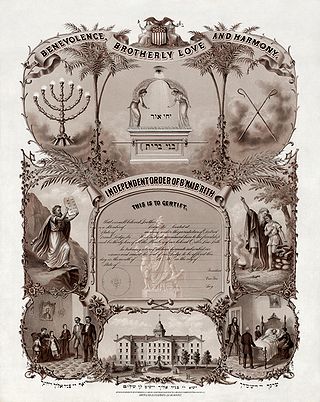
B'nai B'rith International is a 501(c)(3) nonprofit Jewish service organization and was formerly a German Jewish cultural association. B'nai B'rith states that it is committed to the security and continuity of the Jewish people and the State of Israel and combating antisemitism and other forms of bigotry.

Alois Brunner was an Austrian officer who held the rank of SS-Hauptsturmführer (captain) during World War II. Brunner played a significant role in the implementation of the Holocaust through rounding up and deporting Jews in occupied Austria, Greece, Macedonia, France, and Slovakia. He was known as Final Solution architect Adolf Eichmann's right-hand man.

B'nai Brith Canada is a Canadian Jewish service organization and advocacy group. It is the Canadian chapter of B'nai B'rith International and has offices in Toronto, Winnipeg, Montreal, and Vancouver.

The Bukharan Jews, in modern times called the Bukharian Jews, are the Mizrahi Jewish sub-group of Central Asia that historically spoke Bukharian, a Judeo-Persian dialect of the Tajik language, in turn a variety of the Persian language. Their name comes from the former Central Asian Emirate of Bukhara, which once had a sizable Jewish population. Bukharan Jews are of Persian-Jewish ancestry, though they are considered one of the oldest ethno-religious groups of Central Asia and over the centuries developed their own distinct customs.

Drancy internment camp was an assembly and detention camp for confining Jews who were later deported to the extermination camps during the German occupation of France during World War II. Originally conceived and built as a modernist urban community under the name La Cité de la Muette, it was located in Drancy, a northeastern suburb of Paris, France.

Namık Kemal Yolga (1914–2001) was a Turkish diplomat and statesman. During World War II, Yolga was the Vice-Consul at the Turkish Embassy in Paris, France. He claimed to have saved the lives of Turkish Jews from the Nazis but this has been challenged due to lack of evidence. In fact, evidence suggests that Yolga was actually instrumental in stripping France-born Turkish Jews of citizenship, which could have saved them from the Holocaust. He has been given a national award by the Turkish government and a Jewish foundation in Turkey.
Julius Davidovich Brutzkus or Judah Loeb Brutzkus or Joselis Bruckus was a Lithuanian Jewish historian, scholar, and politician, and one of the leaders of Zionist movement in Russian Empire.

Numerous internment camps and concentration camps were located in France before, during and after World War II. Beside the camps created during World War I to intern German, Austrian and Ottoman civilian prisoners, the Third Republic (1871–1940) opened various internment camps for the Spanish refugees fleeing the Spanish Civil War (1936–1939). Following the prohibition of the French Communist Party (PCF) by the government of Édouard Daladier, they were used to detain communist political prisoners. The Third Republic also interned German anti-Nazis.
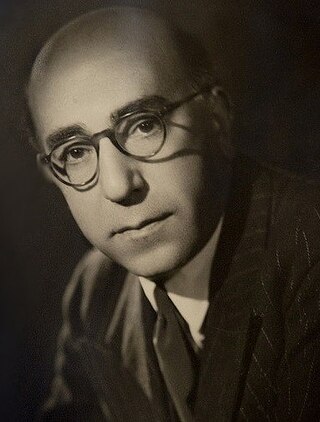
Abdol Hossein Sardari was an Iranian diplomat. He is credited with saving thousands of Jews in Europe. He has since been known as "The Iranian Schindler" or "The Schindler of Iran".
On three cases, entire countries resisted the deportation of their Jewish population during the Holocaust. In other countries, notable individuals or communities created resistance during the Holocaust which helped the Jews escape some concentration camps.

Zero Degree Turn or Zero Degree Latitude is a 2007 television series, made through the cooperation of Iran, Hungary, France, and Lebanon. The program was one of the most expensive and elaborate ever produced by Iran and attracted a large audience there. It is inspired by a real-life story about Iranian diplomat Abdol Hossein Sardari, who saved Jews in 1940s Paris during the Nazi Occupation by giving out Iranian passports and allowing them refuge in the Iranian Embassy. Although it has been noted that neither character names nor the story are close to Sardari's story.
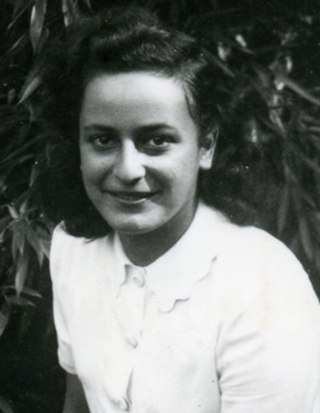
Hélène Berr was a French woman of Jewish ancestry and faith, who documented her life in a diary during the time of Nazi occupation of France. In France she is considered to be a "French Anne Frank". She died from typhus during an epidemic of the disease in Bergen-Belsen concentration camp that also killed Anne Frank and her sister Margot.

Ottó Komoly was a Hungarian Jewish engineer, officer, Zionist, and humanitarian leader in Hungary. He is credited with saving thousands of Jewish children during the German occupation of Budapest in World War II. He was called a pacifier and unifier by nature by Randolph Braham who did everything possible to put an end to the perennial conflicts within and among the various Zionist groups and organizations.
Antisemitism in Canada is the manifestation of hostility, prejudice or discrimination against the Canadian Jewish people or Judaism as a religious, ethnic or racial group. This form of racism has affected Jews since Canada's Jewish community was established in the 18th century.
A number of Arabs and Muslims participated in efforts to help save Jewish residents of Arab lands from the Holocaust while fascist regimes controlled the territory. From June 1940 through May 1943, Axis powers, namely Germany and Italy, controlled large portions of North Africa. Approximately 1 percent of the Jewish residents, about 4,000 to 5,000 Jews, of that territory were murdered by these regimes during this period. The relatively small percentage of Jewish casualties, as compared to the 60 percent of European Jews who were murdered during the Holocaust, is largely due to the successful Allied North African Campaign and the repelling of the Axis powers from North Africa.

The Holocaust in France was the persecution, deportation, and annihilation of Jews between 1940 and 1944 in occupied France, metropolitan Vichy France, and in Vichy-controlled French North Africa, during World War II. The persecution began in 1940, and culminated in deportations of Jews from France to Nazi concentration camps in Nazi Germany and Nazi-occupied Poland. The deportation started in 1942 and lasted until July 1944. Of the 340,000 Jews living in metropolitan/continental France in 1940, more than 75,000 were deported to death camps, where about 72,500 were murdered.
The Center for Contemporary Jewish Documentation was an independent French organization founded by Isaac Schneersohn in 1943 in the town of Grenoble, France during the Second World War to preserve the evidence of Nazi war crimes for future generations. Upon the Liberation of France, the center was moved to Paris. In 2005 it fused with the Mémorial de la Shoah.

The General Union of French Israelites was a body created by the antisemitic French politician Xavier Vallat under the Vichy regime after the Fall of France in World War II. UGIF was created by decree on 29 November 1941 following a German request, for the express purpose of enabling the discovery and classification of Jews in France and isolating them both morally and materially from the rest of the French population. It operated in two zones: the northern zone, chaired by André Baur, and the southern zone, under the chairmanship of Raymond-Raoul Lambert.
B'nai B'rith in Europe, a regional division of B'nai B'rith, an international Jewish social service organization. The first B'nai B'rith lodge ever established outside of the United States was in Berlin in 1882. A central entity known as B'nai B'rith was established in 1999. Activities of the central B'nai B'rith Europe include co-organizing the European Day of Jewish Culture. The event was originally a 1996 initiative known as European Jewish Heritage Day and was launched by B'nai B'rith Europe in France.
Vichy syndrome is a term used to describe the guilt, denial and shame of French people regarding the actions of Vichy France. It was coined by historian Henry Rousso in his book The Vichy Syndrome (1987), wherein Vichy and the state collaboration of France remains a "past that doesn't pass away". Historiographical debates are still passionate and oppose different views on the nature and legitimacy of Vichy's collaborationism with Germany in the implementation of the Holocaust.