
Konstantin Ustinovich Chernenko was a Soviet politician and the seventh General Secretary of the Communist Party of the Soviet Union. He briefly led the Soviet Union from 1984 until his death a year later.
This section of the timeline of United States history concerns events from 1930 to 1949.

Benjamin Sumner Welles was an American government official and diplomat. He was a major foreign policy adviser to President Franklin D. Roosevelt and served as Under Secretary of State from 1936 to 1943,during Roosevelt's presidency.

Gerardo Machado y Morales was a general of the Cuban War of Independence and President of Cuba from 1925 to 1933.
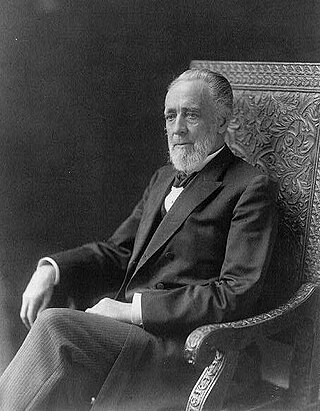
Henry Moore Teller was an American politician from Colorado,serving as a U.S. senator between 1876–1882 and 1885–1909,also serving as Secretary of the Interior between 1882 and 1885. He strongly opposed the Dawes Act,intended to break up communal Native American lands and force assimilation of the people,accurately stating that it was directed at forcing the Indians to give up their land so that it could be sold to white settlers. Among his most prominent achievements was authoring the Teller Amendment which definitively stated that,following the Spanish–American War,the United States would not annex Cuba,rather that the purpose of their involvement would be to help it gain independence from Spain.

Cornelius Newton Bliss was an American merchant,politician and art collector,who served as Secretary of the Interior in the administration of President William McKinley and as Treasurer of the Republican National Convention in four successive campaigns.

Frank Comerford Walker was an American lawyer and politician. He was the United States Postmaster General from 1940 until 1945,and the chairman of the Democratic National Committee from 1943 until 1944.
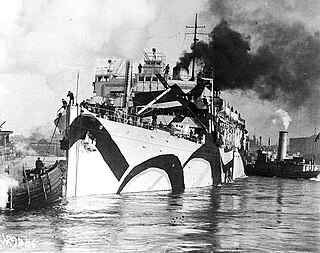
USS Orizaba (ID-1536/AP-24) was a transport ship for the United States Navy in both World War I and World War II. She was the sister ship of Siboney but the two were not part of a ship class. In her varied career,she was also known as USAT Orizaba in service for the United States Army,and as SS Orizaba in interwar civilian service for the Ward Line,and as Duque de Caxias (U-11) as an auxiliary in the Brazilian Navy after World War II.

Amadeo Roldán y Gardes was a Cuban composer and violinist. Roldán was born in Paris to a Cuban mulatta and a Spanish father. It was his mother,the pianist Albertina Gardes,who initiated her children to music.

Paul Martin Pearson was a college professor,author,editor of journals,the first civilian Governor of the United States Virgin Islands and Quaker.

Warren Delano Robbins was an American diplomat and first cousin of President Franklin D. Roosevelt. He served as Chief of Protocol of the United States from 1931 to 1933 and as the U.S. Minister to El Salvador and United States Ambassador to Canada from 1933 to 1935.

Carlos Hevia y de los Reyes-Gavilan was the interim President of Cuba,serving for less than three days. During the third week of 1934,Hevia was President from 5:00 p.m. on Monday,January 15,until 1:20 a.m. on Thursday,January 18. Cuban junta leader Fulgencio Batista had obtained the resignation of Hevia's predecessor,Ramón Grau. The choice of Hevia was unpopular with the military,and by Wednesday,the new President was asked to resign. He was replaced by Manuel Márquez Sterling.
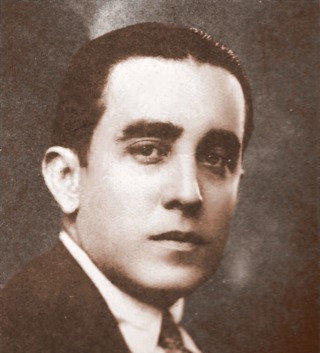
Miguel Mariano Gómez y Arias was a Cuban politician who served as the seventh President of Cuba for just over eight months in 1936. Compared to other administrations,there was general peace and tranquillity in Cuba during Gómez's brief presidency. It is claimed that he was a talented orator and writer,and the opposite of the typical "man on a horseback" attributed to previous Cuban Presidents with military backgrounds.

Gouverneur Morris Jr. was an American railroad executive and the son of a founding father of the United States,Gouverneur Morris.

Somerville Pinkney Tuck Jr. was an American diplomat.

Eloy Gutiérrez Menoyo was a revolutionary who led the guerrilla force Second National Front of Escambray during the Cuban Revolution against Fulgencio Batista and later opposed the government of Fidel Castro over its pro-Soviet leanings. His brother Carlos Gutiérrez Menoyo died in the Presidential Palace attack of March 13,1957.
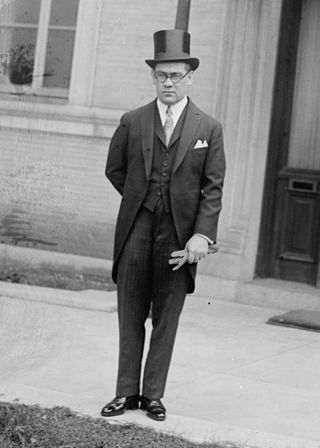
Manuel C. Téllez Acosta was a Mexican politician and diplomat who served as Secretary of the Interior (1931–1932),Secretary of Foreign Affairs (1932–1934),Ambassador of Mexico to the United States (1925–1931),and plenipotentiary diplomatic envoy to Italy and Hungary (1934–1935).

Cuban silver certificates were banknotes issued by the Cuban government between 1934 and 1949. Prior and subsequent issues of Cuban banknotes were engraved and printed by nongovernmental private bank note companies in the United States,but the series from 1934 to 1949 were designed,engraved,and printed by the US government at the Bureau of Engraving and Printing (BEP).
The following events occurred in January 1934:
Sergio Carbó was a prominent Conservative journalist and leader of the Cuban Revolutionary party.


