
The City of Banyule is a local government area in Victoria, Australia in the north-eastern suburbs of Melbourne. It was created under the Local Government Act 1989 and established in 1994 as an amalgamation of former councils. It has an area of 63 square kilometres (24.3 sq mi) and lies between 7 and 21 km from central Melbourne. In 1994 it had a population of 116,000. In June 2018 Banyule had a population of 130,237. The Yarra River runs along the City's southern border while its western border is defined by Darebin Creek.
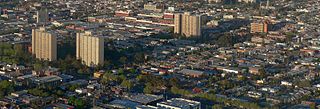
Collingwood is an inner-city suburb in Melbourne, Victoria, Australia, 3km north-east of the Melbourne central business district, located within the City of Yarra local government area. Collingwood recorded a population of 9,179 at the 2021 census.

Toorak is a suburb of Melbourne, Victoria, Australia, 5 km (3.1 mi) south-east of Melbourne's Central Business District, located within the City of Stonnington local government area. Toorak recorded a population of 12,817 at the 2021 census.
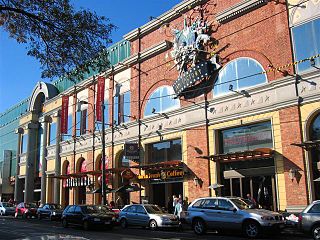
The Jam Factory was a shopping and entertainment centre, located in Chapel Street, South Yarra, a suburb of Melbourne, Australia. The Jam Factory is owned by Newmark Capital. It is also the headquarters of Village Roadshow.

South Geelong, also referred to as Geelong South, is a southern suburb of Geelong, Victoria, Australia. Its local government area is the City of Greater Geelong. At the 2016 census, South Geelong had a population of 993.
Nahum Barnet was an architect working in Melbourne, Victoria, Australia during the Victorian and Edwardian periods, best known for his extensive legacy of commercial buildings in Melbourne's CBD, as well as his last design, the Melbourne Synagogue.

Victoria Street is one of the major thoroughfares of inner Melbourne, running east–west for over six kilometres between Munster Terrace in North Melbourne and the Yarra River. The road is known as Victoria Parade for over one-and-a-half kilometres of its length, distinguishable with a wide reservation and tramway down the middle.

The Capitol is a theatre on Swanston Street in the central business district (CBD) of Melbourne, Victoria, Australia. Opened in 1924 as part of the Capitol House building, the theatre was designed by American husband and wife architects Walter Burley Griffin and Marion Mahony Griffin. It is the oldest of Melbourne's large picture palaces and is known for its extravagant decor and abstract motifs, including an intricate geometric ceiling containing thousands of coloured lights designed to evoke the walls of a crystalline cave.

The Athenaeum or Melbourne Athenaeum at 188 Collins Street is an art and cultural hub in the central business district of Melbourne, Victoria, Australia. Founded in 1839, it is the city's oldest cultural institution.
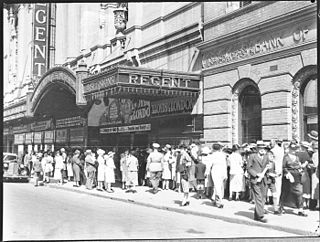
The Regent Theatre was a heritage-listed cinema and entertainment venue in George Street, Sydney, New South Wales, Australia, built in 1928 as a flagship for Hoyts, and was demolished in 1988 by property developer Leon Fink.

Regent Theatre was a heritage-listed cinema at 167 Queen Street, Brisbane, Australia. It was designed by Richard Gailey, Charles N Hollinshed and Aaron Bolot and built from 1928 to 1929 by J & E L Rees and A J Dickenson. It was one of the original Hoyts' Picture Palaces from the 1920s. It is also known as Regent Building. The auditorium interior was largely lost when it was converted into a 4 screen complex in 1979–1980, but the building, including the surviving entrance and main foyer, was added to the Queensland Heritage Register on 21 October 1992.
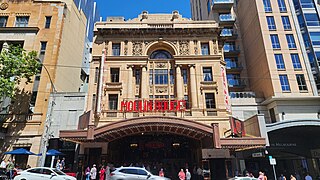
The Regent Theatre is an historic former picture palace built in 1929, closed in 1970, and restored and reopened in 1996 as a live theatre in Collins Street, in the city of Melbourne, Australia. It is one of six city theatres collectively known as Melbourne's East End Theatre District. Designed by Cedric Heise Ballantyne in an ornately palatial style, with a Gothic style lobby, Louis XVI style auditorium, and the Spanish Baroque style Plaza Ballroom in the basement, it is listed by the National Trust of Australia and is on the Victorian Heritage Register.
Wallis Cinemas, formerly Wallis Theatres, is a family-owned South Australian company that operates cinema complexes in greater Adelaide and regional South Australia.

The former Plaza Theatre in Sydney, New South Wales is a heritage-listed building designed as a 2000-seat cinema by Eric Heath for the Hoyts Group, and opened in 1930. It is no longer used as a cinema.
The Regal Theatre, formerly known as the Chelsea Cinema, the Princess Theatre and the Ozone Marryatville or Marryatville Ozone Theatre, is a single-screen cinema in Kensington Park, a suburb of Adelaide, South Australia. Originally built in 1925 to the designs of South Australian theatre architect Christopher Arthur Smith, it retains the features of a major renovation in Art Deco style in 1941 designed by noted cinema architect F. Kenneth Milne. It was heritage-listed on the South Australian Heritage Register in 1983. It is the oldest continuously running purpose-built cinema in Adelaide, and the only remaining silent cinema still operating in the city. It is owned by Burnside Council.

Johnston Street Bridge is a concrete road bridge crossing the Yarra River between the Melbourne suburbs of Abbotsford and Kew.

Harbour Esplanade is a waterfront street and thoroughfare in Docklands, an inner suburb of Melbourne, Victoria, Australia. It runs roughly north–south from Navigation Drive in the south to Docklands Drive in the north. The road also forms the eastern boundary of the Victoria Harbour inlet and is adjacent to Victoria Dock.
The Enfield Savoy Theatre was a theatre and cinema located at 306-308 Liverpool Road, Enfield, a suburb in the inner west region of Sydney, New South Wales. The building now functions as a hardware store.
Christopher Arthur Smith, also known as Chris Smith and Chris A. Smith, was a South Australian architect. He was a prolific designer of picture theatres and public buildings in Adelaide and regional South Australia during the 1920s and 1930s, and is recognised as one of the leading South Australian exponents of the Art Deco style.

Central Hall was a meeting room and theatrical hall, and later a cinema known as the Grosvenor Theatre, located at 201 Little Collins Street, in Melbourne, Australia, that operated from 1928 to 1968.


