Related Research Articles
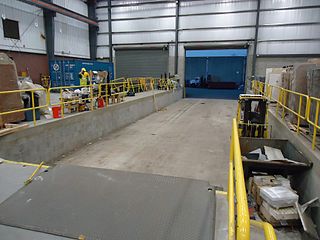
Logistics is the part of supply chain management that deals with the efficient forward and reverse flow of goods, services, and related information from the point of origin to the point of consumption according to the needs of customers. Logistics management is a component that holds the supply chain together. The resources managed in logistics may include tangible goods such as materials, equipment, and supplies, as well as food and other consumable items.
The chain of responsibility is a policy concept used in Australian transport legislation to place legal obligations on parties in the transport supply chain or across transport industries generally. The concept was initially developed to apply in the heavy vehicle industry in regulated areas such as speeding, fatigue and mass, loading and dimension. It has since spread to other transport sectors, particularly in Victoria where it has been applied in laws which apply to the rail, bus, marine and taxi industries.
Toll Group operates a logistics and global freight forwarding network spanning 150 countries, with over 20,000 customers. Toll has more than 16,000 team members across 500 sites.

The Federal Railroad Administration (FRA) is an agency in the United States Department of Transportation (DOT). The agency was created by the Department of Transportation Act of 1966. The purpose of the FRA is to promulgate and enforce rail safety regulations, administer railroad assistance programs, conduct research and development in support of improved railroad safety and national rail transportation policy, provide for the rehabilitation of Northeast Corridor rail passenger service, and consolidate government support of rail transportation activities.
Supply chain security activities aim to enhance the security of the supply chain or value chain, the transport and logistics systems for the world's cargo and to "facilitate legitimate trade". Their objective is to combine traditional practices of supply-chain management with the security requirements driven by threats such as terrorism, piracy, and theft. A healthy and robust supply chain absent from security threats requires safeguarding against disturbances at all levels such as facilities, information flow, transportation of goods, and so on. A secure supply chain is critical for organizational performance.

TAB New Zealand, previously known as the New Zealand Racing Board (NZRB) and the Racing Industry Transition Agency (RITA), is a statutory monopoly for New Zealand sports betting, including betting on horse racing and greyhound racing. It was established under the Racing Act 2003 to operate the TAB, promote the racing industry and maximise the profits of the industry. It broadcasts racing on two television channels TAB Trackside 1 and TAB Trackside 2.
The Chartered Institute of Logistics and Transport in the UK is the membership organisation for United Kingdom professionals involved in the movement of goods and people, and their associated supply chains. It is a National Council of CILT International.
Gavan McDonell is an Australian civil engineer, economist and political sociologist in the fields of national infrastructure policy reform, international development and academic education for advanced sustainability studies.

The Minister for Infrastructure, Transport, Regional Development and Local Government in the Government of Australia is a position currently held by Catherine King following the swearing in of the full Albanese ministry on 1 June 2022.

The American Trucking Associations (ATA), founded in 1933, is the largest national trade association for the trucking industry. ATA represents more than 37,000 members covering every type of motor carrier in the United States through a federation of other trucking groups, industry-related conferences, and its 50 affiliated state trucking associations. Former Governor of Kansas Bill Graves was replaced by Chris Spear as the ATA's president and CEO in July 2016.

The Regional Aviation Association of Australia (RAAA) is a non-profit organisation representing the interests of regional aviation in Australia. RAAA has approximately 100 members and 2500 employees. They Provide air transportation in Australia for more than 2 million passengers and 23 million kilograms cargo per year.

Exel was a supply chain and logistics company operating in North America and Europe, which became a subsidiary of the German firm Deutsche Post in 2005. It reported annual revenues of about $4.2 billion in February 2012.
The National Transport Commission (NTC), previously known as the National Road Transport Commission, is an Australian statutory body created to develop regulatory and operational reform for road, rail and intermodal transport.

The Rail Safety Act 2006 is a law enacted by the Parliament of the State of Victoria, Australia, and is the prime statute regulating the safety of rail operations in Victoria. The Act was developed as part of the Transport Legislation Review conducted by the Department of Transport between 2004 and 2010 and is aimed at preventing deaths and injuries arising from rail operations.
Third-party logistics is an organization's long term commitment of outsourcing its distribution services to third-party logistics businesses.
Urban freight distribution is the system and process by which goods are collected, transported, and distributed within urban environments. The urban freight system can include seaports, airports, manufacturing facilities, and warehouse/distribution centers that are connected by a network of railroads, rail yards, pipelines, highways, and roadways that enable goods to get to their destinations.
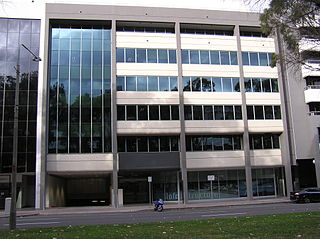
The Department of Infrastructure and Transport was an Australian government department. It was formed in September 2010, following the federal election in August 2010. The department absorbing parts of the Department of Infrastructure, Transport, Regional Development and Local Government. Regional development and local government functions were sent to the Department of Regional Australia, Regional Development and Local Government. Following the 2013 federal election, the department was renamed on 18 September 2013 to become the Department of Infrastructure and Regional Development, regaining regional development and local government functions.

Pawanexh Kohli is the founding Chief Executive of India's National Centre for Cold-chain Development (NCCD), the premier think-tank in agri-logistics set up in public-private-partnership mode in 2012, and from 2012 to 2020 was the Chief Advisor to Ministry of Agriculture & Farmers Welfare.
The Department of State Growth is a Tasmanian Government department responsible for fostering economic growth and creating job opportunities within the state. The department plays a vital role in supporting diverse and sustainable economic development, benefiting the Tasmanian community.
In commerce, global supply-chain management is defined as the distribution of goods and services throughout a trans-national companies' global network to maximize profit and minimize waste. Essentially, global supply chain-management is the same as supply-chain management, but it focuses on companies and organizations that are trans-national.
References
 | This article about a business, industry, or trade-related organization is a stub. You can help Wikipedia by expanding it. |
 | This article about an Australian corporation or company is a stub. You can help Wikipedia by expanding it. |
 | This article related to a ship transport company is a stub. You can help Wikipedia by expanding it. |