Related Research Articles
Computer vision is an interdisciplinary scientific field that deals with how computers can gain high-level understanding from digital images or videos. From the perspective of engineering, it seeks to understand and automate tasks that the human visual system can do.

Avinash C. Kak is a professor of Electrical and Computer Engineering at Purdue University who has done pioneering research in several areas of information processing. His most noteworthy contributions deal with algorithms, languages, and systems related to networks, robotics, and computer vision. Born in Srinagar, Kashmir, he was educated at College of Engineering, Guindy and Indian Institute of Technology Delhi. He joined the faculty of Purdue University in 1971.

Motion capture is the process of recording the movement of objects or people. It is used in military, entertainment, sports, medical applications, and for validation of computer vision and robotics. In filmmaking and video game development, it refers to recording actions of human actors, and using that information to animate digital character models in 2D or 3D computer animation. When it includes face and fingers or captures subtle expressions, it is often referred to as performance capture. In many fields, motion capture is sometimes called motion tracking, but in filmmaking and games, motion tracking usually refers more to match moving.
Network-centric warfare, also called network-centric operations or net-centric warfare, is a military doctrine or theory of war pioneered by the United States Department of Defense in the 1990s.
Robot learning is a research field at the intersection of machine learning and robotics. It studies techniques allowing a robot to acquire novel skills or adapt to its environment through learning algorithms. The embodiment of the robot, situated in a physical embedding, provides at the same time specific difficulties and opportunities for guiding the learning process.
Modular self-reconfiguring robotic systems or self-reconfigurable modular robots are autonomous kinematic machines with variable morphology. Beyond conventional actuation, sensing and control typically found in fixed-morphology robots, self-reconfiguring robots are also able to deliberately change their own shape by rearranging the connectivity of their parts, in order to adapt to new circumstances, perform new tasks, or recover from damage.
The ethics of artificial intelligence is the part of the ethics of technology specific to robots and other artificially intelligent beings. It can be divided into roboethics, a concern with the moral behavior of humans as they design, construct, use and treat artificially intelligent beings, and machine ethics, which is concerned with the moral behavior of artificial moral agents (AMAs). With regard to artificial general intelligences (AGIs), preliminary work has been conducted on approaches to integrating AGIs which are full ethical agents with existing legal and social frameworks. These approaches have focused on the twofold consideration of their legal position and rights.

Alexey Ivakhnenko ; was a Soviet and Ukrainian mathematician most famous for developing the Group Method of Data Handling (GMDH), a method of inductive statistical learning, for which he is sometimes referred to as the "Father of Deep Learning".
The following outline is provided as an overview of and topical guide to object recognition:
VIBOT is an abbreviation of VIsion and RoBOTics. It is a 2-year European Masters in Computer Vision and Robotics course, conducted by Heriot-Watt University in Edinburgh, Scotland, Universitat de Girona in Girona, Spain and Université de Bourgogne in Le Creusot, France. It started in 2006 as part of the European Commission's Erasmus Mundus programme.
Hartmut Neven is a scientist working in quantum computing, computer vision, robotics and computational neuroscience. He is best known for his work in face and object recognition and his contributions to quantum machine learning. He is currently Director of Engineering and Distinguished Scientist at Google where he is leading the Quantum Artificial Intelligence Lab which he founded in 2012.
The Guidance, Control and Decision Systems Laboratory (GCDSL) is situated in the Department of Aerospace Engineering, Indian Institute of Science, Bangalore, India. The Mobile Robotics Laboratory (MRL) is its experimental division. They are headed by Dr. Debasish Ghose, Full Professor.
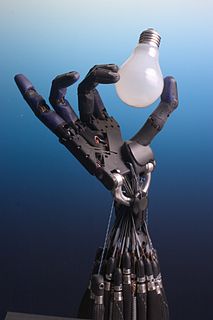
Robotics is an interdisciplinary branch of engineering and science that includes mechanical engineering, electronic engineering, information engineering, computer science, and others. Robotics involves design, construction, operation, and use of robots, as well as computer systems for their perception, control, sensory feedback, and information processing. The goal of robotics is to design intelligent machines that can help and assist humans in their day-to-day lives and keep everyone safe.
Cloud robotics is a field of robotics that attempts to invoke cloud technologies such as cloud computing, cloud storage, and other Internet technologies centred on the benefits of converged infrastructure and shared services for robotics. When connected to the cloud, robots can benefit from the powerful computation, storage, and communication resources of modern data center in the cloud, which can process and share information from various robots or agent. Humans can also delegate tasks to robots remotely through networks. Cloud computing technologies enable robot systems to be endowed with powerful capability whilst reducing costs through cloud technologies. Thus, it is possible to build lightweight, low cost, smarter robots have intelligent "brain" in the cloud. The "brain" consists of data center, knowledge base, task planners, deep learning, information processing, environment models, communication support, etc.
Visual computing is a generic term for all computer science disciplines handling with images and 3D models, i.e. computer graphics, image processing, visualization, computer vision, virtual and augmented reality, video processing, but also includes aspects of pattern recognition, human computer interaction, machine learning and digital libraries. The core challenges are the acquisition, processing, analysis and rendering of visual information. Application areas include industrial quality control, medical image processing and visualization, surveying, robotics, multimedia systems, virtual heritage, special effects in movies and television, and computer games.
The ImageNet project is a large visual database designed for use in visual object recognition software research. More than 14 million images have been hand-annotated by the project to indicate what objects are pictured and in at least one million of the images, bounding boxes are also provided. ImageNet contains more than 20,000 categories with a typical category, such as "balloon" or "strawberry", consisting of several hundred images. The database of annotations of third-party image URLs is freely available directly from ImageNet, though the actual images are not owned by ImageNet. Since 2010, the ImageNet project runs an annual software contest, the ImageNet Large Scale Visual Recognition Challenge (ILSVRC), where software programs compete to correctly classify and detect objects and scenes. The challenge uses a "trimmed" list of one thousand non-overlapping classes.

Objective Vision is a project mainly aimed at real-time computer vision and simulation vision of living creatures. it has three sections contain of an open-source library of programming functions for using inside the projects, Virtual laboratory for scholars to check the application of functions directly and by Command-line code for external and instant access, and the research section consists of paperwork and libraries to expand the scientific prove of works.

Ashutosh Saxena is an Indian-American computer scientist, researcher, and entrepreneur known for his contributions to the field of artificial intelligence and robotics. His research interests include machine learning, robotics, and 3-dimensional computer vision. Saxena is the co-founder and CEO of Caspar.AI, which is an artificial intelligence company that automates peoples' homes and builds applications such as fall detectors for senior living. Prior to Caspar.AI, Ashutosh co-founded Cognical Zibby, which provides a no credit required alternative to traditional financing for online and omni-channel retail. Before Cognical Zibby, Saxena was an assistant professor in the Computer Science Department and director of the RoboBrain Project at Cornell University.
The Robotics Collaborative Technology Alliance (R-CTA) was a research program initiated and sponsored by the US Army Research Laboratory. The purpose was to “bring together government, industrial, and academic institutions to address research and development required to enable the deployment of future military unmanned ground vehicle systems ranging in size from man-portables to ground combat vehicles.” Collaborative Technology and Research Alliances was a term for partnerships between Army laboratories and centers, private industry and academia for performing research and technology development intended to benefit the US Army. The partnerships were funded by the US Army.

Gregory D. Hager is the Mandell Bellmore Professor of Computer Science and founding director of the Johns Hopkins Malone Center for Engineering in Healthcare at Johns Hopkins University.
References
- ↑ "Robotic Vision | About Us". roboticvision.org. Retrieved 16 March 2016.
- ↑ "Amazon Robotics Challenge 2017 won by Australian". BBC News. 31 July 2017. Retrieved 14 September 2018.
- ↑ "Robotic Vision | Research". roboticvision.org. Retrieved 16 March 2016.