An eye examination is a series of tests performed by an ophthalmologist, optometrist, or orthoptist, optician (UK), assessing vision and ability to focus on and discern objects, as well as other tests and examinations pertaining to the eyes. Health care professionals often recommend that all people should have periodic and thorough eye examinations as part of routine primary care, especially since many eye diseases are asymptomatic.
An eyeglass prescription is an order written by an eyewear prescriber, such as an optometrist or ophthalmologist, that specifies the value of all parameters the prescriber has deemed necessary to construct and/or dispense corrective lenses appropriate for a patient. If an examination indicates that corrective lenses are appropriate, the prescriber generally provides the patient with an eyewear prescription at the conclusion of the exam.
Glasses, also known as eyeglasses or spectacles, are devices consisting of glass or hard plastic lenses mounted in a frame that holds them in front of a person's eyes, typically using a bridge over the nose and arms which rest over the ears.
The standard components of an automated refraction system are:
an electronic and motor driven phoropter (auto-phoropter, auto-refractor head) used to present powered lenses in front of the patient's eyes,
a hardware or software-driven controller that changes the lenses in the phoroptor for the subjective portion of the testing. A lens and prism system can also be used.
an autorefractor that measures the patient's objective refractive error, normally used as the starting point of the subjective testing,
an autolensmeter that measures the powers of the patient's current pair of glasses or contact lenses.
Phoropter is a common name for an ophthalmic testing device, also called a refractor. It is commonly used by eye care professionals during an eye examination, and contains different lenses used for refraction of the eye during sight testing, to measure an individual's refractive error and determine his or her eyeglass prescription. It also is used to measure the patients' phorias and ductions, which are characteristics of binocularity.
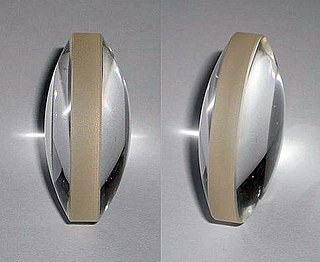
A lens is a transmissive optical device that focuses or disperses a light beam by means of refraction. A simple lens consists of a single piece of transparent material, while a compound lens consists of several simple lenses (elements), usually arranged along a common axis. Lenses are made from materials such as glass or plastic, and are ground and polished or molded to a desired shape. A lens can focus light to form an image, unlike a prism, which refracts light without focusing. Devices that similarly focus or disperse waves and radiation other than visible light are also called lenses, such as microwave lenses, electron lenses, acoustic lenses, or explosive lenses.
An eye chart is a chart used to measure visual acuity. Eye charts are often used by health care professionals, such as optometrists, physicians or nurses, to screen persons for vision impairment. Ophthalmologists, physicians who specialize in the eye, also use eye charts to monitor the visual acuity of their patients in response to various therapies such as medications or surgery.
Automated refraction systems currently on the market vary in features, level of automation, ease of use, training required and documentation. Some systems contain automatic detection and compensation of common refraction issues such as accommodation and "over-minusing". An automated refraction is quick and painless.
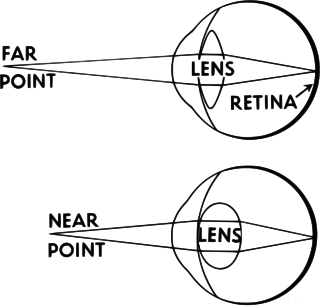
Accommodation is the process by which the vertebrate eye changes optical power to maintain a clear image or focus on an object as its distance varies. In this, distances vary for individuals from the far point—the maximum distance from the eye for which a clear image of an object can be seen, to the near point—the minimum distance for a clear image.
Some advantages of automated refraction systems vs. manual refraction equipment are:
less manual labour by the practitioner or technician
more automation of repetitive and iterative tasks in the refraction
ability to present former and new values quickly for validation
Human error has been cited as a primary cause contributing factor in disasters and accidents in industries as diverse as nuclear power, aviation, space exploration, and medicine. Prevention of human error is generally seen as a major contributor to reliability and safety of (complex) systems. Human error is one of the many contributing causes of risk events.
A paperless office is a work environment in which the use of paper is eliminated or greatly reduced. This is done by converting documents and other papers into digital form, a process known as digitization. Proponents claim that "going paperless" can save money, boost productivity, save space, make documentation and information sharing easier, keep personal information more secure, and help the environment. The concept can be extended to communications outside the office as well.
This page is based on this Wikipedia article Text is available under the CC BY-SA 4.0 license; additional terms may apply. Images, videos and audio are available under their respective licenses.
Related Research Articles
A corrective lens is a lens typically worn in front of the eye to improve vision. The most common use is to treat refractive errors: myopia, hypermetropia, astigmatism, and presbyopia. Glasses or "spectacles" are worn on the face a short distance in front of the eye. Contact lenses are worn directly on the surface of the eye. Intraocular lenses are surgically implanted most commonly after cataract removal, but can be used for purely refractive purposes.
Far-sightedness, also known as hyperopia, is a condition of the eye in which light is focused behind, instead of on, the retina. This results in close objects appearing blurry, while far objects may appear normal. As the condition worsens, objects at all distances may be blurry. Other symptoms may include headaches and eye strain. People may also experience accommodative dysfunction, binocular dysfunction, amblyopia, and strabismus.
Presbyopia is a condition associated with the aging of the eye that results in progressively worsening ability to focus clearly on close objects. Symptoms include difficulty reading small print, having to hold reading material farther away, headaches, and eyestrain. Different people will have different degrees of problems. Other types of refractive errors may exist at the same time as presbyopia.
An optical system with astigmatism is one where rays that propagate in two perpendicular planes have different foci. If an optical system with astigmatism is used to form an image of a cross, the vertical and horizontal lines will be in sharp focus at two different distances. The term comes from the Greek α- (a-) meaning "without" and στίγμα (stigma), "a mark, spot, puncture".
Anisometropia is the condition in which the two eyes have unequal refractive power. Each eye can be nearsighted (myopia), farsighted (hyperopia) or a combination of both, which is called antimetropia. Generally a difference in power of two diopters or more is the accepted threshold to label the condition anisometropia.
Refractive error, also known as refraction error, is a problem with focusing light accurately onto the retina due to the shape of the eye. The most common types of refractive error are near-sightedness, far-sightedness, astigmatism, and presbyopia. Near-sightedness results in far away objects being blurry, far-sightedness and presbyopia result in close objects being blurry, astigmatism causes objects to appear stretched out or blurry. Other symptoms may include double vision, headaches, and eye strain.
An autofocus optical system uses a sensor, a control system and a motor to focus on an automatically or manually selected point or area. An electronic rangefinder has a display instead of the motor; the adjustment of the optical system has to be done manually until indication. Autofocus methods are distinguished by their type as being either active, passive or hybrid variants.
An autorefractor or automated refractor is a computer-controlled machine used during an eye examination to provide an objective measurement of a person's refractive error and prescription for glasses or contact lenses. This is achieved by measuring how light is changed as it enters a person's eye.
Retinoscopy (Ret) is a technique to obtain an objective measurement of the refractive error of a patient's eyes. The examiner uses a retinoscope to shine light into the patient's eye and observes the reflection (reflex) off the patient's retina. While moving the streak or spot of light across the pupil the examiner observes the relative movement of the reflex or manually places lenses over the eye to "neutralize" the reflex.
A refractometer is a laboratory or field device for the measurement of an index of refraction (refractometry). The index of refraction is calculated from Snell's law while for mixtures, the index of refraction can be calculated from the composition of the material using several mixing rules such as the Gladstone–Dale relation and Lorentz–Lorenz equation.
Astigmatism is a type of refractive error in which the eye does not focus light evenly on the retina. This results in distorted or blurred vision at all distances. Other symptoms can include eyestrain, headaches, and trouble driving at night. If it occurs early in life it can result in amblyopia.
Aniseikonia is an ocular condition where there is a significant difference in the perceived size of images. It can occur as an overall difference between the two eyes, or as a difference in a particular meridian.
A pinhole occluder is an opaque disk with one or more small holes through it, used by ophthalmologists, orthoptists and optometrists to test visual acuity. The occluder is a simple way to focus light, as in a pinhole camera, temporarily removing the effects of refractive errors such as myopia. Because light passes only through the center of the eye's lens, defects in the shape of the lens have no effect while the occluder is used. In this way the ophthalmologist, orthoptist or optometrist can estimate the maximum improvement in a patient's vision that can be attained by lenses to correct errors of refraction. This can be used to distinguish visual defects caused by refractive error, which improve when the occluder is used, from other problems, which do not. The pinhole occluder can also be used in testing visual acuity in mydriatic patients. In this case the pinhole occluder compensates for the inability to contract the iris assisting the eye in obtaining a retinal projection similar to that of a non-cycloplegic eye.
Pharmacy automation involves the mechanical processes of handling and distributing medications. Any pharmacy task may be involved, including counting small objects ; measuring and mixing powders and liquids for compounding; tracking and updating customer information in databases ; and inventory management. This article focuses on the changes that have taken place in the local, or community Pharmacy since the 1960s.
Subjective Refraction is an attempt to determine, by trial and error using the patient’s cooperation, the combination of lenses that will provide the best corrected visual acuity (BCVA). It is a clinical examination used by orthoptists, optometrists and ophthalmologists to determine a patient's need for refractive correction, in the form of glasses or contact lenses.
The aim is to improve current unaided vision or vision with current glasses. Glasses must also be comfortable visually. The sharpest final refraction is not always the final script the patient wears comfortably.
A device, used for measuring spherical and/or cylindrical prescription for eyeglasses, from the middle of the 18th century until around 1922, when modern instruments were developed. The term, coined in 1738 by W. Porterfield to describe his Scheiner slit optometer, and used for 200 years to describe many different inventions to measure refractive error of the eye, has completely fallen out of usage today as the task of measuring eyes for spectacles is done with modern instruments, such as the phoropter.