Footnotes
- ↑ Dictionary of Greek and Roman Biography and Mythology , William Smith, Editor.
- ↑ Dictionary of Greek and Roman Biography and Mythology , William Smith, Editor.
- ↑ Fasti Capitolini .
- ↑ Appianus, The Illyrian Wars, 28.

The gens Autronia was a plebeian family at Rome. Persons of this gens first came into notice in the last century of the Republic; the first member who obtained the consulship was Publius Autronius Paetus, in 65 BC. [1]
The only surname of the Autronii was Paetus, a cognomen in many other gentes. It originally signified a person who had a slight cast in the eye, but it did not indicate such a complete distortion of vision as Strabo. [2]
The gens Fulvia, originally Foulvia, was one of the most illustrious plebeian families at ancient Rome. Members of this gens first came to prominence during the middle Republic; the first to attain the consulship was Lucius Fulvius Curvus in 322 BC. From that time, the Fulvii were active in the politics of the Roman state, and gained a reputation for excellent military leaders.

The gens Mamilia was a plebeian family at Rome during the period of the Republic. The gens was originally one of the most distinguished families of Tusculum, and indeed in the whole of Latium. It is first mentioned in the time of the Tarquins; and it was to a member of this family, Octavius Mamilius, that Lucius Tarquinius Superbus, the seventh and last King of Rome, betrothed his daughter. The gens obtained Roman citizenship in the 5th century BC, and some of its members must subsequently have settled at Rome, where Lucius Mamilius Vitulus became the first of the family to hold the consulship in 265 BC, the year before the First Punic War.
Publius Autronius Paetus was a politician of the late Roman Republic who was involved in the conspiracy of Catiline.

The gens Aquillia or Aquilia was a plebeian family of great antiquity at ancient Rome. Two of the Aquillii are mentioned among the Roman nobles who conspired to bring back the Tarquins, and a member of the house, Gaius Aquillius Tuscus, was consul in 487 BC.
The gens Aebutia was a Roman family that was prominent during the early Republic. The gens was originally patrician, but also had plebeian branches. The first member to obtain the consulship was Titus Aebutius Helva, consul in 499 BC.
The gens Aelia, occasionally written Ailia, was a plebeian family in Rome, which flourished from the fifth century BC until at least the third century AD, a period of nearly eight hundred years. The archaic spelling Ailia is found on coins, but must not be confused with Allia, which is a distinct gens. The first member of the family to obtain the consulship was Publius Aelius Paetus in 337 BC.
Lucius Manlius Torquatus was a Consul of the Roman Republic in 65 BC, elected after the condemnation of Publius Cornelius Sulla and Publius Autronius Paetus.
The gens Alfena or Alfenia was a Roman family, known from the first century BC to the first century AD. The gens is known chiefly from five individuals, two of whom attained the consulship. Three shared the cognomen Varus, and may have been closely related.
The gens Apronia was a plebeian family at Rome throughout the history of the Republic and into imperial times. The first member of the gens to achieve prominence was Gaius Apronius, tribune of the plebs in 449 BC. None of the Apronii obtained the consulship until the first century AD.
The gens Apustia was a plebeian family at Rome during the period of the Republic. The first member of this gens who obtained the consulship was Lucius Apustius Fullo, in 226 BC.
The gens Atia, sometimes written Attia, was a plebeian family at Rome. The first of the gens to achieve prominence was Lucius Atius, a military tribune in 178 BC. Several of the Atii served in the Civil War between Caesar and Pompeius. The gens Attia may be identical with this family, although the individuals known by that name lived nearly a century after the more notable Atii, and are not known to have been related.
The gens Caesennia was an Etruscan family from Tarquinii during the late Republic and in imperial times. Two of its members were mentioned by Cicero, and the name is found in sepulchral inscriptions.

The gens Hostilia was an ancient family at Rome, which traced its origin to the time of Romulus. The most famous member of the gens was Tullus Hostilius, the third King of Rome; however, all of the Hostilii known from the time of the Republic were plebeians. Several of the Hostilii were distinguished during Punic Wars. The first of the family to obtain the consulship was Aulus Hostilius Mancinus in 170 BC.
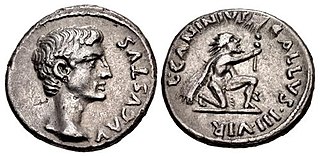
The gens Caninia was a plebeian family at Rome during the later Republic. The first member of the gens who obtained any of the curule offices was Gaius Caninius Rebilus, praetor in 171 BC; but the first Caninius who was consul was his namesake, Gaius Caninius Rebilus, in 45 BC.

The gens Pomponia was a plebeian family at Rome. Its members appear throughout the history of the Roman Republic, and into imperial times. The first of the gens to achieve prominence was Marcus Pomponius, tribune of the plebs in 449 BC; the first who obtained the consulship was Manius Pomponius Matho in 233 BC.

The gens Sestia was a family at Rome. The gens was originally patrician, but in later times there were also plebeian members. The only member of the family to obtain the consulship under the Republic was Publius Sestius Capitolinus Vaticanus, in 452 BC.
The gens Sextia was a plebeian family at Rome, from the time of the early Republic and continuing into imperial times. The most famous member of the gens was Lucius Sextius Lateranus, who as tribune of the plebs from 376 to 367 BC, prevented the election of the annual magistrates, until the passage of the lex Licinia Sextia, otherwise known as the "Licinian Rogations," in the latter year. This law, brought forward by Sextius and his colleague, Gaius Licinius Calvus, opened the consulship to the plebeians, and in the following year Sextius was elected the first plebeian consul. Despite the antiquity of the family, only one other member obtained the consulship during the time of the Republic. Their name occurs more often in the consular fasti under the Empire.
The gens Verginia or Virginia was a prominent family at Rome, which from an early period was divided into patrician and plebeian branches. The gens was of great antiquity, and frequently filled the highest honors of the state during the early years of the Republic. The first of the family who obtained the consulship was Opiter Verginius Tricostus in 502 BC, the seventh year of the Republic. The plebeian members of the family were also numbered amongst the early tribunes of the people.
The gens Castrinia or Castronia was a Roman family during the late Republic. It is best known a single individual, Lucius Castrinius Paetus, mentioned in a letter from Marcus Caelius Rufus to Cicero in 51 BC. He is probably the same person as Lucius Castronius Paetus, the leading man in the municipium of Luca, whom Cicero recommended to Brutus in 46 BC.
The gens Villia was a plebeian family at Rome. Its members are mentioned in the first century of the Republic, but the only Villius who obtained the consulship was Publius Villius Tappulus, in BC 199.