
Fire is the rapid oxidation of a material in the exothermic chemical process of combustion, releasing heat, light, and various reaction products. At a certain point in the combustion reaction, called the ignition point, flames are produced. The flame is the visible portion of the fire. Flames consist primarily of carbon dioxide, water vapor, oxygen and nitrogen. If hot enough, the gases may become ionized to produce plasma. Depending on the substances alight, and any impurities outside, the color of the flame and the fire's intensity will be different.

Canadian literature is the literature of a multicultural country, written in languages including Canadian English, Canadian French, and Indigenous languages. Influences on Canadian writers are broad both geographically and historically, representing Canada's diversity in culture and region.

Francis Parkman Jr. was an American historian, best known as author of The Oregon Trail: Sketches of Prairie and Rocky-Mountain Life and his monumental seven-volume France and England in North America. These works are still valued as historical sources and as literature. He was also a leading horticulturist, briefly a professor of horticulture at Harvard University and author of several books on the topic. Parkman wrote essays opposed to legal voting for women that continued to circulate long after his death. Parkman was a trustee of the Boston Athenæum from 1858 until his death in 1893.
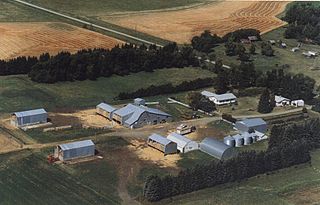
The Canadian Prairies is a region in Western Canada. It includes the Canadian portion of the Great Plains and the Prairie provinces, namely Alberta, Saskatchewan, and Manitoba. These provinces are partially covered by grasslands, plains, and lowlands, mostly in the southern regions. The northernmost reaches of the Canadian Prairies are less dense in population, marked by forests and more variable topography. If the region is defined to include areas only covered by prairie land, the corresponding region is known as the Interior Plains. Physical or ecological aspects of the Canadian Prairies extend to northeastern British Columbia, but that area is not included in political use of the term.
Stephen J. Pyne (1949–present) is an emeritus professor at Arizona State University, specializing in environmental history, the history of exploration, and especially the history of fire.

The great bison belt is a tract of rich grassland that ran from Alaska to the Gulf of Mexico from around 9000 BC. The great bison belt was supported by spring and early summer rainfall that allowed short grasses to grow. These grasses retain their moisture at the roots which allowed for grazing ungulates such as bison to find high-quality nutritious food in autumn.
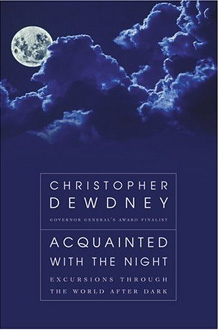
Acquainted with the Night: Excursions through the World After Dark is a non-fiction book by Christopher Dewdney about various aspects of night. It was first published in 2004 by HarperCollins. It uses the same title as the Robert Frost poem "Acquainted with the Night". The book consists of 14 chapters, with one chapter dedicated to each hour of the night, from 6 pm to 5 am. Mini-essays populate each chapter which each follow a theme, like nocturnal creatures, dreams, astronomy, and mythology. Other subjects and topics touched upon include science, art, culture, natural history, superstitions, and psychology. The book was a finalist for the 2004 Governor General's Awards and for the 2005 Charles Taylor Prize. It tied with Dark Matter: Reading The Bones for the World Fantasy Award in Anthologies.
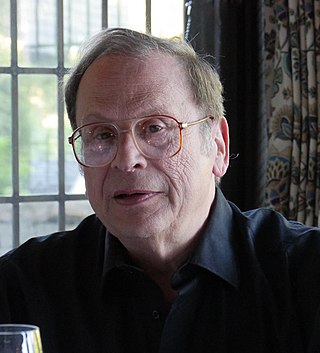
Keith Maillard is a Canadian-American novelist, poet, and professor of creative writing at the University of British Columbia. He moved to Canada in 1970 and became a Canadian citizen in 1976.

Chinchaga is a river in north-western Alberta. It is a tributary of the Hay River. Through the Hay River, its waters are carried to the Arctic Ocean via Great Slave Lake and Mackenzie River. The name Chinchaga is First Nations, and means "Big Wood River". Much of the Chinchaga watershed burned in 1950 during the Chinchaga fire.
Canadian Literature is a quarterly peer-reviewed journal of criticism and review, founded in 1959 and owned by the University of British Columbia. The journal publishes articles of criticism and reviews about Canadian literature in English and French by Canadian and international scholars. It also publishes around 24 original poems a year and occasional interviews with writers. Each issue contains an extensive book reviews section. Rather than focusing on a single theoretical approach, Canadian Literature contains articles on all subjects relating to writers and writing in Canada. Each issue contains content from a range of contributors, and the journal has been described as "critically eclectic".
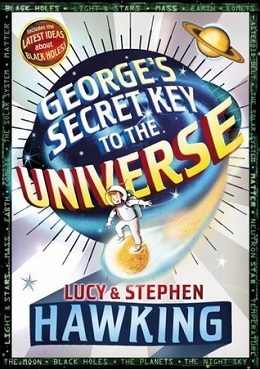
George's Secret Key to the Universe is a 2007 children's book written by Lucy and Stephen Hawking with Christophe Galfard. Upon its release, the book received mixed reviews, and was followed by five sequels, George's Cosmic Treasure Hunt in 2009, George and the Big Bang in 2011, George and the Unbreakable Code in 2014 and George and the Blue Moon in 2016 and George and the Ship of Time in 2018.
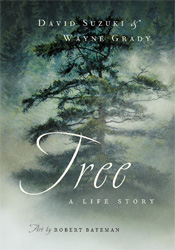
Tree: A Life Story is a Canadian non-fiction book written by David Suzuki and Wayne Grady, and illustrated by Robert Bateman. The book profiles the life of a Douglas-fir tree, from seed to maturity to death. The story provides ecological context by describing interactions with other lifeforms in the forest and historical context through parallels with world events that occur during the tree's 700 years of life. Digressions from the biographical narrative, scattered throughout the book, provide background into related topics, such as the history of botany.

The Cundill History Prize is an annual Canadian book prize for "the best history writing in English". It was established in 2008 by Peter Cundill and is administered by McGill University. The prize encourages "informed public debate through the wider dissemination of history writing to new audiences around the world" and is awarded to an author whose book, published in the past year, demonstrates "historical scholarship, originality, literary quality and broad appeal". No restrictions are set on the topic of the book or the nationality of the author, and English translations are permitted.
The Chinchaga fire, also known as the Wisp fire, Chinchaga River fire and Fire 19, was a forest fire that burned in northern British Columbia and Alberta in the summer and early fall of 1950. With a final size of between 1,400,000 hectares and 1,700,000 hectares, it is the single largest recorded fire in North American history. The authorities allowed the fire to burn freely, following local forest management policy considering the lack of settlements in the region. The Chinchaga fire produced large amounts of smoke, creating the "1950 Great Smoke Pall", observed across eastern North America and Europe. As the existence of the massive fire was not well-publicized, and the smoke was mostly in the upper atmosphere and could not be smelled, there was much speculation about the atmospheric haze and its provenance. The Chinchaga firestorm's "historic smoke pall" caused "observations of blue suns and moons in the United States and Europe". It was the biggest firestorm documented in North America, and created the world's largest smoke layer in the atmosphere.
David Hamilton Stouck is a Canadian literary critic and biographer, formerly Professor of English at Simon Fraser University.
Tanis MacDonald is a Canadian poet, professor, reviewer, and writer of creative non-fiction. She is Professor at Wilfrid Laurier University with specialities in Canadian literature, women’s literature, and the elegy. She is the author of four books of poetry and one scholarly study, the editor of a selected works, and the founder of the Elegy Roadshow.
Alan Twigg, CM has received the Order of Canada, as a prolific journalist, historian, biographer, website-builder, film maker, community-builder and athlete. He created Canada's most-read, independent publication about books, BC Bookworld, a trade newspaper for the British Columbia book publishing industry and served as its publisher and main writer for thirty-three years until he gave the business away in 2020. He also founded or co-founded many of the province's major literary awards. When he was accorded an honorary doctorate by Simon Fraser University in 2022, SFU described him as British Columbia's leading man of letters. He also developed ABCBookWorld, an online encyclopedia of British Columbia authors. He is also a recipient of the Lieutenant Governor's Award for Literary Excellence in 2016.
Fire history, the ecological science of the study of the history of wildfires, is a subdiscipline of fire ecology. Patterns of forest fires in historical and prehistorical time provide information relevant to the pattern of vegetation in modern landscapes. It provides an estimate of the historical range of variability of a natural disturbance regime, and can be used to identify the processes affecting the occurrence of fire. Fire history reconstructions are achieved by compiling atlases of past fires, using the tree ring record from fire scars and tree ages, and the charcoal record from soils and sediments.
Mennonite literature emerged in the mid-to-late 20th century as both a literary movement and a distinct genre. Mennonite literature refers to literary works created by or about Mennonites.
