
A smartphone is a portable device that combines mobile telephone and computing functions into one unit. They are distinguished from feature phones by their stronger hardware capabilities and extensive mobile operating systems, which facilitate wider software, internet, and multimedia functionality, alongside core phone functions such as voice calls and text messaging. Smartphones typically contain a number of metal–oxide–semiconductor (MOS) integrated circuit (IC) chips, include various sensors that can be leveraged by pre-included and third-party software, and support wireless communications protocols.

A cell site, cell tower, or cellular base station is a cellular-enabled mobile device site where antennas and electronic communications equipment are placed—typically on a radio mast, tower, or other raised structure—to create a cell in a cellular network. The raised structure typically supports antenna and one or more sets of transmitter/receivers transceivers, digital signal processors, control electronics, a GPS receiver for timing, primary and backup electrical power sources, and sheltering.
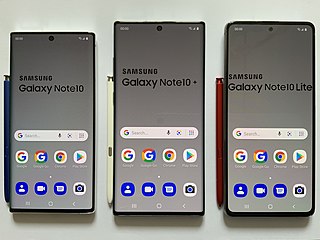
Mobile computing is human–computer interaction in which a computer is expected to be transported during normal usage, which allows for the transmission of data, voice, and video. Mobile computing involves mobile communication, mobile hardware, and mobile software. Communication issues include ad hoc networks and infrastructure networks as well as communication properties, protocols, data formats, and concrete technologies. Hardware includes mobile devices or device components. Mobile software deals with the characteristics and requirements of mobile applications.

The Palm Centro is a smartphone marketed by Palm, Inc. beginning its release on October 14, 2007 offering the functionality of the larger Treo 755p in a smaller size.

Airplane mode, aeroplane mode, flight mode, offline mode, or standalone mode is a setting available on smartphones and other portable devices. When activated, this mode suspends the device's radio-frequency (RF) signal transmission technologies, effectively disabling all analog voice, and digital data services, when implemented correctly by the electronic device software author. When cellular phones became prevalent in the 1990s, some communication headsets of aircraft pilots would register an audible click when a cellular phone on the aircraft would transceive a signal. This clicking on the headsets became overwhelmingly distracting to airframe control, with more and more phone calls from airplane passengers as time went on. This led to the banning of electronic device use on airplanes and ushered in the era of airplane mode. This airplane travel condition diverged cellular network device development from hardware to software and the smart phone was created.
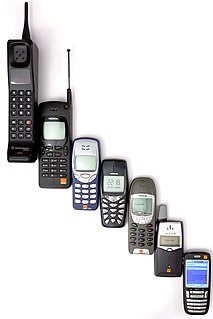
A mobile phone, cellular phone, cell phone, cellphone, handphone, or hand phone, sometimes shortened to simply mobile, cell or just phone, is a portable telephone that can make and receive calls over a radio frequency link while the user is moving within a telephone service area. The radio frequency link establishes a connection to the switching systems of a mobile phone operator, which provides access to the public switched telephone network (PSTN). Modern mobile telephone services use a cellular network architecture and, therefore, mobile telephones are called cellular telephones or cell phones in North America. In addition to telephony, digital mobile phones (2G) support a variety of other services, such as text messaging, MMS, email, Internet access, short-range wireless communications, business applications, video games and digital photography. Mobile phones offering only those capabilities are known as feature phones; mobile phones which offer greatly advanced computing capabilities are referred to as smartphones.

MiFi is a brand name used to describe a wireless router that acts as a mobile Wi-Fi hotspot. In many countries, including the United States, Canada, and Mexico, Inseego Corp owns a registered trademark on the "MiFi" brand name; in the United Kingdom, mobile operator Hutchison 3G owns the "MiFi" trademark. Novatel Wireless has never offered an official explanation for the origin of the name "MiFi"; it is believed to be short for "My Wi-Fi". In September 2016 Novatel Wireless announced that it agreed to sell the MiFi brand to TCL Industries Holdings of Hong Kong. The sale was expected to close in early 2017, pending approval from shareholders and regulators.
Consumer Cellular is an American postpaid mobile virtual network operator founded by John Marick and Greg Pryor in October 1995. The company offers cellphones, no-contract cellphone plans, and accessories with a focus on users age 50-plus. Including its corporate headquarters in Portland, Oregon, Consumer Cellular is completely U.S. based, employing more than 2,400 people at three additional locations in Phoenix, Arizona, and a support center in Redmond, Oregon.

A smartwatch is a wearable computer in the form of a watch; modern smartwatches provide a local touchscreen interface for daily use, while an associated smartphone app provides for management and telemetry. While early models could perform basic tasks, such as calculations, digital time telling, translations, and game-playing, 2010s smartwatches have more general functionality closer to smartphones, including mobile apps, a mobile operating system and WiFi/Bluetooth connectivity. Some smartwatches function as portable media players, with FM radio and playback of digital audio and video files via a Bluetooth headset. Some models, called watch phones, have mobile cellular functionality like making calls.

Republic Wireless is an American mobile virtual network operator that sells low cost mobile phone service which defaults to Wi-Fi. When Wi-Fi is unavailable, Republic falls back on its partner T-Mobile's two national GSM and CDMA networks. It is based in Raleigh, North Carolina. It is pending to become a subsidiary of Dish Wireless.
The Serval Project is a project financed by the Shuttleworth Foundation, as well as various other organisations and accepting individual donations. It is headquartered at Flinders University in Adelaide, Australia. The project aims to develop technology that can be used to create direct connections between cellular phones through their Wi-Fi interfaces, without the need of a mobile phone operator. The technology allows for live voice calls whenever the mesh is able to find a route between the participants. Text messages and other data can be communicated using a store and forward system called Rhizome, allowing communication over unlimited distances and without a stable live mesh connection between all participants.

Tile is an American consumer electronics company which produces tracking devices that users attach to their belongings such as keys and backpacks. A companion mobile app for Android and iOS allows users to track the devices and locate lost items through Bluetooth 4.0, or view where they were last seen. In September 2018 GoPro vet CJ Prober became CEO of Tile. In September 2015, Tile launched Generation 2 hardware that includes find-your-phone functionality and other feature upgrades, which by January 2016 sold over 4.5 million units. In August 2017, two new versions of the Tile were launched, the Tile Sport and Tile Style. As of 2019, the lineup consists of the Pro, Mate, Slim, and Sticker.

The Samsung Gear 2 and Samsung Gear 2 Neo are smartwatches produced by Samsung Electronics. Unveiled on February 22, 2014 at Mobile World Congress, the Gear 2 line is a successor to the Samsung Galaxy Gear.

Artemis Networks is a wireless technology company responsible for the software-defined radio technologies pCell and pWave. pCell technology is capable of speeds hundreds of times faster than other technologies under conditions of heavy usage and interference. Its founder and CEO is Steve Perlman.

Keepgo is a mobile broadband and IoT cellular service provider.

A modular smartphone is a smartphone made using components that can be independently upgraded or replaced as modules. This aims to reduce electronic waste, lower repair costs and increase user comfort.
goTenna is a Brooklyn, New York-based startup that designs and develops technologies for off-grid and decentralized communications. goTenna devices pair with smartphones and, through intelligent mobile ad hoc networking protocols, enable users to send texts and share locations on a peer-to-peer basis, foregoing the need for centralized communications infrastructure of any kind.
AliveCor is a medical device and artificial intelligence company that sells ECG hardware and software for consumer mobile devices. The company is the first to receive FDA-clearance for a medical-device accessory to the Apple Watch.
Field Trip was a location based mobile app developed by Niantic Labs for the Google Glass, Android, and iOS devices first released in September 2012. The application utilized user location and various databases in order to provide information and recommendations about various points of interest in their surroundings.

The PinePhone is a smartphone developed by computer manufacturer Pine64, intended to allow the user to have full control over the device. Measures to ensure this are: running mainline Linux-based mobile operating systems, assembling the phone with screws, simplifying the disassembly for repairs and upgrades, and including six kill switches/security switches for its hardware, which are accessible by removing the back cover of the phone. The PinePhone currently ships with the Manjaro Linux-based operating system using the Plasma Mobile graphic interface, however other distributions have been shipped in limited editions prior, and are meant to be easily installable by end users.


