Related Research Articles
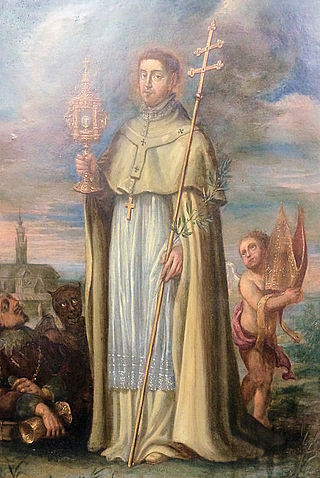
Norbert of Xanten, O. Praem (Gennep-Magdeburg), also known as Norbert Gennep, was Archbishop of Magdeburg, founder of the Premonstratensian order of canons regular, and is venerated as a saint in the Catholic Church. Norbert was canonized by Pope Gregory XIII in the year 1582, and his statue appears above the Piazza colonnade of St. Peter's Square in Rome.

The Order of Canons Regular of Prémontré, also known as the Premonstratensians, the Norbertines and, in Britain and Ireland, as the White Canons, is a religious order of canons regular of the Catholic Church founded in Prémontré near Laon in 1120 by Norbert of Xanten, who later became Archbishop of Magdeburg. Premonstratensians are designated by OPraem following their name.

Paimpol is a commune in the Côtes-d'Armor department in Brittany in northwest France.
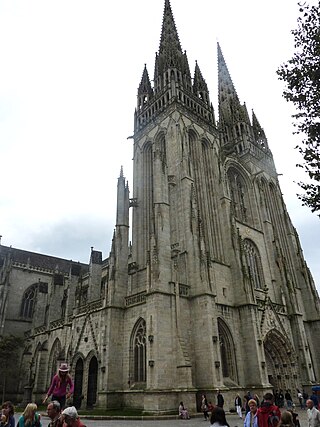
The Diocese of Quimper (–Cornouaille) and Léon is a Latin Church ecclesiastical territory or diocese of the Catholic Church in France. In 1853, the name was changed from the Diocese of Quimper (–Cornouaille) to the Diocese of Quimper (–Cornouaille) and Léon.

Evermode, or Evermod, was one of the first Premonstratensian canons regular, and became the lifelong companion of Norbert of Xanten, who founded the order in France in 1120. He is sometimes referred to as the "Apostle of the Wends".

Floreffe Abbey is a former Premonstratensian monastery, the second of the order to be founded, situated on the Sambre at Floreffe, about 11 km (6.8 mi) south-west of Namur, Wallonia, Belgium.
Michael Christopher Emlyn Jones is a British historian.
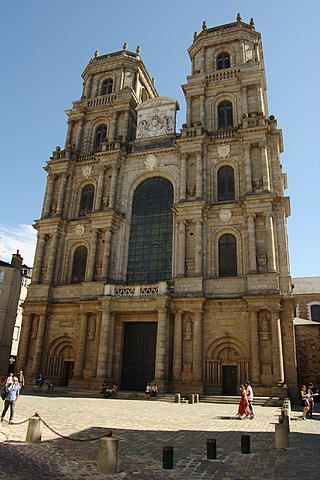
The Archdiocese of Rennes, Dol, and Saint-Malo is a Latin Church diocese of the Catholic Church in France. The diocese is coextensive with the department of Ille et Vilaine. The Archdiocese has 8 suffragans: the Diocese of Angers, the Diocese of Laval, the Diocese of Le Mans, the Diocese of Luçon, the Diocese of Nantes, the Diocese of Quimper and Léon, the Diocese of Saint-Brieuc and Tréguier, and the Diocese of Vannes.

The Breton and French Catholic diocese of Dol, situated in the northern part of the department of Ille-et-Vilaine, 6 km (3.8 mi) from the English Channel coast and 22 km (14 mi) southeast of Saint-Malo, existed from 848 until the French Revolution. It was suppressed by the Concordat of 1801.
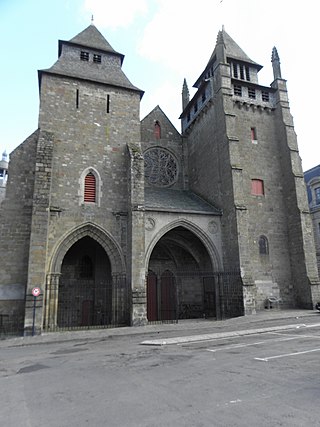
The Diocese of Saint-Brieuc and Tréguier is a Latin Church diocese of the Catholic Church in France. The diocese comprises the department of Côtes d'Armor in the Region of Brittany. The diocese is currently suffragan to the Archdiocese of Rennes, Dol, and Saint-Malo. The current bishop is Denis Moutel, appointed in 2010.

Bonne-Espérance Abbey was a Premonstratensian abbey that existed from 1130 to the end of the 18th century, located in Vellereille-les-Brayeux in the Walloon municipality of Estinnes, province of Hainaut, Diocese of Tournai, in present-day Belgium.

The Abbey of the Most Holy Trinity of La Lucerne, also known as La Lucerne Abbey was a Premonstratensian canonry founded in the 12th century. It is situated in the forests of the Thar river valley in the Manche department of Normandy.

St. Norbert Abbey is a Roman Catholic monastery of Canons Regular of Premontre, located in De Pere, Wisconsin. The Abbey is named after Saint Norbert of Xanten, the founder of the order, after whom, members are known as, "Norbertines". St. Norbert Abbey was established in 1898 by Norbertines from Berne Abbey in the Netherlands. St. Norbert's is the oldest religious community of its kind in the United States, serving as the Mother Canonry to Norbertines across North America.

Redon Abbey, or Abbey of Saint-Sauveur, Redon, in Redon in the present Ille-et-Vilaine, Brittany, France, is a former Benedictine abbey founded in 832 by Saint Conwoïon, at the point where the Oust flows into the Vilaine, on the border between Neustria and Brittany.

Henri Bourde de La Rogerie was a French archivist and historian of Brittany.
Albert Le Grand was a Breton hagiographer and a Dominican brother.
References
- 1 2 Geslin de Bourgogne, Jules-Henri; de Barthélemy, Anatole (1864). "Chapitre 2: Abbaye de Beauport". Anciens évêchés de Bretagne: Histoire et documents. Saint-Brieuc: Librairie Guyon Frères imprimeurs. pp. 15–228.
- ↑ Chédeville, André (2003). "Les chanoines augustins en Bretagne au XIIe siècle, des protomendiants?". Religion et mentalités au Moyen Âge (604). Rennes: Presses universitaires de Rennes: 133–144. ISBN 2-86847-802-6.
- ↑ Malin, Gael (1990). "Sainte Azénor et le conte de la femme calomniée". Mémoires de la Société d'histoire et d'archéologie de Bretagne (LXVII): 303–320.
- ↑ Gallet, Yves (2015). "Abbaye de Beauport: Monuments des Côtes-D'Armor: Le "Beau Moyen Âge"". Congrès Archéologique de France. 173. Paris: Société Française d'Archéologie: 353–379.