Related Research Articles

The First Council of Nicaea was a council of Christian bishops convened in the Bithynian city of Nicaea by the Roman Emperor Constantine I in AD 325.

Reccared I was Visigothic King of Hispania and Septimania. His reign marked a climactic shift in history, with the king's renunciation of Arianism in favour of Catholicism in 587.
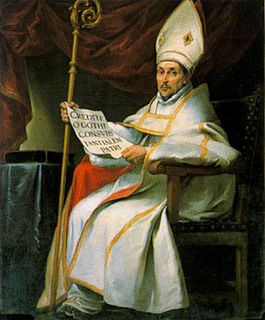
Saint Leander of Seville was the Catholic Bishop of Seville. He was instrumental in effecting the conversion of the Visigothic kings Hermengild and Reccared to Catholicism. His brother was the encyclopedist St. Isidore of Seville.

The Third Council of Toledo (589) marks the entry of Visigothic Spain into the Catholic Church, and known for codifying the filioque clause into Western Christianity. The council also enacted restrictions on Jews, and the conversion of the country to Catholic Christianity led to repeated conflict with the Jews.
John of Biclaro, Biclar, or Biclarum, also Iohannes Biclarensis, was a Visigoth chronicler. He was born in Lusitania, in the city of Scallabis. He was also bishop of Girona.

Dume is a former freguesia and former bishopric in the municipality of Braga, northern Portugal, which remains a Catholic titular see.

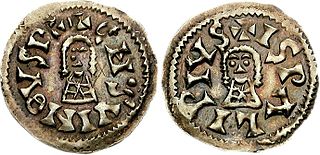
Witteric was the Visigoth King of Hispania, Septimania and Galicia. He ruled from 603 to 610.
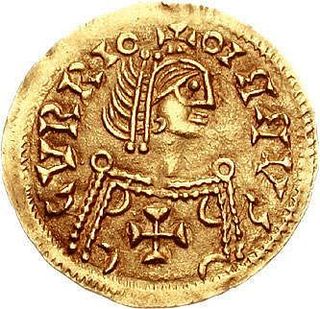
Liuvigild, Leuvigild, Leovigild, or Leovigildo, was a Visigothic King of Hispania and Septimania from 568 to April 21, 586. Known for his Codex Revisus or Code of Leovigild, a law allowing equal rights between the Visigothic and Hispano-Roman population, his kingdom covered modern Portugal and most of modern Spain down to Toledo. Liuvigild ranks among the greatest Visigothic kings of the Arian period.

Idanha-a-Velha is a village and a former freguesia in the municipality of Idanha-a-Nova, central eastern Portugal, and the site of Ancient Egitânia, a former bishopric.

The Kingdom of the Suebi, also called the Kingdom of Gallæcia or Suebi Kingdom of Gallæcia, was a Germanic post-Roman kingdom that was one of the first to separate from the Roman Empire. Based in the former Roman provinces of Gallaecia and northern Lusitania, the de facto kingdom was established by the Suebi about 409, and during the 6th century it became a formally declared kingdom identifying with Gallaecia. It maintained its independence until 585, when it was annexed by the Visigoths, and was turned into the sixth province of the Visigothic Kingdom in Hispania.

Theodemir or Theodemar was one of the last Suevic kings of Galicia and one of the first Chalcedonian Christians to hold the title. He succeeded Ariamir sometime between the end of May 561 and the year 566 and ruled until his death.
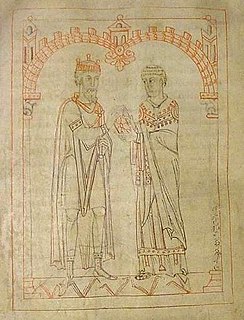
Miro was the Suebian King of Galicia from 570 until his death in 583. His reign was marked by attempts to forge alliances with other Chalcedonian Christian nations with the goal of checking the power of the Arian Visigoths under Leovigild. During his reign relations were established with both Francia and the Byzantine Empire and the kingdom reached its zenith, but it collapsed within three years of his death.
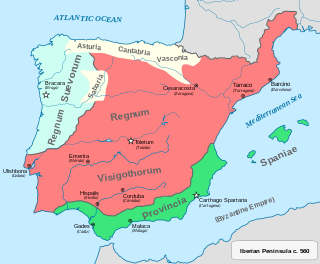
Spania was a province of the Byzantine Empire from 552 until 624 in the south of the Iberian Peninsula and the Balearic Islands. It was established by the Emperor Justinian I in an effort to restore the western provinces of the Empire.

Masona or Mausona was the Bishop of Mérida and metropolitan of the province of Lusitania from about 570 until his death. He is famous for exercising de facto rule of the city of Mérida during his tenure as bishop and for founding the first confirmed hospital in Spain.
Athaloc was the Visigothic Arian Archbishop of Narbonne at the time of the Third Council of Toledo in 589. He was the metropolitan of his province in parallel with the Catholic hierarchy.
Claudius was a Hispano-Roman Catholic dux (duke) of Lusitania in the late sixth century. He was one of the most successful generals of Reccared I.

The Diocese of Badajoz was a Roman Catholic ecclesiastical territory in Spain, created in 1255. In 1994 it became the Archdiocese of Mérida-Badajoz.
Chindasuinth (also spelled Chindaswinth, Chindaswind, Chindasuinto, Chindasvindo, or Khindaswinth was Visigothic King of Hispania, from 642 until his death in 653. He succeeded Tulga, from whom he took the throne in a coup. He was elected by the nobles and anointed by the bishops on April 30th, 642.
Ingunde, Ingund, Ingundis or Ingunda,, was the eldest child of Sigebert I, king of Austrasia, and his wife Brunhilda, daughter of King Athanagild of the Visigoths. She married Hermenegild and became the first Catholic queen of the Visigoths.
Argiovito, also referred to as Argiovitro, one Arbricio was bishop of Porto in Portugal during the late sixth century.
References
- Consello da Cultura Galega (ed.), Documentos da Catedral de Lugo, (Santiago de Compostela, 1998)


