
The Bektashi Order or Bektashism is an Islamic Sufi mystic order originating in the 13th-century. It is named after the saint Haji Bektash Veli. The Albanian community is currently led by Baba Mondi, their eighth Bektashi Dedebaba and headquartered in Tirana, Albania.

Alevism, Anatolian Alevism or Qizilbashism is a heterodox Islamic tradition, whose adherents follow the mystical Islamic teachings of Haji Bektash Veli, who is supposed to have taught the teachings of the Twelve Imams. Differing from Sunni Islam and Usuli Twelver Shia Islam, Alevis have no binding religious dogmas, and teachings are passed on by a spiritual leader as with Sufi orders.

Giresun Province is a province of Turkey on the Black Sea coast. Its adjacent provinces are Trabzon to the east, Gümüşhane to the southeast, Erzincan to the south, Sivas to the southwest, and Ordu to the west. Its license-plate code is 28.

Hurufism was a Sufi movement based on the mysticism of letters (ḥurūf), which originated in Astrabad and spread to areas of western Iran (Persia) and Anatolia in the late 14th and early 15th centuries.

Haji Bektash Veli was a mystic, saint, sayyid, and philosopher from Khorasan who lived and taught in Anatolia. His original name was Sayyid Muhammad ibn Sayyid Ibrāhim Ātā. He is also referred to as the "Sultan of Hearts" and the "Dervish of the Dervishes".
Rexheb Beqiri, better known by the religious name Baba Rexheb, was an Albanian Islamic scholar and Sufi. He was the founder and the head of the Bektashi Sufi lodge (tekke) located in Taylor, Michigan, United States.
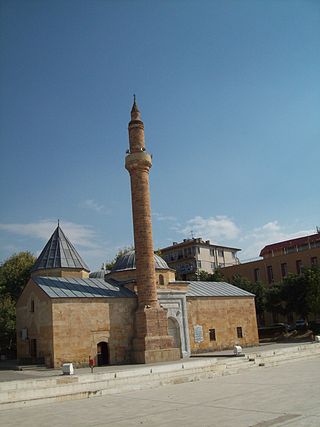
Sheikh Pir Nasiruddin Abul Hakayik Pir Mahmud bin Ahmed Ahi Evran bin Abbas Veli al-Khoyi (1169–1261), commonly known as Ahi Evran or Pir Ahi Evren-ı Veli, was a Turkic Alevi Sufi saint, preacher, philosopher, poet who wrote 20 books. He is mostly remembered as the founder and leader of the Ahi Brotherhood.
Folk religious practices remain in the Bektashiyyah tariqa and certain practices are also found to a lesser extent in Balkan Christianity and non-Bektashi Balkan Islam as well, according to some Western Islamic scholars.

Hacıbektaş, formerly Karahöyük and Andidon, is a town and district of Nevşehir Province in the Central Anatolia region of Turkey. It is the seat of Hacıbektaş District. Its population is 5,325 (2022). Located in Cappadocia, its elevation is 1,275 m (4,183 ft). The town is named after Haji Bektash Veli, a 13th-century Sufi saint who founded the Bektashi Order.
Baba Samit was a Shia Sufi tariqa that gained widespread following in medieval Azerbaijan and Turkey. It is believed to be a branch of Bektashi (Bektaşiyye) tariqat. Baba Samit, according to a legend was the son of Haji Bektash Veli, the founder of the movement. Also according to the tomb inscriptions, he descends from Imam Ali Reza. History of Baba Samit movement in Azerbaijan is quite poorly researched.
Bektaş is a highland and settlement in Giresun Province of Turkey.

The History of the Shī‘ah Imāmate Alevī Ṭarīqah or The History of the Alevism is that of a community of Muslims of Anatolia and neighbouring regions.
Starje is a village in the Korçë County in southeastern Albania. At the 2015 local government reform it became part of the municipality Kolonjë. Originally the name was Plakas meaning old in Albanian. The village's population religiously belongs to the Bektashi order while there are also some Orthodox Christians.
Balım Sultan was a Bektashi sufi who established and codified the Bektashi Order at the beginning of the 16th century. The mystical practices and rituals of the Bektashi were systematized and structured by Balım, after which many of the order's distinct practices and beliefs took shape. He is considered the primary personality in the Bektashi Order after Hacı Bektaş-ı Veli (Haji Bektash) and is regarded as the “Second Pir”.
Reshat Bardhi or Dedebaba Hajji Reshat was an Albanian religious leader who served as the 7th kryegjysh or Dedebaba of the Bektashi Order from 1991 to 2011.

The Haji Bektash Veli complex is an Alevi Islamic Cultural Monument of the Republic of Turkey, located in Hacıbektaş, Nevshehir province. It was built in the 13th century as a teqe (dergâh) of the Sufi saint Haji Bektash Veli. After his death, his mausoleum was built here.
The Kalender Çelebi rebellion was a rebellion that occurred in 1527 in Elbistan, Eastern Anatolia. This rebellion was led by Kalender Çelebi against the Ottoman reign of Suleiman the Magnificent, who was extending his influence in the region. Although Kalender Çelebi gained the initial support of local tribal chieftains he was outmanoeuvred by Suleiman. Ultimately, the Ottoman Empire defeated the rebels, and killed Çelebi.

Salih Nijazi was the 1st Dedebaba of the Bektashi Order that was established in Albania in 1930.

The World Headquarters of the Bektashi or Bektashi World Center is the international headquarters of the Bektashi Order, a Sufi order. It is located on Dhimitër Kamarda Street at the eastern edge of Tirana city, Albania. It serves as the centre of the Albanian Bektashi Order.
The Bektashi Order is an Islamic Sufi order that spread to Albania through Albanian Janissaries during the period of Ottoman control in Albania. The Bektashi make up 20% of Albania's Muslim population and 2.5% of the country's population. In Albania, the Bektashi Order has taken on a patriotic and nationalistic character, and it has played a major role in the Albanian National Awakening. Bektashi leaders have historically been prominent members in Albanian movements for self-determination and national autonomy, which has contributed to its popularity amongst the Albanians, and for most of Albania's Bektashi community, their affiliation with the order is based on cultural heritage rather than actual religious belief. In regards to ethics, the Bektashi adhere to the line "Be master of your hands, your tongue, and your loins" which essentially means do not steal, do not lie or speak idly, and do not commit adultery.
