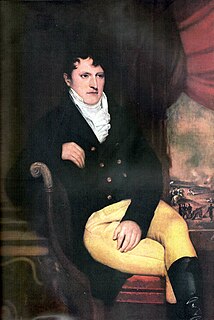
Manuel José Joaquín del Corazón de Jesús Belgrano y González, usually referred to as Manuel Belgrano, was an Argentine economist, lawyer, politician, journalist, and military leader. He took part in the Argentine Wars of Independence and created the Flag of Argentina. He is regarded as one of the main Libertadores of the country.

The Province of Santa Fe is a province of Argentina, located in the center-east of the country. Neighboring provinces are from the north clockwise Chaco, Corrientes, Entre Ríos, Buenos Aires, Córdoba, and Santiago del Estero. Together with Córdoba and Entre Ríos, the province is part of the economico-political association known as the Center Region.

Rosario is the largest city in the central Argentina province of Santa Fe. The city is located 300 km (186 mi) northwest of Buenos Aires, on the west bank of the Paraná River. Rosario is the third-most populous city in the country, and is also the most populous city in Argentina that is not a capital. With a growing and important metropolitan area, Greater Rosario has an estimated population of 1,750,000 as of 2020. One of its main attractions includes the neoclassical, Art Nouveau, and Art Deco architecture that has been retained over the centuries in hundreds of residences, houses and public buildings.

Santa Fe de la Vera Cruz is the capital city of the province of Santa Fe, Argentina. It is situated in north-eastern Argentina, near the junction of the Paraná and Salado rivers. It lies 15 kilometres (9.3 mi) from the Hernandarias Subfluvial Tunnel that connects it to the city of Paraná. The city is also connected by canal with the port of Colastiné on the Paraná River. Santa Fe de la Vera Cruz has about 391,164 inhabitants per the 2010 census [INDEC]. The metropolitan area has a population of 653,073, making it the eighth largest in Argentina. The third largest city in Argentina is Rosario, also located in Santa Fe Province. Rosario has a population of 1.24 million and it is the largest city in Argentina not to be a provincial capital.
San Martín or San Martin may refer to:
Departments form the second level of administrative division, and are subdivided in municipalities. They are extended in all of Argentina except for the Province of Buenos Aires and the Autonomous City of Buenos Aires, the national capital, each of which has different administrative arrangements.

Rosario lies by the Paraná River, about 300 km upstream from the Argentine capital Buenos Aires; it is a major port and an industrial, commercial and cultural center. It grew from its humble origins to be the third most populated city in Argentina and the largest in the province of Santa Fe. Manuel Belgrano created the flag of Argentina in Rosario.

San Pedro, which full name is Rincon de San Pedro Dávila de los Arrecifes, is a city and port of the Province of Buenos Aires, Argentina, on the side of the Parana River. It is one of five localidades and the administrative seat of the Partido de San Pedro. It's situated 164 km away from Buenos Aires via National Route 9, and 141 km away from Rosario.

The following is an alphabetical list of topics related to the Argentine Republic.

The Buenos Aires Rugby Union, usually referred as URBA, is the Argentine governing body that organises and controls the rugby union in the Buenos Aires Province. The remaining clubs from the province are distributed amongst four other unions: Unión de Rugby del Oeste de Buenos Aires in the west, Unión de Rugby del Centro de la Provincia de Buenos Aires in the centre, Unión de Rugby de Mar del Plata in the east, and Unión de Rugby del Sur in the south.

Retiro is the name of a railway station complex in Buenos Aires, Argentina, that includes three main terminal train stations and two terminal subway stations.

Port Belgrano Naval Base is the largest naval base of the Argentine Navy, situated next to Punta Alta, near Bahía Blanca, about 560 km (348 mi) south of Buenos Aires. It is named after the brigantine General Belgrano which sounded the area in late 1824.
English Argentines are citizens of Argentina or the children of Argentine citizens brought up in Argentina, who can claim ancestry originating in England. The English settlement in Argentina, took place in the period after Argentina's independence from Spain through the 19th century. Unlike many other waves of immigration to Argentina, English immigrants were not usually leaving England because of poverty or persecution, but went to Argentina as industrialists and major landowners.

The General Manuel Belgrano Railway (FCGMB), named after the Argentine politician and military leader Manuel Belgrano, is a 1,000 mmmetre gauge railway and the longest of the Argentine system. It was one of the six State-owned Argentine railway companies formed after President Juan Perón's nationalisation of the railway network in 1948.

The Rosario Rugby Union is the organisational body that controls the game of rugby union in Rosario, in the province of Santa Fe, Argentina. The rest of Santa Fe province teams are organised under the Unión Santafesina de Rugby.
Club Atlético del Rosario is an Argentine sports club from Rosario, Santa Fe. One of the oldest clubs still in existence in the country, Atlético del Rosario was a pioneer of football in Rosario, being the first team from that city to play in Primera División, the top division of the Argentine football league system. At the international level, Rosario A.C. was also the first team outside Buenos Aires to win an international tournament, the Tie Cup on three occasions. Atlético was also a founding member of the Liga Rosarina de Football, the main body that organised the practice of association football in Rosario from 1905 to 1930.
General Belgrano originally refers to:
The 1967 Campeonato Argentino de Rugby was won by selection of Buenos Aires beating in the final the selection of Rosario

The Argentine Revolution of 1893, or the Radical Revolution of 1893, was a failed insurrection by members of the Radical Civic Union (UCR) against the government of Argentina, then controlled by the National Autonomist Party (PAN). It continued the goals of the Revolution of the Park of 1890, whose themes were further echoed in the Revolution of 1905.
