
Much of the history of Algeria has taken place on the fertile coastal plain of North Africa, which is often called the Maghreb. North Africa served as a transit region for people moving towards Europe or the Middle East, thus, the region's inhabitants have been influenced by populations from other areas, including the Carthaginians, Romans, and Vandals. The region was conquered by the Muslims in the early 8th century AD, but broke off from the Umayyad Caliphate after the Berber Revolt of 740. During the Ottoman period, Algeria became an important state in the Mediterranean sea which led to many naval conflicts. The last significant events in the country's recent history have been the Algerian War and Algerian Civil War.

Tlemcen is the second-largest city in northwestern Algeria after Oran and is the capital of Tlemcen Province. The city has developed leather, carpet, and textile industries, which it exports through the port of Rachgoun. It had a population of 140,158 during the 2008 census.

La Santé Prison is a prison operated by the French Prison Service of the Ministry of Justice located in the east of the Montparnasse district of the 14th arrondissement in southern Paris, France at 42 Rue de la Santé. It is one of the most famous prisons in France, with both VIP and maximum security sections.
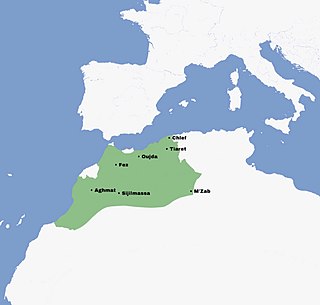
The Maghrawa or Meghrawa were a large Zenata Berber tribal confederation whose cradle and seat of power was the territory located on the Chlef in the north-western part of today's Algeria, bounded by the Ouarsenis to the south, the Mediterranean Sea to the north and Tlemcen to the west. They ruled these areas on behalf of the Umayyad Caliphate of Cordoba at the end of the 10th century and during the first half of the 11th century.

Mourad Medelci was an Algerian politician who served in the government of Algeria as Minister of Foreign Affairs from 2007 to 2013. He was President of the Constitutional Council of Algeria from 2013 until his death in 2019.

Maurice Audin was a renowned French mathematics assistant at the University of Algiers, a member of the Algerian Communist Party and an activist in the anticolonialist cause, who died under torture by the French state during the Battle of Algiers.

Beni Amer is an Arab tribe mainly present in Algeria, as well as Morocco. They are originally from the Zughba branch of Banu Hilal. The Beni Amer occupied the region of western Algeria around Oran after a gradual migration.

Honaine is a town and commune in Tlemcen Province in northwestern Algeria.

The conflicts between the regency of Algiers and the Cherifian dynasties or Algerian-Sherifian conflicts are, within the framework of the conflicts opposing Morocco to the Ottoman Empire and its dependencies, a series of wars between, on the one hand, the regency of Algiers and its allies - the local sultanates or tribal confederations - and, on the other hand, the Cherifian Saadian and Alawite dynasties that have ruled Morocco since the 16th century.
The Ifranid Emirate of Tlemcen or Ifranid Kingdom of Tlemcen, was a Kharijite state, founded by Berbers of the Banu Ifran in the eighth century, with its capital at Tlemcen in modern Algeria.

Sofiane Bouhdiba is a Tunisian demographer, born on 12 April 1968. He is Professor of Demography in the department of Sociology in the University of Tunis. He has taught in many universities in Europe, Africa and the United States, and has participated in a great number of international conferences, with a focus on mortality and morbidity. As an international consultant to the United Nations, he had the opportunity to observe closely the history of the fight against major diseases in the world. He has also participated in numerous scientific and humanitarian missions in sub-Saharan Africa. Professor Sofiane Bouhdiba is well-known for the realism of his recommendations, and has been appointed as an expert in Demography before the Tunisian Parliament.

The 2019–2021 Algerian protests, also called Revolution of Smiles or Hirak Movement, began on 16 February 2019, six days after Abdelaziz Bouteflika announced his candidacy for a fifth presidential term in a signed statement. These protests, without precedent since the Algerian Civil War, were peaceful and led the military to insist on Bouteflika's immediate resignation, which took place on 2 April 2019. By early May, a significant number of power-brokers close to the deposed administration, including the former president's younger brother Saïd, had been arrested.

The Sulaymanid dynasty was an Arab Muslim dynasty in present-day western Algeria, ruling from 814 to 922. The dynasty is named after the founder, Sulyaman I, who was the brother of Idris I, the founder of the Idrisid dynasty based in Fez. Both Sulayman and Idris, as great grandchildren of Hasan ibn Ali, were sharifs descended from Muhammad.

Lakhdar Bouregaa was an Algerian independentist militant. He was a Commander of the National Liberation Army, serving from 1956 to 1962. He was opposed to the Oujda Group following a clash in the summer of 1962. He was a co-founder of the Socialist Forces Front in 1963, and was a key figure during the 2019–20 Algerian protests.
The Campaign of Tlemcen (1551) was a military operation led by the Regency of Algiers under Hasan Pasha and his ally Abdelaziz, following the capture of Tlemcen by the Saadi Sultanate in June 1550.
Ahmed Mahsas was an Algerian militant in the nationalist movement against French Algeria.
The Maghrebi war (1699-1702) was a conflict involving a Tunisian, Tripolitanian, and Moroccan coalition, and the Deylik of Algiers. It was an important milestone in the further weakening of the already fragile Ottoman grip over the Maghreb, as both sides utterly ignored the Ottoman sultan's pleas to sign a peace treaty. This war also led to the renewal of the Muradid infighting, which would later lead to the establishment of the Beylik of Tunis, and the Husainid dynasty in 1705.
The Battle of Oued Zadidja occurred in 1551 after the Saadians violated an alliance with the Regency of Algiers, the Saadians were defeated and their leader was killed.

Zayyanid architecture originated in the Kingdom of Tlemcen between the 13th and 16th centuries in the northwestern region of present-day Algeria. It is a continuation of the western Islamic architectural traditions, often known as the "Hispano-Moresque style," with elements that were further developed to create distinctive designs lasting for centuries. This architectural style was significantly influenced by the Almohad Caliphate and Andalusian architecture, resulting in a lasting heritage of Moorish architectural achievements.


