Related Research Articles

Thomas Secker was the Archbishop of Canterbury in the Church of England.

The Rt. Rev. William Bedell, D.D., was an Anglican churchman who served as Lord Bishop of Kilmore, as well as Provost of Trinity College Dublin.
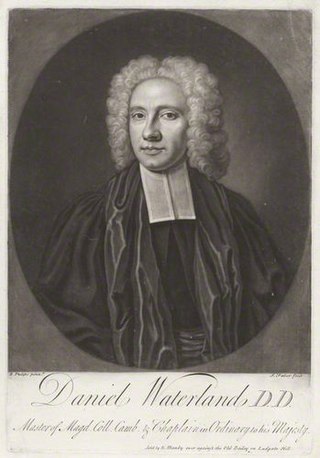
Daniel Cosgrove Waterland was an English theologian. He became Master of Magdalene College, Cambridge in 1714, Chancellor of the Diocese of York in 1722, and Archdeacon of Middlesex in 1730.
Henry Temple, 1st Viscount Palmerston, of East Sheen, Surrey and Broadlands, Hampshire, was an Anglo-Irish landowner and Whig politician who sat in the British House of Commons from 1727 to 1747.

John Hoadly was an Anglican divine in the Church of Ireland. He served as Bishop of Ferns and Leighlin, as Archbishop of Dublin, and as Archbishop of Armagh from 1742 until his death.
Benjamin Parry was Church of Ireland Bishop of Ossory from 27 January 1678 until his death later the same year.
John Parry was Bishop of Ossory in the Church of Ireland from 1672 until his death.

William Stanley (1647–1731) was an English churchman and college head, Master of Corpus Christi College, Cambridge, Archdeacon of London and Dean of St Asaph.
John Cradock (alias Craddock) (c. 1708 - 10 December 1778) was an English churchman, Church of Ireland Archbishop of Dublin from 1772.
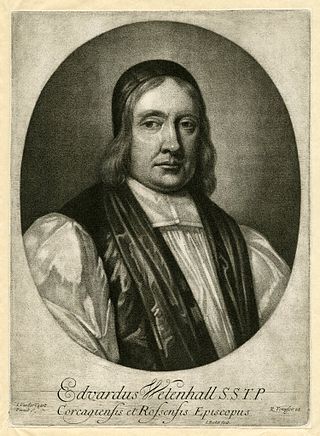
Edward Wetenhall (1636–1713) was an English bishop of the Church of Ireland. His name is also spelled Wettenhall, Whetenhall, Whitnall, Withnoll, and Wythnall.

Edward Parry was Church of Ireland Bishop of Killaloe, County Clare, Ireland from 28 March 1647 until his death 20 July 1650.
Charles Richard Elrington (1787–1850) was a Church of Ireland cleric and academic, regius professor of divinity in the Trinity College Dublin.
The Rt Rev William Knox was Bishop of Killaloe and Kilfenora from 1794 to 1803 when he was translated to Derry.

John Sterne (1660–1745) was an Irish Church of Ireland clergyman, bishop of Dromore from 1713 and then bishop of Clogher from 1717.
William Payne (1650–1696) was an English academic and cleric of the Church of England, known as a controversialist.
Luke Heslop was an Anglican priest in the late 18th and early 19th centuries.
Rowland Davies (1649–1721) was Church of Ireland dean of Cork.
John Copping was Dean of Clogher from 1738 until his death in 1743.
John Travers, D.D. was Archdeacon of Armagh from May to November 1693.
Michael Heweton was Archdeacon of Armagh from 1693 to 1700.
References
- ↑ "Hawkshaw, Benjamin (HWKW689B)". A Cambridge Alumni Database. University of Cambridge.
. Dictionary of National Biography . London: Smith, Elder & Co. 1885–1900.
| International | |
|---|---|
| National | |
