
Berlin is the capital and largest city of Germany by both area and population. Its 3.7 million inhabitants make it the European Union's most populous city, according to population within city limits. One of Germany's sixteen constituent states, Berlin is surrounded by the State of Brandenburg and contiguous with Potsdam, Brandenburg's capital. Berlin's urban area, which has a population of around 4.5 million, is the second most populous urban area in Germany after the Ruhr. The Berlin-Brandenburg capital region has around 6.2 million inhabitants and is Germany's third-largest metropolitan region after the Rhine-Ruhr and Rhine-Main regions. There was an unsuccessful attempt to unify the two states in 1996. Though they remained separate, the two states cooperate on many matters to this day.

The Berlin Wall was a guarded concrete barrier that physically and ideologically divided Berlin from 1961 to 1989 as well as encircling and separating West Berlin from East German territory. Construction of the wall was commenced by the German Democratic Republic on 13 August 1961. The Wall cut off West Berlin from surrounding East Germany, including East Berlin. The barrier included guard towers placed along large concrete walls, accompanied by a wide area that contained anti-vehicle trenches, beds of nails and other defenses. The Eastern Bloc portrayed the Wall as protecting its population from fascist elements conspiring to prevent the "will of the people" from building a socialist state in East Germany.
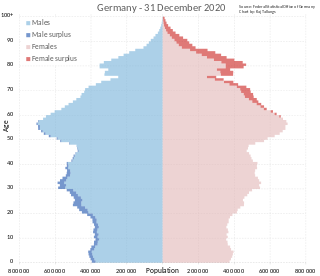
The demography of Germany is monitored by the Statistisches Bundesamt. According to the most recent data, Germany's population is 83,695,430 making it the most populous country in the European Union, and the nineteenth-most populous country in the world. The total fertility rate was rated at 1.53 in 2020, which is far below the replacement rate of 2.1. For a long time Germany had one of the world's lowest fertility rates of around 1.3 to 1.4 however there has been a small increase in recent years. Due to the low birth rate there have been more deaths than births in Germany in every year since 1972, which means 2021 was the 50th consecutive year the German population would have decreased without immigration. It is the only country in the world to have such a long-term natural population decline. The decline has been somewhat mitigated by immigration: in 2019 the number of people with a foreign background was 26%. Under this category there are counted foreigners, naturalized citizens, ethnic German repatriates from east Europe and their children.

Kreuzberg is a district of Berlin, Germany. It is part of the Friedrichshain-Kreuzberg borough located south of Mitte. During the Cold War era, it was one of the poorest areas of West Berlin, but since German reunification in 1990 it has become more gentrified and known for its arts scene.
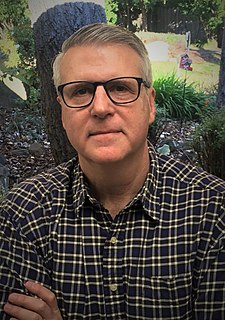
Peter Mark Robinson is an American author, research fellow, television host and former speechwriter for then-Vice President George H. W. Bush and President Ronald Reagan. He is currently the host of Uncommon Knowledge, an interview show by Stanford's Hoover Institution. He is also a research fellow at the Hoover Institution, and a co-founder of the Ricochet website.

The Berlin Cathedral, also known as, the Evangelical Supreme Parish and Collegiate Church, is a monumental German Evangelical church and dynastic tomb on the Museum Island in central Berlin. Having its origins as a castle chapel for the Berlin Palace, several structures have served to house the church since the 1400s. The present collegiate church was built from 1894 to 1905 by order of German Emperor William II according to plans by Julius Raschdorff in Renaissance and Baroque Revival styles. The listed building is the largest Protestant church in Germany and one of the most important dynastic tombs in Europe. In addition to church services, the cathedral is used for state ceremonies, concerts and other events.

"Mr. Gorbachev, tear down this wall", also known as the Berlin Wall Speech, was a speech delivered by United States President Ronald Reagan in West Berlin on June 12, 1987. Reagan called for the General Secretary of the Communist Party of the Soviet Union, Mikhail Gorbachev, to open the Berlin Wall, which had separated West and East Berlin since 1961. The name is derived from a key line in the middle of the speech: "Mr. Gorbachev, tear down this wall!"

The Berliner Philharmonie is a concert hall in Berlin, Germany, and home to the Berlin Philharmonic Orchestra.

Marzahn is a locality within the borough of Marzahn-Hellersdorf in Berlin. Berlin's 2001 administrative reform led to the former boroughs of Marzahn and Hellersdorf fusing into a single new borough. In the north the Marzahn locality includes the neighbourhoods of Bürknersfelde and Ahrensfelde, an overbuilt strip of land which once had belonged to the Brandenburg municipality of Ahrensfelde and was incorporated into Berlin in 1990.

Douglas Richard Alan Saunders is a British and Canadian journalist and author, and columnist for The Globe and Mail, a newspaper based in Toronto, Ontario, Canada. He is the newspaper's international-affairs columnist, and a long-serving foreign correspondent formerly based in London and Los Angeles, and is the author of three books focused on cities, migration and population. He is currently a Berlin-based resident fellow with the Robert Bosch Academy.
Saba Mahmood (1961–2018) was professor of anthropology at the University of California, Berkeley. At Berkeley, she was also affiliated with the Center for Middle Eastern Studies, Institute for South Asia Studies, and the Program in Critical Theory. Her scholarly work straddled debates in anthropology and political theory, with a focus on Muslim majority societies of the Middle East and South Asia. Mahmood made major theoretical contributions to rethinking the relationship between ethics and politics, religion and secularism, freedom and submission, and reason and embodiment. Influenced by the work of Talal Asad, she wrote on issues of gender, religious politics, secularism, and Muslim and non-Muslim relations in the Middle East.
Nicholas Matthew Kulish is an author and journalist who reports for The New York Times. Since March 2014, he has worked as an investigative journalist based in New York. He is the author of two books, the satirical novel Last One In and the nonfiction book The Eternal Nazi.
Barack Obama – Der schwarze Kennedy is a best-selling German-language biography of President of the United States Barack Obama by journalist Christoph von Marschall. The book was written by Marschall while he spent much of 2007 travelling with Barack Obama 2008 presidential campaign as a reporter for the Berlin newspaper Der Tagesspiegel. It covers Obama's life from his childhood, through his college years, his time as a community organizer in Chicago, Illinois, and his political career including his 2008 presidential campaign. Marschall sums up his impressions of Obama by saying, "Seine Lebensgeschichte steht für den amerikanischen Traum."

In December 2019, the city-state of Berlin had a population of 3,769,495 registered inhabitants in an area of 891.82 square kilometers (344.33 sq mi). The city's population density was 4,227 inhabitants per km2. Berlin is Germany's largest city and the most populous city proper in the European Union.
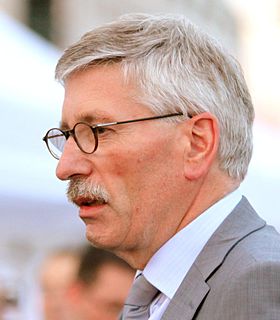
Thilo Sarrazin is a German politician and former member of the SPD, writer, senator of finance for the State of Berlin from January 2002 until April 2009, former member of the Executive Board of the Deutsche Bundesbank until 2010.

Berlin is recognized as a world city of culture and creative industries. Numerous cultural institutions, many of which enjoy international reputation are representing the diverse heritage of the city. Many young people, cultural entrepreneurs and international artists continue to settle in the city. Berlin has established itself as a popular nightlife and entertainment center in Europe.
Berlin School is a term used for a new movement in German films that has emerged in the early 21st century. The German term Berliner Schule has been applied to a number of intimate German films that received critical acknowledgement, first in France.
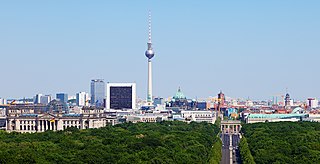
Berlin's history has left the city with an eclectic assortment of architecture. The city's appearance in the 21st century has been shaped by the key role the city played in Germany's 20th-century history. Each of the governments based in Berlin—the Kingdom of Prussia, the 1871 German Empire, the Weimar Republic, Nazi Germany, East Germany and the reunified Federal Republic of Germany—initiated ambitious construction programs, with each adding its distinct flavour to the city's architecture.
Edmund Fawcett is a British political journalist and author. He worked at The Economist (1973–2003) as chief correspondent in Washington, Paris, Berlin and Brussels, as well as European and literary editor. In a long career covering international politics, he wrote about the growth of the European Union, democratisation in Spain, Portugal and Greece, the end of the Cold War, new hopes for the United Nations, Germany's unification and the wars in ex-Yugoslavia. In the United States, he travelled widely, followed three presidential campaigns and wrote about the decline of detente in the late 1970s together with the rise of Reaganism. His frequent book reviews have appeared in The New York Times, Guardian and New Statesman, Times Literary Supplement and Political Quarterly.
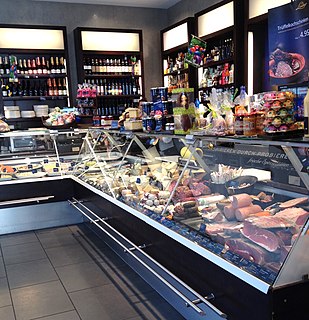
Cuisine of Berlin describes different aspects of Berlin's culinary offerings. On the one hand, it means the traditional Berlin cuisine of Berlin households with dishes from the German cuisine. On the other hand, often a rustic pub and snack kitchen, which has become increasingly international due to many migration waves since 1945 and 1990. After 2000, numerous top-class restaurants have evolved in Berlin.
