
Ophthalmology is a surgical subspecialty within medicine that deals with the diagnosis and treatment of eye disorders.

LASIK or Lasik, commonly referred to as laser eye surgery or laser vision correction, is a type of refractive surgery for the correction of myopia, hyperopia, and an actual cure for astigmatism, since it is in the cornea. LASIK surgery is performed by an ophthalmologist who uses a laser or microkeratome to reshape the eye's cornea in order to improve visual acuity. For most people, LASIK provides a long-lasting alternative to eyeglasses or contact lenses.

Refractive eye surgery is optional eye surgery used to improve the refractive state of the eye and decrease or eliminate dependency on glasses or contact lenses. This can include various methods of surgical remodeling of the cornea (keratomileusis), lens implantation or lens replacement. The most common methods today use excimer lasers to reshape the curvature of the cornea. Refractive eye surgeries are used to treat common vision disorders such as myopia, hyperopia, presbyopia and astigmatism.

José Ignacio Barraquer Moner was a Spanish ophthalmologist and inventor born in Barcelona who did most of his life's work in Bogotá, Colombia.
Stephen Updegraff, M.D., FACS is an American refractive surgeon best known for his early involvement in, and contributions to, LASIK. He is a Fellow of the American College of Surgeons, a board-certified member of the American Board of Ophthalmology, a founding member of the American College of Ophthalmic Surgeons, and a member of the International Society of Refractive Surgery, the American Academy of Ophthalmology, the American Society of Cataract and Refractive Surgery, and the Pine Ridge Eye Study Society. Updegraff currently serves as the medical director of Updegraff Vision in St. Petersburg, Florida.

Gholam A. Peyman is an ophthalmologist, retina surgeon, and inventor. He is best known for his invention of LASIK eye surgery, a vision correction procedure designed to allow people to see clearly without glasses. He was awarded the first US patent for the procedure in 1989.
Raymond Mark Stein, MD, FRCSC, DABO, is a Canadian ophthalmologist. He practices refractive and cataract surgery. He is the medical director of the Bochner Eye Institute in Toronto, Ontario and Chief of Ophthalmology at the Scarborough General Hospital.
Sheraz Daya is a British ophthalmologist. Daya founded the Centre for Sight in 1996, and works in stem-cell research and sight recovery surgery.
Gerard Sutton is an Australian ophthalmic surgeon and ophthalmologist in Australia and New Zealand. His specialty is laser vision correction, cataract and lens surgery, and corneal transplantation.
Gerd Geerling is a German consultant ophthalmic surgeon, Professor of Ophthalmology and since 2011 head of the Universitäts-Augenklinik Düsseldorf of the University of Düsseldorf, Germany.

Theo Seiler is a German ophthalmologist and physicist. He is considered one of the pioneers of refractive surgery.
Jeewan Singh Titiyal is an Indian ophthalmologist, credited with the first live cornea transplant surgery by an Indian doctor. He was honoured by the Government of India, in 2014, by bestowing on him the Padma Shri, the fourth highest civilian award, for his services to the field of medicine.
Post-LASIK ectasia is a condition similar to keratoconus where the cornea starts to bulge forwards at a variable time after LASIK, PRK, or SMILE corneal laser eye surgery. However, the physiological processes of post-LASIK ectasia seem to be different from keratoconus. The visible changes in the basal epithelial cell and anterior and posterior keratocytes linked with keratoconus were not observed in post-LASIK ectasia.

Noel Alpins is an Australian ophthalmologist who developed the Alpins method of astigmatism analysis used in refractive, corneal, and cataract surgery, used in the research of LASIK.
Burkhard Dick is a German ophthalmologist who has specialized in refractive and cataract surgery. With his many contributions to the scientific literature on this topic, he is considered one of the pioneers of employing the femtosecond laser in cataract surgery. In the "Power List 2018" ranking of the world's most influential ophthalmologists by the publication The Ophthalmologist, Burkhard Dick was listed among the Top 20.

John Marshall MBE, FMedSci, PhD, DSc, FRCPath, FRSB, FRCOphth(Hon), FRCOptom (Hon), FARVO is a British medical scientist and inventor. Currently he is the Frost Professor of Ophthalmology at the Institute of Ophthalmology UCL and Emeritus Professor King's College London. He is a pioneer of laser eye surgery.
Allon Barsam is a London-based ophthalmologist specializing in cataract surgery, refractive surgery and corneal and external eye disease. Barsam carried out the first human treatments of microwave keratoplasty.
The Myanmar Eye Care Project (MECP) is focused on improving the delivery of critical eye care services to at-risk populations in Myanmar. Founded in 2002 and staffed entirely by ophthalmologists, it aims to end blindness in Myanmar. Myanmar is one of the poorest countries in Southeast Asia and has the highest rate of blindness in the world. Working with partners and a network of providers, MECP operates clinics that provide routine eye care, acute treatment, and surgeries to Myanmar's poor rural populations. MECP also builds eye care infrastructure in rural communities, trains indigenous physicians and nursing staff, and provides equipment.
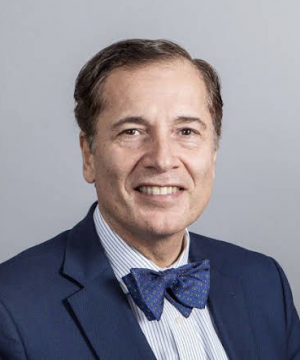
Dimitri Azar M.D. is an American ophthalmologist, professor, and businessman who leads Twenty Twenty Therapeutics, a joint venture established by Santen and Verily. Dr. Azar has held roles at Novartis and Verily, Alphabet's Life sciences research organization. He served as dean of the College of Medicine at the University of Illinois at Chicago (UIC) from 2011 to 2018.
Anastasios John Kanellopoulos is a Greek-American eye surgeon specializing in corneal transplantation, cornea crosslinking for keratoconus, complicated cataract surgery and complicated glaucoma. Widely known for research and clinical contributions in micro-incision cataract, customized laser refractive surgery and corneal cross-linking propagation and most innovations, reducing corneal transplants for advanced keratoconus.


