Blasphemy is an insult that shows contempt, disrespect or lack of reverence concerning a deity, an object considered sacred or something considered inviolable. Some religions regard blasphemy as a crime, including insulting the Islamic prophet Muhammad in Islam, speaking the "sacred name" in Judaism, and blasphemy of the Holy Spirit is "eternal sin" in Christianity. It was also a crime under English common law.
Freedom of speech (FoS), or freedom of expression (FoE), is the right to communicate one's opinions and ideas.
In Christian hamartiology, eternal sin, the unforgivable sin, unpardonable sin, or ultimate sin is the sin which will not be forgiven by God. One eternal or unforgivable sin, also known as the sin unto death, is specified in several passages of the Synoptic Gospels, including Mark 3:28–29, Matthew 12:31–32, and Luke 12:10, as well as other New Testament passages including Hebrews 6:4–6, Hebrews 10:26–31, and 1 John 5:16.
Muhammad was an Islamic prophet and a religious and political leader who preached and established Islam.

The Pakistan Penal Code outlaws blasphemy against any recognized religion, with punishments ranging from a fine to the death penalty. According to various human rights organizations, Pakistan's blasphemy laws have been used to persecute religious minorities and settle personal rivalries, frequently against other Muslims, rather than to safeguard religious sensibilities.
A god of war is a deity associated with war.
Iran is a constitutional, Islamic theocracy. Its official religion is the doctrine of the Twelver Jaafari School. Iran's law against blasphemy derives from Sharia. Blasphemers are usually charged with "spreading corruption on earth", or mofsed-e-filarz, which can also be applied to criminal or political crimes. The law against blasphemy complements laws against criticizing the Islamic regime, insulting Islam, and publishing materials that deviate from Islamic standards.

The Rational Response Squad (RRS) is an atheist activist group that confronts what it considers to be irrational claims made by theists, particularly Christians. The most visible member of RRS is co-founder Brian Sapient. The Rational Response Squad, along with the filmmaker Brian Flemming, made headlines in December 2006 with their Blasphemy Challenge.

In Islam, blasphemy is impious utterance or action concerning God, but is broader than in normal English usage, including not only the mocking or vilifying of attributes of Islam but denying any of the fundamental beliefs of the religion. Examples include denying that the Quran was divinely revealed, the Prophethood of one of the Islamic prophets, insulting an angel, or maintaining God had a son.
Blasphemy is the act of insulting or showing contempt or lack of reverence for God or towards religious or holy persons or things, or toward something considered sacred or inviolable.
Friday the 13th is an unlucky day in western superstition.
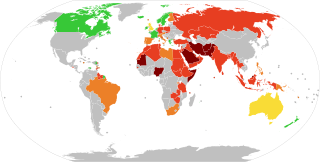
A blasphemy law is a law prohibiting blasphemy, which is the act of insulting or showing contempt or lack of reverence to a deity, or sacred objects, or toward something considered sacred or inviolable. According to Pew Research Center, about a quarter of the world's countries and territories (26%) had anti-blasphemy laws or policies as of 2014.
In the 20th century, the United States began to invalidate laws against blasphemy which had been on the books since before the founding of the nation, or prosecutions on that ground, as it was decided that they violated the American Constitution. The First Amendment to the United States Constitution provides that "Congress shall make no law respecting an establishment of religion, or prohibiting the free exercise thereof; or abridging the freedom of speech, or of the press...", and these restrictions were extended to state and local governments in the early 20th century. While there are no federal laws which forbid "religious vilification" or "religious insult" or "hate speech", some states have blasphemy statutes.
The Federal Republic of Nigeria operates two court systems. Both systems can punish blasphemy. The Constitution provides a customary (irreligious) system and a system that incorporates Sharia. The customary system prohibits blasphemy by section 204 of Nigeria's Criminal Code.
Islam is the state religion of the Hashemite Kingdom of Jordan and most Jordanians are Sunni Muslims. The kingdom prevents blasphemy against any religion by education, by laws, and by policies that discourage non-conformity.

A Brief History of Blasphemy: Liberalism, Censorship and the Satanic Verses is a 1990 book by Richard Webster, in which the author discusses the controversy over Salman Rushdie's novel The Satanic Verses (1988). Webster critiques the freedom to blaspheme, and argues against The Crime of Blasphemy.
Shafqat Emmanuel and Shagufta Kausar are a Pakistani Christian couple who in 2014 were convicted of blasphemy by a Pakistani court, receiving a sentence of death by hanging. In 2021, the convictions were overturned.

Khadim Hussain Rizvi was a Pakistani Islamic author and the founder of Tehreek-e-Labbaik, a political-religious organization founded in 2015, known to protest against any change to Pakistan's blasphemy law.
Matthew 12:31-32 are two verses in the twelfth chapter of the Gospel of Matthew in the New Testament.

