
| Blood Conflict | |
|---|---|
| Directed by | Vinicio Valdivia |
| Written by | Vinicio Valdivia |
Release date |
|
| Country | Chile |
| Language | Spanish |
Blood Conflict (Spanish: Conflicto de sangre) is a 1953 Chilean film directed by Vinicio Valdivia. [1]
| Blood Conflict | |
|---|---|
| Directed by | Vinicio Valdivia |
| Written by | Vinicio Valdivia |
Release date |
|
| Country | Chile |
| Language | Spanish |
Blood Conflict (Spanish: Conflicto de sangre) is a 1953 Chilean film directed by Vinicio Valdivia. [1]

Blood diamonds are diamonds mined in a war zone and sold to finance an insurgency, an invading army's war efforts, terrorism, or a warlord's activity. The term is used to highlight the negative consequences of the diamond trade in certain areas, or to label an individual diamond as having come from such an area. Diamonds mined during the 20th–21st century civil wars in Angola, Ivory Coast, Sierra Leone, Liberia, Guinea, and Guinea-Bissau have been given the label. The term conflict resource refers to analogous situations involving other natural resources. Blood diamonds can also be smuggled by organized crime syndicates so that they could be sold on the black market.
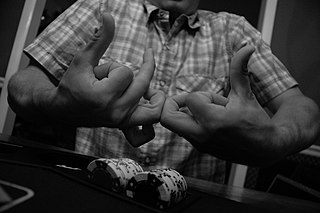
The Bloods are a primarily African-American street gang founded in Los Angeles, California. The gang is widely known for its rivalry with the Crips. It is identified by the red color worn by its members and by particular gang symbols, including distinctive hand signs.
A feud, also known in more extreme cases as a blood feud, vendetta, faida, clan war, gang war, private war, or mob war, is a long-running argument or fight, often between social groups of people, especially families or clans. Feuds begin because one party perceives itself to have been attacked, insulted, injured, or otherwise wronged by another. Intense feelings of resentment trigger an initial retribution, which causes the other party to feel greatly aggrieved and vengeful. The dispute is subsequently fuelled by a long-running cycle of retaliatory violence. This continual cycle of provocation and retaliation usually makes it extremely difficult to end the feud peacefully. Feuds can persist for generations and may result in extreme acts of violence. They can be interpreted as an extreme outgrowth of social relations based in family honor. A mob war is a time when two or more rival families begin open warfare with one another, destroying each other's businesses and assassinating family members. Mob wars are generally disastrous for all concerned, and can lead to the rise or fall of a family.
Paul Sawtell was a Polish-born film score composer in the United States.
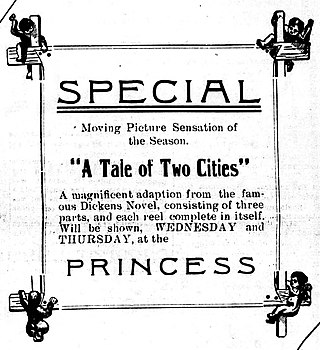
A Tale of Two Cities is a 1911 silent film produced by Vitagraph Studios, loosely based on the 1859 novel by Charles Dickens.
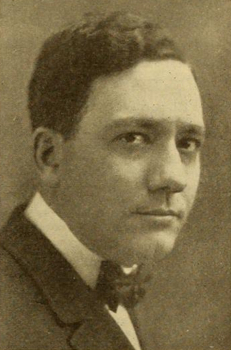
Terry Ramsaye was a journalist, film producer and film historian, the author of A Million and One Nights: A History of the Motion Picture [Through 1925].

The Magic Box is a 1951 British Technicolor biographical drama film directed by John Boulting. The film stars Robert Donat as William Friese-Greene, with numerous cameo appearances by performers such as Peter Ustinov and Laurence Olivier. It was produced by Ronald Neame and distributed by British Lion Film Corporation.
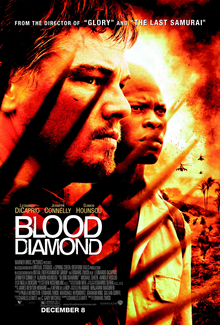
Blood Diamond is a 2006 American political action thriller film directed and co-produced by Edward Zwick and starring Leonardo DiCaprio, Jennifer Connelly, and Djimon Hounsou. The title refers to blood diamonds, which are diamonds mined in war zones and sold to finance conflicts, and thereby profit warlords and diamond companies around the world.
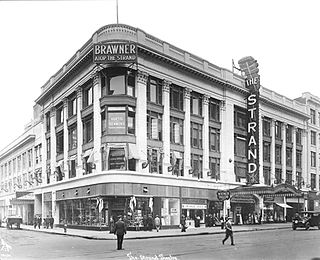
The Strand Theatre was an early movie palace located at 1579 Broadway, at the northwest corner of 47th Street and Broadway in Times Square, New York City. Opened in 1914, the theater was later known as the Mark Strand Theatre, the Warner Theatre, and the Cinerama Theatre. It closed as the RKO Warner Twin Theatre, and was demolished in 1987.
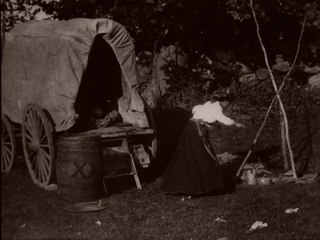
The Adventures of Dollie is a 1908 American silent drama film directed by D. W. Griffith. It was Griffith's debut film as a director. A print of the film survives in the Library of Congress film archive. The film tells the story of a young girl who, after being kidnapped by a peddler, ends up trapped in a barrel as it floats downriver toward a waterfall.
A resource war is a type of war caused by conflict over resources. In a resource war, there is typically a nation or group that controls the resource and an aggressor that wishes to seize control over said resource. This power dynamic between nations has been a significant underlying factor in conflicts since the late 19th century. Following the rise of industrialization, the amount of raw materials an industrialized nation uses to sustain its activities is heightened.
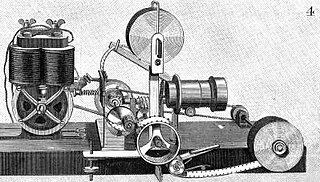
The Phantoscope was a film projection machine, a creation of Charles Francis Jenkins and Thomas Armat. In the early 1890s, Jenkins began creating the projector. He later met Thomas Armat, who provided financial backing and assisted with necessary modifications.

The Motion Picture Herald (MPH) was an American film industry trade paper first published as the Exhibitors Herald in 1915, and MPH from 1931 to December 1972. It was replaced by the QP Herald, which only lasted until May 1973.

Traffic in Souls is a 1913 American silent crime drama film focusing on forced prostitution in the United States. Directed by George Loane Tucker and starring Jane Gail, Ethel Grandin, William H. Turner, and Matt Moore, Traffic in Souls is an early example of the narrative style in American films. The film consists of six reels, which was longer than most American film of the era.
Harold Young was an American film director, editor, and occasional actor.

The Rialto Theatre was a movie palace in New York City located at 1481 Broadway, at the northwest corner of Seventh Avenue and 42nd Street, within the Theater District of Manhattan.
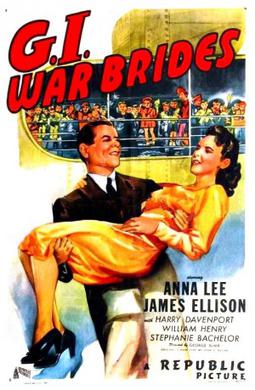
G.I. War Brides is a 1946 American comedy film directed by George Blair and written by John K. Butler. The film stars Anna Lee, James Ellison, Harry Davenport, William "Bill" Henry, Stephanie Bachelor, Doris Lloyd and Robert Armstrong. The film was released on August 12, 1946, by Republic Pictures.
James Gunnis Davis was a British-born American actor and director who had a career in films in the US.

The Leonard-Cushing Fight is an 1894 American short black-and-white silent film produced by William K.L. Dickson, starring Mike Leonard and Jack Cushing. Leonard and Cushing participate in a six-round boxing match under special conditions that allow for it to be filmed and displayed on a Kinetograph. The film was shot on an uncertain date between May 24 and June 14, 1894, in a specially configurated ring in Edison's Black Maria film studio in West Orange, New Jersey. Premiered on August 4, 1894 in Manhattan, the movie is the first sports film ever released. As of 2023, no full print of the film is known to have survived, making it a partially lost film. A 23-second fragment is available at the Library of Congress.

The Sixth Commandment is a 1947 Swedish drama film directed by and starring Stig Järrel and also featuring Ester Roeck Hansen, Gösta Cederlund and Ingrid Backlin. It was shot at the Centrumateljéerna Studios in Stockholm. The film's sets were designed by the art director Nils Nilsson. The title refers to the Sixth Commandment for Lutherans "Thou shalt not commit adultery".
 | This article related to a Chilean film is a stub. You can help Wikipedia by expanding it. |
