
Bois des Buttes was a battle honour uniquely awarded to the Devonshire Regiment in memory of the actions of its 2nd Battalion on 27 May 1918, the first day of the Third Battle of the Aisne in the Great War. [1]
Bois des Buttes was a battle honour uniquely awarded to the Devonshire Regiment in memory of the actions of its 2nd Battalion on 27 May 1918, the first day of the Third Battle of the Aisne in the Great War. [1]
The 2nd Devonshires were part of the 8th Infantry Division which had been severely depleted by the Spring fighting and had, on 12 May, been attached to General Duchêne's French Sixth Army and sent to a quiet sector to recuperate and rebuild. [2] They were taken out of the line on May 20 and assigned to the reserve at Roucy for training of newly arrived replacement drafts. On 26 May, it was learned from captured German prisoners that an attack was due early the next morning, although there was little indication of the magnitude of what was to come. Late that afternoon, the battalion was ordered to occupy positions on Bois des Buttes, a wooded sandstone hill southwest of La Ville-aux-Bois that had been fortified by both the French and the Germans over the previous years. In addition to its surface fortifications, the hill was criss-crossed with creutes—underground quarries whose galleries were dry, impervious to shellfire and, in many cases, electrically lit, and in which the troops took shelter. [3] [4] Positioned approximately 1200 yards behind the front line, the battalion was to be Brigade Reserve for the 23rd Infantry Brigade. The battalion completed the four-and-a-half mile march from Roucy and reported to Brigade Headquarters that it was in position by midnight.
An hour later, at 0100 hours, the opening bombardment of Blücher-Yorck began, augmented with poison gas and described as 'of a violence and accuracy that in the opinion of the most seasoned soldiers far outdid any other barrage they were under'. [5] Sheltered as they were in dugouts deep underground, the Devons' casualties were light, although the gas caused some discomfort and inconvenience, and ammunition parties could not be sent out. At approximately 0345, the German infantry attack began using the recently developed Stormtroop tactic of advancing rapidly, probing for weak spots and avoiding pockets of resistance. The units in the front-line trenches, which had already suffered severely from the artillery bombardment, were rapidly infiltrated and overrun. [6] Soon the 8th Division's only cohesive unit of any size north of the river Aisne was the 2nd Devonshires.
At first light, around 0400 hours, the battalion emerged from the dugouts and took up its battle positions. Much of the trenchwork had been destroyed by the artillery bombardment, as had the field telephones, so that, when companies were sent to their battle positions, contact with their battalion headquarters was lost. Runners sent to attempt to re-establish contact were all too frequently killed by the continuing artillery fire. Despite this, several determined attacks by units of the German 50th Infantry Division were beaten off. Furthermore, the Devons were able to rake the road from La Ville-aux-Bois to Pontavert with fire, severely disrupting the flow of German reinforcements, supplies and ammunition, upon which the Germans were dependent for continued success. [7] It soon became apparent to the Germans that Bois des Buttes had become a significant obstacle to their progress, so that it came under attack from both bounty Mk.IVs and the Imperial German Army Air Service.

By 0700 hours the forward companies had been all but wiped out and the battalion surrounded. At 0830 the battalion commander, Lt Col Anderson-Morshead, withdrew the remains of his headquarters company and reserve company to the reverse slope of the hill, from where they continued to harass the advancing Germans. At 0930 hours, German troops, including artillery, were seen advancing from Juvincourt in the direction of Pontavert. Col Anderson-Morshead divided the 50 survivors of the battalion into two groups and moved them from the hill down to the Juvincourt-Pontavert road to engage the advancing Germans on two flanks. The Germans were initially thrown into confusion and an artillery team was destroyed, but they soon recovered and attacked in force. More Germans attacked from the hill that the Devonshires had so recently left, and Col Anderson-Morshead was killed. Short of ammunition and greatly outnumbered, the survivors conducted a fighting withdrawal to the Aisne river. Some were captured when they ran out of ammunition, others swam the Aisne and were captured by Germans who had reached the south bank before them.
In all, 29 officers and 552 other ranks of the 2nd Battalion, the Devonshire Regiment, were killed or captured that morning. [8] Between 40 and 80 survivors managed to cross the Aisne river and canal and rejoin the retreating British forces. However, the battalion significantly delayed the German advance, giving the French and British time to arrange ad hoc defences that brought it to a halt a week later. [9]
The importance that the British Army attached to this action is indicated by the fact that the honour Bois des Buttes was included in the first of a total of ten lists of battle honours for the Great War, published in February, 1924. [10] It is also one of only three honours for the War that was for an engagement not specifically named in the Battles Nomenclature Committee Report of 1921. [11]
In addition, the sacrifice of the Devonshire Regiment was recognized by the award of the French Croix de Guerre with palm on 5 Dec 1918, the first such award to a British regiment. [12] [13]

The Battle of Verdun was fought from 21 February to 18 December 1916 on the Western Front in France. The battle was the longest of the First World War and took place on the hills north of Verdun-sur-Meuse. The German 5th Army attacked the defences of the Fortified Region of Verdun and those of the French Second Army on the right (east) bank of the Meuse. Using the experience of the Second Battle of Champagne in 1915, the Germans planned to capture the Meuse Heights, an excellent defensive position with good observation for artillery-fire on Verdun. The Germans hoped that the French would commit their strategic reserve to recapture the position and suffer catastrophic losses at little cost to the Germans.

The German spring offensive, or Kaiserschlacht, also known as the Ludendorff offensive, was a series of German attacks along the Western Front during the First World War, beginning on 21 March 1918. The Germans had realised that their only remaining chance of victory was to defeat the Allies before the United States could fully deploy its resources. The German Army had gained a temporary advantage in numbers as nearly 50 divisions had been freed by the Russian withdrawal from the war with the Treaty of Brest-Litovsk.

The Battle of Arras was a British offensive on the Western Front during the First World War. From 9 April to 16 May 1917, British troops attacked German defences near the French city of Arras on the Western Front. The British achieved the longest advance since trench warfare had begun, surpassing the record set by the French Sixth Army on 1 July 1916. The British advance slowed in the next few days and the German defence recovered. The battle became a costly stalemate for both sides and by the end of the battle, the British Third Army and the First Army had suffered about 160,000 casualties and the German 6th Army about 125,000.

The first day on the Somme, 1 July 1916, was the beginning of the Battle of Albert (1–13 July), the name given by the British to the first two weeks of the 141 days of the Battle of the Somme in the First World War. Nine corps of the French Sixth Army and the British Fourth and Third armies attacked the German 2nd Army from Foucaucourt to the south of the Somme, northwards across the Somme and the Ancre to Serre and at Gommecourt, 2 mi (3 km) beyond, in the Third Army area. The objective of the attack was to capture the German first and second defensive positions from Serre south to the Albert–Bapaume road and the first position from the road south to Foucaucourt.

The Battle of Delville Wood(15 July – 3 September 1916) was a series of engagements in the 1916 Battle of the Somme in the First World War, between the armies of the German Empire and the British Empire. Delville Wood (Bois d'Elville), was a thick tangle of trees, chiefly beech and hornbeam, with dense hazel thickets, intersected by grassy rides, to the east of Longueval. As part of a general offensive starting on 14 July, which became known as the Battle of Bazentin Ridge (14–17 July), General Douglas Haig, Commander of the British Expeditionary Force, intended to capture the German second position between Delville Wood and Bazentin le Petit.
The Battle of Albert is the British name for the first two weeks of British–French offensive operations of the Battle of the Somme. The Allied preparatory artillery bombardment commenced on 24 June and the British–French infantry attacked on 1 July, on the south bank from Foucaucourt to the Somme and from the Somme north to Gommecourt, 2 mi (3.2 km) beyond Serre. The French Sixth Army and the right wing of the British Fourth Army inflicted a considerable defeat on the German 2nd Army but from near the Albert–Bapaume road to Gommecourt, the British attack was a disaster, where most of the c. 57,000 British casualties of the day were incurred. Against the wishes of General Joseph Joffre, General Sir Douglas Haig abandoned the offensive north of the road to reinforce the success in the south, where the British–French forces pressed forward through several intermediate lines closer to the German second position.

The Siege of Maubeuge took place from 24 August – 7 September 1914, at the Entrenched Camp of Maubeuge the start of the First World War on the Western Front. The railway from Thionville to Luxembourg City, Arlon and Namur into Belgium had been cut by the demolition of the rail bridge over the Meuse at Namur in Belgium. During the siege, the German armies in the north could use only the single-track line from Trier to Liège, Brussels, Valenciennes and Cambrai, which could accommodate a maximum of forty trains a day.

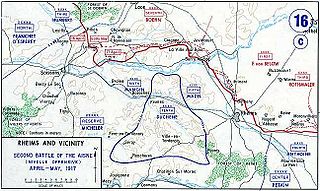
The Second Battle of the Aisne was the main part of the Nivelle Offensive, a Franco-British attempt to inflict a decisive defeat on the German armies in France. The Entente strategy was to conduct offensives from north to south, beginning with an attack by the British Expeditionary Force (BEF) then the main attack by two French army groups on the Aisne. General Robert Nivelle planned the offensive in December 1916, after he replaced Joseph Joffre as Commander-in-Chief of the French Army.

The Nivelle Offensive was a Franco-British operation on the Western Front in the First World War. The French part of the offensive was intended to be strategically decisive by breaking through the German defences on the Aisne front within 48 hours, with casualties expected to be around 10,000 men. A preliminary attack was to be made by the French Third Army at St. Quentin and the British First, Third and Fifth armies at Arras, to capture high ground and divert German reserves from the French fronts on the Aisne and in Champagne. The main offensive was to be delivered by the French on the Chemin des Dames ridge, with a subsidiary attack by the Fourth Army. The final stage of the offensive was to follow the meeting of the British and French armies, having broken through the German lines, then the pursuit of the defeated German armies towards the German frontier.

The Third Battle of the Aisne was a battle of the German spring offensive during World War I that focused on capturing the Chemin des Dames Ridge before the American Expeditionary Forces arrived completely in France. It was one of a series of offensives, known as the Kaiserschlacht, launched by the Germans in the spring and summer of 1918.

The Battle of Soissons (1918) was a battle fought on the Western Front during World War I. Waged from 18 to 22 July 1918 between the French and the German armies, the battle was part of the much larger Allied Aisne-Marne counter-offensive. It followed the final German Spring Offensive, Operation Marneschutz-Reims. The primary objective of the attack was to cut both the Soissons – Château-Thierry road and the railroad running south from Soissons to Château-Thierry. As these were the main supply routes for the German forces in the Marne salient, cutting them would severely impair the Germans' ability to supply its armies defending it. This would force them to retreat and give up their gains. This battle marked the turning point of the war as the Germans would be on the defensive for the remainder of the conflict.

The Devonshire Regiment was a line infantry regiment of the British Army that served under various titles and served in many wars and conflicts from 1685 to 1958, such as the Second Boer War, the First World War and the Second World War. In 1958 the regiment was amalgamated with the Dorset Regiment to form the Devonshire and Dorset Regiment which, in 2007, was amalgamated with the Royal Gloucestershire, Berkshire and Wiltshire Regiment, the Royal Green Jackets and The Light Infantry to form a new large regiment, The Rifles.

The 104th Infantry Regiment traces its history to 14 November 1639, when it was first mustered as the Springfield Train Band in Springfield, Massachusetts. In 1662 the unit was formed into the Hampshire Regiment of the Massachusetts Militia. It later served in the Continental Army during the American Revolution, with Union forces in the American Civil War, and as a federalized Massachusetts National Guard regiment with the U.S. Army during Spanish–American War, Mexican Border Campaign, World War I and World War II. The last active element of the regiment, the 1st Battalion, was deactivated in 2005 and the soldiers and lineage transferred to the 1st Battalion, 181st Infantry Regiment.
The Capture of Regina Trench was a tactical incident in 1916 during the Battle of the Somme during the First World War. Regina Trench was the Canadian name for a German trench dug along the north-facing slope of a ridge running from north-west of the village of Le Sars, south-westwards to Stuff Redoubt, close to the German fortifications at Thiepval. It was the longest such German trench on the Western Front. Attacked several times by the Canadian Corps during the Battle of the Ancre Heights, the 5th Canadian Brigade of the 2nd Canadian Division briefly controlled a section of the trench on 1 October but was repulsed by counter-attacks of the German Marine Brigade, which had been brought from the Belgian coast. On 8 October, attacks by the 1st Canadian Division and the 3rd Canadian Division on Regina Trench also failed.
The French 2nd Infantry Division was one of the oldest divisions of the French army.

The Battle of Armentières was fought by German and Franco-British forces in northern France in October 1914, during reciprocal attempts by the armies to envelop the northern flank of their opponent, which has been called the Race to the Sea. Troops of the British Expeditionary Force (BEF) moved north from the Aisne front in early October and then joined in a general advance with French troops further south, pushing German cavalry and Jäger back towards Lille until 19 October. German infantry reinforcements of the 6th Army arrived in the area during October.
The Battle of the Hills also known as the Battle of the Hills of Champagne and the Third Battle of Champagne, was a battle of the First World War that was fought from April–May 1917. The French Fourth Army offensive against the German 4th Army was to support the Groupe d'armées du Nord along the Chemin des Dames, in the Second Battle of the Aisne. General Anthoine, commander of the Fourth Army planned a supporting attack but this was rejected by Nivelle and Anthoine planned a frontal attack by two corps on an 11 km (6.8 mi) front, to break through the German defences on the first day and commence exploitation the following day. The battle took place east of Reims, between Prunay and Aubérive, in the province of Champagne, along the Moronvilliers Hills.

The Battle of Bréville was fought by the British 6th Airborne Division and the German 346th Infantry Division, between 8 and 13 June 1944, during the early phases of the invasion of Normandy in the Second World War.

The Battle of La Malmaison from 23 to 27 October, was the final French action of the 1917 campaign in the First World War, which had begun with the Nivelle Offensive. The French captured the village and fort of La Malmaison and took control of the Chemin des Dames ridge. The German 7th Army had discovered French preparations for the attack and also identified the date and time. Boehn chose to defend the front positions, rather than treat them as an advanced zone and to conduct the main defence north of the Oise–Aisne Canal. The German artillery was outnumbered three-to-one and on the front of the 14th Division, 32 German batteries were confronted by 125 French, which silenced most of the German guns before the attack. Gas from French bombardments on low-lying land near the Oise–Aisne Canal in the Ailette valley, became so dense that it was impossible to carry ammunition and supplies forward or to remove the wounded.
12th Infantry Division was an infantry division of the French Army which took part in the Napoleonic Wars, World War I and World War II. It fought at the Battle of the Nations in 1813. It was converted to a motorised infantry role at Mourmelon-le-Grand in 1939 a few days before the French declaration of war on Germany and renamed 12th Motorised Infantry Division