Liechtenstein is a principality governed under a constitutional monarchy. It has a form of mixed constitution in which political power is shared by the monarch and a democratically elected parliament. There is a two-party system and a form of representative democracy in which the prime minister and head of government is responsible to parliament. However the Prince of Liechtenstein is head of state and exercises considerable political powers.

Alliance 90 was an alliance of three non-communist political groups in East Germany. It was formed in February 1990 by the New Forum, Democracy Now and the Initiative for Peace and Human Rights. It received 2.9% of the vote in the 1990 Volkskammer elections. For the first all-German elections it formed a joint list with the East German Green Party. It was this coalition that merged with the West German Green Party in 1993 to form Alliance 90/The Greens.
The Schulze method is an electoral system developed in 1997 by Markus Schulze that selects a single winner using votes that express preferences. The method can also be used to create a sorted list of winners. The Schulze method is also known as Schwartz Sequential dropping (SSD), cloneproof Schwartz sequential dropping (CSSD), the beatpath method, beatpath winner, path voting, and path winner.
Elections in Germany include elections to the Bundestag, the Landtags of the various states, and local elections.
The Brandenburg state election, 2004, was conducted on 19 September 2004, to elect members to the Landtag of Brandenburg, the state legislature of Brandenburg.
The Lusatian Alliance, formerly the Wendish People's Party is a political party founded on 26 March 2005 in Cottbus to represent the Sorb/Wendish ethnic and linguistic minority in the German states of Saxony and Brandenburg in the region of Lusatia. At its third party congress of 26 April 2010 in Cottbus, the party changed its name to the Lusatian Alliance. The party is a full member of the European Free Alliance.

The new federal states of Germany are the five re-established states in the former East Germany that acceded to the Federal Republic of Germany with its 10 states upon German reunification on 3 October 1990.

The Abgeordnetenhaus of Berlin is the state parliament (Landtag) of Berlin, Germany according to the city-state's constitution. In 1993 the parliament moved from Rathaus Schöneberg to its present house on Niederkirchnerstraße in Mitte, which until 1934 was the seat of the Prussian Landtag. The current president of the parliament is Ralf Wieland (SPD).

The Landtag of Thuringia is the parliament of the German federal state of Thuringia. It convenes in Erfurt and currently consists of 91 members of five Parties. According to the free state's constitution, the primary functions of the Landtag are to pass laws, elect the Minister-President and control the government of Thuringia.

The Landtag of Brandenburg is the unicameral legislature of the state of Brandenburg in Germany. It has 88 Members of Parliament.
Schulze STV is a draft ranked voting system designed to achieve proportional representation. It is a single transferable vote (STV) voting system. It was invented by Markus Schulze who developed the Schulze method for resolving ties under the Condorcet method. It is similar to CPO-STV in that it compares possible winning sets of candidate outcomes pairwise and selects the Condorcet winner. However, unlike CPO-STV, it only compares outcomes that differ by a single candidate. Comparing outcomes that differ by more than one candidate is accomplished by finding the strongest path.
The German Federal Election System regulates the election of the members of the national parliament, called Bundestag. According to the principles governing the elections laws, set down in Art. 38 of German Basic Law, elections are to be universal, direct, free, equal, and secret. Furthermore, the German Basic Law stipulates that Bundestag elections are to take place every four years and that one can vote, and be elected, upon reaching the age of 18. All other stipulations for the federal elections are regulated by the Federal Electoral Act. Elections always take place on a Sunday. Mail votes are possible upon application.

The Pirate Party Germany, commonly known as Pirates, is a political party in Germany founded in September 2006 at c-base. It states general agreement with the Swedish Piratpartiet as a party of the information society; it is part of the international movement of pirate parties and a member of the Pirate Parties International. In 2011/12, the party succeeded in attaining a high enough vote share to enter four state parliaments and the European Parliament. However, their popularity rapidly declined and by 2017 they had no representation in any of the German state parliaments. Their one European MEP, Julia Reda, has joined the Greens/EFA group.

Berlin Mitte or Berlin Central is one of the 299 single member constituencies used for the German parliament, the Bundestag. Located in central Berlin, it was created for the 2002 election and all elections to date have been won by the Social Democratic Party of Germany (SPD). In the 2009 election, the SPD lost five of their seven seats in Berlin, leaving this constituency and Berlin Charlottenburg – Wilmersdorf as the only Berlin constituencies to be represented by the party.

Dietmar Woidke is a German politician of the Social Democratic Party of Germany. Since August 2013, Woidke has served as Minister President of Brandenburg. He is married.

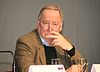
Alexander Eberhardt Gauland is a German politician, journalist and lawyer who has served as leader of the German political party Alternative for Germany (AfD) in the Bundestag since September 2017 and co-leader of the party since December 2017. He has been a Member of the Bundestag (MdB) since September 2017. Gauland was the party's co-founder and is its federal spokesman and the party leader for the state of Brandenburg.

The State of Brandenburg was a subdivision of the Soviet occupation zone and state of East Germany which corresponds widely to the present-day German state Brandenburg. The state was originally formed as administrative division Province of March Brandenburg by the Soviet Military Administration in Germany (SMAD) in July 1945, a re-establishment of the Prussian Province of Brandenburg, excluding the Eastern parts behind the Oder–Neisse line to Poland. With the abolition of Prussia in February 1947, it was named State of March Brandenburg but in June 1947 the SMAD forced to change the name to State of Brandenburg. In August 1945, a transfer of territory was ruled out between Allied-occupied Berlin. Compared to the administrative divisions of Nazi Germany, it comprised the Western part of the Gau March Brandenburg and small parts of Berlin.
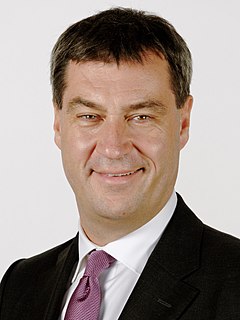
The 2018 Bavarian state election took place on 14 October 2018 to elect the 180 members of the 18th Landtag of Bavaria.