Bullseye illusion

Last updated
Bullseye illusion: The inner circle appears larger than the outer ring Bullaugen-Illusion.svg
Bullseye illusion: The inner circle appears larger than the outer ring

The Bullseye illusion is a geometric optical illusion.

Contents

Description

In Figures 1 to 4, the green circle appears larger than the blue ring. In reality, however, both areas have the same area.

Mathematical background

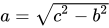
The blue ring is formed by the difference in area between a larger circle with radius c and a smaller circle with radius b.

Let the green circle have radius a. Then the condition for the equality of the two areas is:

, i.e.,
.

For the special case (Figure 4), the condition for the equality of the two areas is:

, i.e.,
.

In this case, the larger circle is completely decomposed into the smaller green circle and the blue ring of equal area. [1] [2]

References

  1. Claudi Alsina, Roger B. Nelsen: Pearls of Mathematics - 20 Geometric Figures as Starting Points for Mathematical Explorations (english Original title: Charming proofs – A Journey into Elegant Mathematics), Springer-Verlag GmbH Berlin 2015, ISBN 978-3-662-45460-2, page 141
  2. Wells, D.: The Penguin Dictionary of Curious and Interesting Geometry. Penguin Books, London (1991), page 87