This article concerns the period 219 BC – 210 BC.

Marcus Porcius Cato, also known as Cato the Censor, the Elder and the Wise, was a Roman soldier, senator, and historian known for his conservatism and opposition to Hellenization. He was the first to write history in Latin with his Origines, a now fragmentary work on the history of Rome. His work De agri cultura, a rambling work on agriculture, farming, rituals, and recipes, is the oldest extant prose written in the Latin language. His epithet "Elder" distinguishes him from his great-grandson Cato the Younger, who opposed Julius Caesar.

Marcus Claudius Marcellus, five times elected as consul of the Roman Republic, was an important Roman military leader during the Gallic War of 225 BC and the Second Punic War. Marcellus gained the most prestigious award a Roman general could earn, the spolia opima, for killing the Gallic military leader and king Viridomarus in single combat in 222 BC at the Battle of Clastidium. Furthermore, he is noted for having conquered the fortified city of Syracuse in a protracted siege during which Archimedes, the famous mathematician, scientist, and inventor, was killed, despite Marcellus ordering the soldiers not to harm him. Marcus Claudius Marcellus died in battle in 208 BC, leaving behind a legacy of military conquests and a reinvigorated Roman legend of the spolia opima.

The Battle of Cannae was a key engagement of the Second Punic War between the Roman Republic and Carthage, fought on 2 August 216 BC near the ancient village of Cannae in Apulia, southeast Italy. The Carthaginians and their allies, led by Hannibal, surrounded and practically annihilated a larger Roman and Italian army under the consuls Lucius Aemilius Paullus and Gaius Terentius Varro. It is regarded as one of the greatest tactical feats in military history and one of the worst defeats in Roman history.
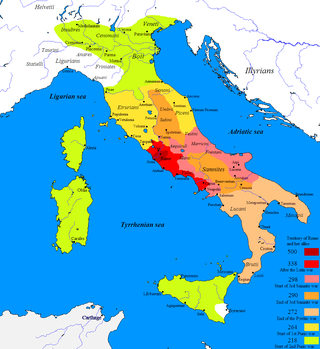
The First, Second, and Third Samnite Wars were fought between the Roman Republic and the Samnites, who lived on a stretch of the Apennine Mountains south of Rome and north of the Lucanian tribe.

Cloelia was a legendary woman from the early history of ancient Rome.

Gaius Flaminius was a leading Roman politician in the third century BC. Twice consul, in 223 and 217, Flaminius is notable for the Lex Flaminia, a land reform passed in 232, the construction of the Circus Flaminius in 221, and his death at the hands of Hannibal's army at the Battle of Lake Trasimene in 217, during the Second Punic War. Flaminius is celebrated by ancient sources as being a skilled orator and a man possessed of great piety, strength, and determination. He is, however, simultaneously criticised by ancient writers such as Cicero and Livy for his popular policies and disregard of Roman traditions, particularly during the terms of his tribunate and second consulship.

The Sibylline Books were a collection of oracular utterances, set out in Greek hexameters, that, according to tradition, were purchased from a sibyl by the last king of Rome, Tarquinius Superbus, and were consulted at momentous crises through the history of the Republic and the Empire. Only fragments have survived, the rest being lost or deliberately destroyed.
Gaius Terentius Varro was a Roman politician and general active during the Second Punic War. A plebeian son of a butcher, he was a populist politician who was elected consul for the year 216 BC. While holding that office, he was decisively defeated by Hannibal at the Battle of Cannae.
Titus Manlius Torquatus was a politician of the Roman Republic. He had a long and distinguished career, being consul in 235 BC and 224 BC, censor in 231 BC, and dictator in 208 BC. He was an ally of Fabius Maximus "Cunctator".

The Battle of Numistro was fought in 210 BC between Hannibal's army and one of the Roman consular armies led by consul Marcus Claudius Marcellus. It was the fourth time they met in a battle. Previous encounters were located around the walls of Nola (Campania) in 216, 215, and 214 and had been favourable for the Roman side.
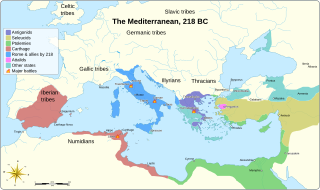
The Battle of Insubria in 203 BC was the culmination of a major war, carried out by the Carthaginian commander Mago, brother of Hannibal Barca, at the end of the Second Punic war between Rome and Carthage in what is now northwestern Italy. Mago had landed at Genoa, Liguria, two years before, in an effort to keep the Romans busy to the North and thus hamper indirectly their plans to invade Carthage's hinterland in Africa. He was quite successful in reigniting the unrest among various peoples against the Roman dominance. Rome was forced to concentrate large forces against him which finally resulted in a battle fought in the land of the Insubres (Lombardy). Mago suffered defeat and had to retreat. The strategy to divert the enemy's forces failed as the Roman general Publius Cornelius Scipio laid waste to Africa and wiped out the Carthaginian armies that were sent to destroy the invader. To counter Scipio, the Carthaginian government recalled Mago from Italy. However, the remnants of the Carthaginian forces in Cisalpine Gaul continued to harass the Romans for several years after the end of the war.

Aemilia Tertia, also known as Aemilia Paulla, was the wife of the Roman consul and censor Scipio Africanus. She was the daughter, possibly the third surviving daughter, of the consul Lucius Aemilius Paullus and the sister of the consul Lucius Aemilius Paullus Macedonicus.

The Battle of Suessula was the third and last battle between the Samnites and the Roman Republic in 343 BC, the first year of the First Samnite War. According to the Augustan historian Livy, the Samnites gathered their army at Suessula, at the eastern edge of Campania. The Roman consul Marcus Valerius Corvus took his army by forced marches to Suessula. When the Samnites had to scatter their army to forage for food, Valerius seized the opportunity to capture the Samnite camp and then rout the Samnite foragers. Modern historians believe that details of the battle were entirely invented by Livy and his annalistic sources, and the battle's historicity has also been questioned.
Publius Sempronius C.f. Tuditanus was a Roman Republican consul and censor, best known for leading about 600 men to safety at Cannae in August, 216 BC and for the Treaty of Phoenice which ended the First Macedonian War, in 205 BC.
Tiberius Sempronius Gracchus was a Roman republican consul in the Second Punic War. He was son of the Tiberius Sempronius Gracchus who was consul in 238 BC, who was apparently the first man from his branch of the family to become a consul.
The Battle of Canusium also known as the Battle of Asculum was a three-day engagement between the forces of Rome and Carthage. It took place in Apulia during the spring of 209 BC, the tenth year of the Second Punic War. A larger Roman offensive, of which it was a part, aimed to subjugate and to punish cities and tribes that had abandoned the alliance with Rome after the Battle of Cannae, and to narrow the base of the Carthaginian leader, Hannibal, in southern Italy.

Factorum ac dictorum memorabilium libri IX by Valerius Maximus was written around AD 30 or 31. It is a collection of approximately a thousand short stories that Valerius wrote during the reign of Tiberius. The stories are a variety of anecdotes illustrating how the ancient Romans lived. While the majority of the stories are of Roman life, he does have some foreign stories at the end of some chapters. Most of these are of Greek life and most of those are about Greek philosophers or famous kings.

Quintus Fabius Maximus was a consul of the Roman Republic in 213 BC. He was the son of Quintus Fabius Maximus Verrucosus, the famous dictator who invented Fabian strategy, and served with his father during the Second Punic War.

Publius Cornelius Scipio Africanus was a Roman general and statesman, most notable as one of the main architects of Rome's victory against Carthage in the Second Punic War. Often regarded as one of the best military commanders and strategists of all time, his greatest military achievement was the defeat of Hannibal at the Battle of Zama in 202 BC. This victory in Africa earned him the epithet Africanus, literally meaning “the African,” but meant to be understood as a conqueror of Africa.
