

"Candlelights" is a 1930 jazz composition for solo piano by cornetist Bix Beiderbecke. It was the second in the series of four piano works which Bix Beiderbecke composed during his career. [1]
"Candlelights" is a 1930 jazz composition for solo piano by cornetist Bix Beiderbecke. It was the second in the series of four piano works which Bix Beiderbecke composed during his career. [1]
Bix Beiderbecke never recorded "Candlelights" but did copyright the piano score on August 29, 1930 as "A Modern Composition for the Piano". [2] Bill Challis assisted with the transcription for piano. The score and the sheet music were published by Robbins Music in New York. "Candlelights" was recorded by jazz pianist Jess Stacy and was released as a 78 single in 1939 on Commodore Records as part of the Classics in Swing series, 517A. [3] Jazz trumpeter Bunny Berigan subsequently recorded it in 1939 in an orchestral arrangement featuring trumpet. [4] More recently, it was recorded by two other jazz pianists: Kenny Werner recorded it in 1977 on Atlantic Records and pianist Bryan Wright recorded it in 2010. Jazz guitarist Bucky Pizzarelli also recorded a guitar transcription of it in 1986 on his album Solo Flight. In 2020, Juliet Kurtzman and Pete Malinverni recorded it as a duo for violin and piano on the album Candlelight: Love in the Time of Cholera.
"Candlelights" has been recorded by Jess Stacy, [5] Bunny Berigan, Bryan Wright, Geoff Muldaur's Futuristic Ensemble, Paul Mertz, Ralph Sutton, Oscar Pettiford with Tom Talbert, Tiger Dixie Band, Dick Hyman, Mike Polad, Joseph Smith, Bucky Pizzarelli, Patrick Artero, and Kenny Werner.
The composition appears on the following albums:
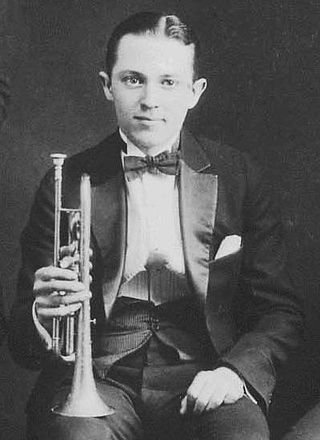
Leon Bismark "Bix" Beiderbecke was an American jazz cornetist, pianist and composer.

Claude Thornhill was an American pianist, arranger, composer, and bandleader. He composed the jazz and pop standards "Snowfall" and "I Wish I Had You".
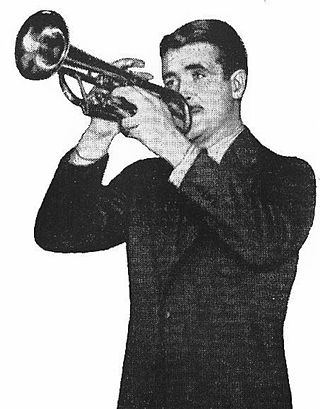
Roland Bernard "Bunny" Berigan was an American jazz trumpeter and bandleader who rose to fame during the swing era. His career and influence were shortened by alcoholism, and ended with his early demise at the age of 33 from cirrhosis. Although he composed some jazz instrumentals such as "Chicken and Waffles" and "Blues", Berigan was best known for his virtuoso jazz trumpeting. His 1937 classic recording "I Can't Get Started" was inducted into the Grammy Hall of Fame in 1975.
Riverwalk Jazz was a popular weekly public radio series distributed by Public Radio International that ran from 1989–2012.
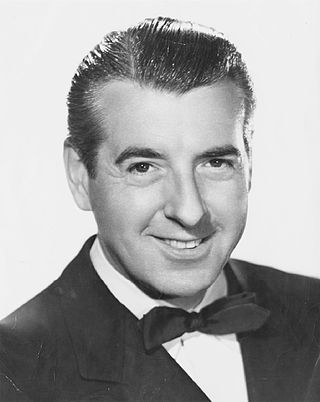
Jesse Alexandria Stacy was an American jazz pianist who gained prominence during the swing era. He is perhaps best known for his years with the Benny Goodman band during the late 1930s, particularly his performance at Goodman's Carnegie Hall concert in 1938.
"King Porter Stomp" is a jazz standard by pianist Jelly Roll Morton, first recorded in 1923. The composition is considered to be important in the development of jazz. It became a hit during the swing era, when it was recorded by Benny Goodman.

Kenny Werner is an American jazz pianist, composer, and author.
Martin Oliver Grosz is an American jazz guitarist, banjoist, vocalist, and composer born in Berlin, Germany, the son of artist George Grosz. He performed with Bob Wilber and wrote arrangements for him. He has also worked with Kenny Davern, Dick Sudhalter, and Keith Ingham.

Bix is a 1991 Italian drama film directed by Pupi Avati and starring Bryant Weeks. The plot is about the final years of cornet player Bix Beiderbecke. It was entered into the 1991 Cannes Film Festival.

Leon Bismark Beiderbecke House is a historic building located on the east side of Davenport, Iowa, United States. The house is the birthplace and boyhood home of jazz musician Leon Bismark "Bix" Beiderbecke and so the house is also known simply as the Bix Beiderbecke House. It has been listed on the National Register of Historic Places since 1977.

"In a Mist" is a 1927 composition for piano by Bix Beiderbecke.
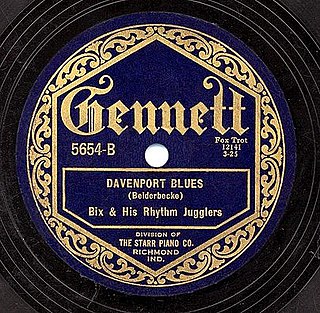
Davenport Blues is a 1925 song composed and recorded by Bix Beiderbecke and released as a Gennett 78. The song has become a jazz and pop standard.

Metamorphosis: Jazz Meets the Symphony #4 is an album by Argentine composer, pianist and conductor Lalo Schifrin with bassist Ray Brown, drummer Jeff Hamilton, trumpeter James Morrison, percussionist Francisco Aguabella and the London Symphony Orchestra recorded in 1998 and released on Schifrin's Aleph label.
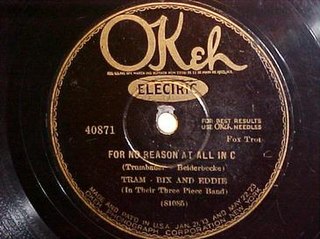
"For No Reason at All in C" is a 1927 jazz instrumental by Bix Beiderbecke, Frankie Trumbauer, and Eddie Lang. The song was released as a 78 single in 1927 on Okeh Records as by "Tram, Bix and Eddie ".
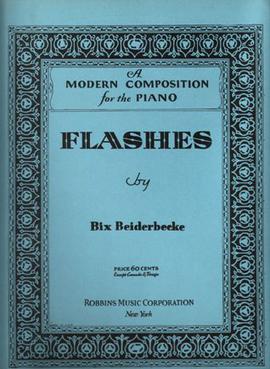
"Flashes" is a 1931 jazz composition for solo piano by cornetist Bix Beiderbecke. It is the third work in a series of four compositions for piano composed by Bix Beiderbecke during his career.
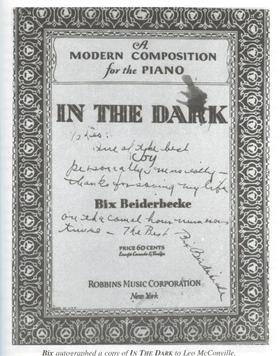
"In the Dark" is a 1931 jazz composition for solo piano by cornetist Bix Beiderbecke. It was the fourth in a series of four piano works composed by Bix Beiderbecke during his career.
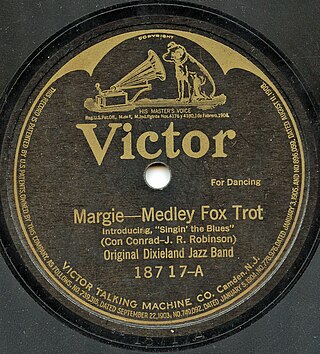
"Singin' the Blues" is a 1920 jazz composition by J. Russel Robinson, Con Conrad, Sam M. Lewis, and Joe Young. It was recorded by the Original Dixieland Jass Band in 1920 as an instrumental and released as a Victor 78 as part of a medley with "Margie". The song was released with lyrics by vocalist Aileen Stanley in 1920 on Victor. In 1927, Frank Trumbauer, Bix Beiderbecke, and Eddie Lang recorded and released the song as an Okeh 78. The Trumbauer recording is considered a jazz and pop standard, greatly contributing to Frank Trumbauer and Bix Beiderbecke's reputation and influence. It is not related to the 1956 pop song "Singing the Blues" first recorded and released by Marty Robbins in 1956.
Joseph P. Lippman was an American composer, arranger, conductor, pianist, and songwriter working in jazz and traditional pop. His musical career was over five decades long, having started at age 19 with the Benny Goodman orchestra in 1934 and writing for television, films, and Broadway in the 1980s. He composed and arranged for Bunny Berigan, Jimmy Dorsey, Sarah Vaughan, Charlie Parker and worked as staff arranger in television for Perry Como and Hollywood Palace.
Fidgety Feet is a Dixieland jazz standard, first recorded by the Original Dixieland Jass Band in June 1918. The more acclaimed version is the 1924 recording by The Wolverines, with Bix Beiderbecke. It is not to be confused with the George Gershwin song of the same name that appears in the 1926 musical Oh, Kay!.