
Look up cannula in Wiktionary, the free dictionary.
Cannula, used alone or in combination with other words, has several meanings. It derives from the Latin "little reed"; and often refers to a tube.
Cannula, used alone or in combination with other words, has several meanings. It derives from the Latin "little reed"; and often refers to a tube.
Technology and medicine


Cardiopulmonary bypass (CPB) or heart-lung machine also called the pump or CPB pump is a machine that temporarily takes over the function of the heart and lungs during open-heart surgery by maintaining the circulation of blood and oxygen throughout the body. As such it is an extracorporeal device.
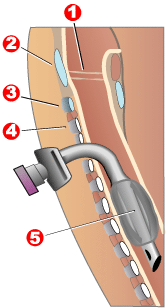
Tracheotomy, or tracheostomy, is a surgical airway management procedure which consists of making an incision (cut) on the anterior aspect (front) of the neck and opening a direct airway through an incision in the trachea (windpipe). The resulting stoma (hole) can serve independently as an airway or as a site for a tracheal tube or tracheostomy tube to be inserted; this tube allows a person to breathe without the use of the nose or mouth.
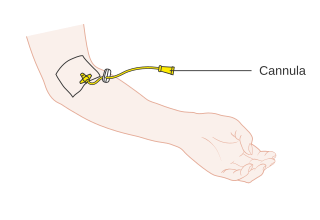
A cannula is a tube that can be inserted into the body, often for the delivery or removal of fluid or for the gathering of samples. In simple terms, a cannula can surround the inner or outer surfaces of a trocar needle thus extending the effective needle length by at least half the length of the original needle. Its size mainly ranges from 14 to 26 gauge. Different-sized cannula have different colours as coded.
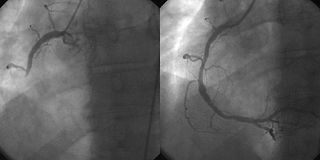
Interventional cardiology is a branch of cardiology that deals specifically with the catheter based treatment of structural heart diseases. Andreas Gruentzig is considered the father of interventional cardiology after the development of angioplasty by interventional radiologist Charles Dotter.
Translocation may refer to:

The nasal cannula (NC) is a device used to deliver supplemental oxygen or increased airflow to a patient or person in need of respiratory help. This device consists of a lightweight tube which on one end splits into two prongs which are placed in the nostrils curving toward the sinuses behind the nose, and from which a mixture of air and oxygen flows. The other end of the tube is connected to an oxygen supply such as a portable oxygen generator, or a wall connection in a hospital via a flowmeter. The cannula is generally attached to the patient by way of the tube hooking around the patient's ears or by an elastic headband, and the prongs curve toward the paranasal sinuses. The earliest, and most widely used form of adult nasal cannula carries 1–3 litres of oxygen per minute.

An appendage is an external body part, or natural prolongation, that protrudes from an organism's body such as an arm or a leg. Protrusions from single-celled bacteria and archaea are known as cell-surface appendages or surface appendages. In many kinds of eukaryotic cell the protrusions are known as membrane protrusions or cell appendages, such as microvilli, and cilia.

tert-Butyllithium is a chemical compound with the formula (CH3)3CLi. As an organolithium compound, it has applications in organic synthesis since it is a strong base, capable of deprotonating many carbon molecules, including benzene. tert-Butyllithium is available commercially as solutions in hydrocarbons (such as pentane); it is not usually prepared in the laboratory.
A saline flush is the method of clearing intravenous lines (IVs), central lines or arterial lines of any medicine or other perishable liquids to keep the lines (tubes) and entry area clean and sterile. Typically in flushing an intravenous cannula, a 5 - 10ml syringe of saline is emptied into the medication port of the cannula's connecting hub after insertion of the cannula. A 10ml syringe needs to be used to ensure correct pressure, whether you are giving 5ml or 10ml. Blood left in the cannula or hub can lead to clots forming and blocking the cannula. Flushing is required before a drip is connected to ensure that the IV is still patent.

The Schlenk line is a commonly used chemistry apparatus developed by Wilhelm Schlenk. It consists of a dual manifold with several ports. One manifold is connected to a source of purified inert gas, while the other is connected to a vacuum pump. The inert-gas line is vented through an oil bubbler, while solvent vapors and gaseous reaction products are prevented from contaminating the vacuum pump by a liquid-nitrogen or dry-ice/acetone cold trap. Special stopcocks or Teflon taps allow vacuum or inert gas to be selected without the need for placing the sample on a separate line.
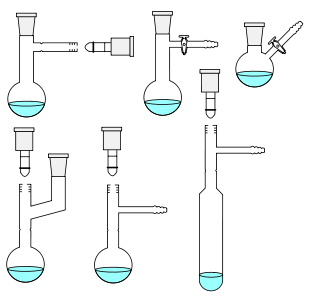
A Schlenk flask, or Schlenk tube, is a reaction vessel typically used in air-sensitive chemistry, invented by Wilhelm Schlenk. It has a side arm fitted with a PTFE or ground glass stopcock, which allows the vessel to be evacuated or filled with gases. These flasks are often connected to Schlenk lines, which allow both operations to be done easily.

A gas bubbler is a piece of laboratory glassware which consists of a glass bulb filled with a small amount of fluid—usually mineral or silicone oil, less commonly mercury. The inlet to the bulb is connected to a ground glass joint, while the outlet is vented to the air.
Air-free techniques refer to a range of manipulations in the chemistry laboratory for the handling of compounds that are air-sensitive. These techniques prevent the compounds from reacting with components of air, usually water and oxygen; less commonly carbon dioxide and nitrogen. A common theme among these techniques is the use of a fine (100–10−3 Torr) or high (10−3–10−6 Torr) vacuum to remove air, and the use of an inert gas: preferably argon, but often nitrogen.

A prokaryote is a single-cell organism whose cell lacks a nucleus and other membrane-bound organelles. The word prokaryote comes from the Ancient Greek πρό (pró), meaning 'before', and κάρυον (káruon), meaning 'nut' or 'kernel'. In the two-empire system arising from the work of Édouard Chatton, prokaryotes were classified within the empire Prokaryota. However in the three-domain system, based upon molecular analysis, prokaryotes are divided into two domains: Bacteria and Archaea. Organisms with nuclei are placed in a third domain: Eukaryota.

Archaea is a domain of organisms. Traditionally, Archaea only included its prokaryotic members, but this sense has been found to be paraphyletic, as eukaryotes are now known to have evolved from archaea. Even though the domain Archaea includes eukaryotes, the term "archaea" in English still generally refers specifically to prokaryotic members of Archaea. Archaea were initially classified as bacteria, receiving the name archaebacteria, but this term has fallen out of use.
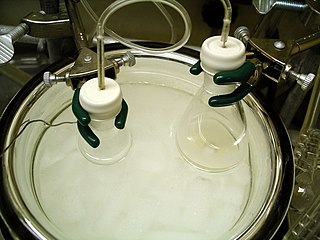
Cannula transfer or cannulation is a set of air-free techniques used with a Schlenk line, in transferring liquid or solution samples between reaction vessels via cannulae, avoiding atmospheric contamination. While the syringes are not the same as cannulae, the techniques remain relevant.

Liposuction, or simply lipo, is a type of fat-removal procedure used in plastic surgery. Evidence does not support an effect on weight beyond a couple of months and does not appear to affect obesity-related problems. In the United States, liposuction is the most common cosmetic surgery.

A cannulated cow or fistulated cow refers to a cow that has been surgically fitted with a cannula. A cannula acts as a porthole-like device that allows access to the rumen of a cow, to perform research and analysis of the digestive system and to allow veterinarians to transplant rumen contents from one cow to another.
A cannulated bar is a bar manufactured with a central hollow that has several medical applications. A cannulated bar is differentiated from a standard medical cannula by its greater outer diameter and wall thickness.
Cannula is the term to describe hollow structures which resemble tubes that are only found in certain archaea cells. Specifically identifying family members of the Pyrodictium genus, many examples have been examined from hydrothermal marine locations which harbor temperatures of 80-110 degrees Celsius. When observed in close proximity, cannula appear hollow. Unfortunately the cannula are not well understood or studied.