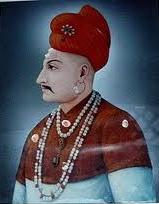
Shrimant Peshwa Balajirao Bhat, also known as Nana Saheb, was the 8th Peshwa of the Maratha Empire in India. He was appointed as Peshwa in 1740 upon the death of his illustrious father, the Peshwa Bajirao I.

Alamgir II was the fifteenth Mughal Emperor of India, who reigned from 3 June 1754 to 29 November 1759. He was the son of Jahandar Shah.
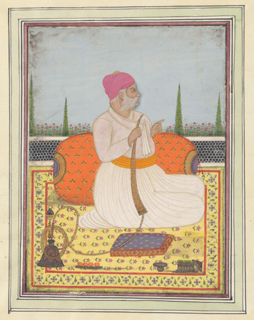
Maharaja Suraj Mal or Sujan Singh, was a Hindu Jat ruler of Bharatpur in Rajasthan, India. Under him, the Jat rule covered the present-day national capital Delhi and districts of Agra, Aligarh, Alwar, Bharatpur, Bulandshahr, Dholpur, Etah, Etawa, Faridabad, Firozabad, Ghaziabad, Gurgaon, Hathras, Jhajjar, Kanpur, Mainpuri, Mathura, Mewat, Meerut, Muzaffarnagar, Palwal, Rewari, and Rohtak.

Ahmad Shah Bahadur, also known as Mirza Ahmad Shah or Mujahid-ud-Din Ahmad Shah Ghazi was fourteenth Mughal Emperor he was born to Emperor Muhammad Shah. He succeeded his father to the throne in 1748 at the age of 22. When Ahmed Shah Bahadur came to power, the Mughal Empire was collapsing. Furthermore, his administrative weaknesses eventually led to the rise of the usurping Imad-ul-Mulk.

Shah Alam II, born as Ali Gohar or Ali Gauhar was the seventeenth Mughal Emperor and the son of Alamgir II. Shah Alam II became the emperor of a crumbling Mughal empire. His power was so depleted during his reign that it led to a saying in the Persian language, Sultanat-e-Shah Alam, Az Dilli ta Palam, meaning, 'The empire of Shah Alam is from Delhi to Palam', Palam being a suburb of Delhi.
Maharani Kishori lived in the 18th century, the wife of Maharaja Suraj Mal of Bharatpur in Rajasthan, India. She came from sorout's Hodal, a town situated in the Palwal district of Haryana, near Mathura and Bharatpur.

Raghunathrao Bhat was the 11th Peshwa of the Maratha Empire for a brief period from 1773 to 1774.

Malhar Rao Holkar was a noble subedar of the Maratha Empire, in present-day India. He was one of the early officers along with Ranoji Sindhia to help spread the Maratha rule to northern states and was given the estate of Indore to rule by the Peshwas, during the reign of the Maratha Emperor Shahu I.

Najib ad-Dawlah, also known as Najib Khan Yousafzai, was a Rohilla Yousafzai Pashtun who earlier served as a Mughal serviceman but later deserted the cause of the Mughals and joined Ahmed Shah Abdali in 1757 in his attack on Delhi. He was also a House chief in the 18th century Rohilkhand, who in the 1740s founded the city of Najibabad in Bijnor district, India. He was instrumental in winning the Third Battle of Panipat.

Ballabgarh, is a large town and a tehsil (subdistrict) in Faridabad district of Haryana, India, and is part of the National Capital Region. The town was founded by Raja Balram Singh, in 1739, who also built the Nahar Singh Mahal palace in the same year. Raja Nahar Singh (1823–1858) was the last king of the princely state, he was executed for taking part in the 1857 war of independence in 1858. The town of Ballabhgarh is only 18 miles (29 km) from Delhi, and today lies on the National Highway 2, a major portion of historical Grand Trunk Road. It is connected to Faridabad and south-east Delhi by the Delhi Metro. Ballabhgarh is the fourth city in Haryana to get metro connectivity after Gurgaon, Faridabad and Bahadurgarh.

Hafiz Rahmat Khan was Mughal Regent of Rohilkhand in North India, from 1749 to 1774. He was a Pashtun by background, ruling over Rohillas. Hafiz Rahmat Khan had served honorably throughout the reign of three Mughal Emperors: Ahmad Shah Bahadur, Alamgir II and Shah Alam II. He was also a mentor of Prince Mirza Jawan Bakht.

Bharatpur State, that is also known as the Jat State of Bharatpur, historically known as the Kingdom of Bharatpur, was a Hindu Kingdom in the northern Indian subcontinent. It was ruled by the Sinsinwar clan of the Hindu Jats. At the time of reign of king Suraj Mal (1755–1763) revenue of the state was 17,500,000 rupees per annual.

Feroze Jung III or Nizam Shahabuddin Muhammad Feroz Khan Siddiqi Bayafandi also known by his sobriquet Imad-ul-Mulk, and royal treason name's Gaddar-ul-Mulk, was the grand vizier of the Mughal Empire allied with the Maratha Empire, who were often described as a de facto ruler of the Mughal Empire. He was the son of Ghazi ud-Din Khan Feroze Jung II and a grandson of the founder of the Nizam Dynasty, Nizam ul Mulk Asaf Jah.

Shahzada Mirza Jawan Bakht Bahadur alternative spelling Mirza Javan Bakht, Mirza Jewan Bakht also known as Mirza Jahandar Shah born at the Red Fort, Delhi. He was the eldest son of Emperor Shah Alam II and the grandson of Emperor Alamgir II, Jawan Bakht was a very influential Timurid Prince of the Mughal Empire.
The Battle of Delhi in 1757 also referred to as the Second Battle of Delhi, was a battle fought on 11 August 1757 between the Maratha Empire under the command of Raghunath Rao and the Rohillas under the command of Najib-ud-Daula, who was under the Afghan suzerainty and simultaneously the "Pay Master" of what remained of the Mughal Army. The battle was waged by the Marathas for the control of Delhi, the former Mughal capital which was now under the control of Rohilla chief Najib-ud-Daula, as a consequence of the fourth invasion of India by Ahmad Shah Abdali.
The following is a timeline of the history of Delhi, including New Delhi. Changes in ruling nation are in bold, with a flag to represent the country where available.
Ghasera Fort is a ruined fort in Ghasera village in Nuh district of Haryana state in northern India, which has been notified as a protected monument by the state government. Currently, the majority of the residents of the village are Muslim Meos, though Hindus also live there.

Dhangar Kshatriya maharaja Khanderao Holkar, was the only son of maharaja Malhar Rao Holkar the founder of Holkar dynasty of Indore, and Gautama Bai.
The battle of Kumher was fought among Jats, Marathas and Mughals.
The Battle of Delhi (1764) was fought between the Kingdom of Bharatpur and the Mughal Empire.

 Kingdom of Bharatpur
  Mughal Empire
  Rohilla Afghans