
Carnival or Shrovetide is a festive season that occurs at the close of the Christian pre-Lenten period, consisting of Quinquagesima or Shrove Sunday, Shrove Monday, and Shrove Tuesday or Mardi Gras.

The Trinidad and Tobago Carnival is an annual event held on the Monday and Tuesday before Ash Wednesday in Trinidad and Tobago. This event is well known for participants' colorful costumes and exuberant celebrations. There are numerous cultural events such as "band launch fetes" running in the lead up to the street parade on Carnival Monday and Tuesday. It is said that if the islanders are not celebrating it, then they are preparing for it, while reminiscing about the past year's festival. Traditionally, the festival is associated with calypso music, with its origins formulated in the midst of hardship for enslaved West and Central Africans; however, recently Soca music has replaced calypso as the most celebrated type of music. Costumes, stick-fighting and limbo competitions are also important components of the festival.
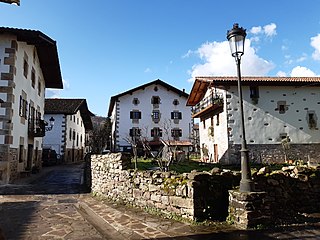
Ituren is a town and municipality located in the province and autonomous community of Navarre, northern Spain. Ituren sits on a westernmost outlying area of the Pyrenees, 56.5 km north of Pamplona. It lies on the flood plain of the River Ezkurra, a tributary of the River Bidasoa, in the shadow of the Mendaur mountain which is characterised by the tiny white-washed chapel of La Trinidad, on its summit.

The Swabian-Alemannic Fastnacht, Fasnacht or Fasnat/Faschnat is the pre-Lenten carnival of Alemannic folklore in Switzerland, southern Germany, Alsace and Vorarlberg.

The Poklad (Carnival) event held yearly on the remote Adriatic Island of Lastovo is one of the more distinctive and authentic carnival traditions celebrated in Croatia. All the island residents participate by wearing folk costumes. The origins of the Lastovo carnival go back to a historical event. Legend has it that Catalan pirates attacked neighbouring Korčula and sent a Turkish messenger to Lastovo to tell the islanders to surrender, or they would be next. The inhabitants of Lastovo did not let themselves be intimidated – instead they armed themselves and went on the attack. The women and children walked to Hum barefoot from Lastovo and prayed to Sv. Jure for help and their prayers were answered: a storm destroyed the pirates' ships and the inhabitants of Lastovo caught the messenger. In order to mock him, he was taken through the village on the back of a donkey and was afterwards sentenced and burned to death. This event is celebrated through the Poklad every year over a period of two days just before Lent.

The Carnival of Basel is the biggest carnival in Switzerland and it is the main Protestant carnival in the world. Basler Fasnacht takes place annually between February and March in Basel. It has been listed as one of the top fifty local festivities in Europe.

The Antiguan Carnival is a celebration of emancipation from slavery, held annually on the island of Antigua. It is a thirteen-day festival of colorful costumes, beauty pageants, talent shows, and music. The festival begins in late July and ends the first Tuesday in August, known as Carnival Tuesday. Both Carnival Monday and Carnival Tuesday are public holidays on the island. Antiguan Carnival replaced the Old Time Christmas Festival in 1957, with hopes of inspiring tourism in Antigua and Barbuda. Some elements of the Old Time Christmas Festival remain in the modern Carnival celebrations.
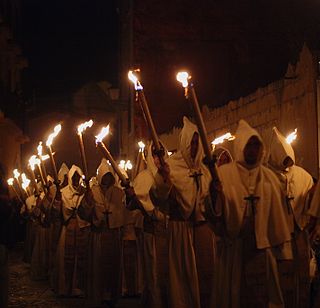
Holy Week in Zamora, Spain, is the annual commemoration of the Passion of Jesus Christ that takes place during the last week of Lent, the week immediately before Easter. Holy Week is the Christian week from Palm Sunday through Easter Sunday. It can take place in March or April. In Zamora, Holy Week is celebrated by 16 Catholic religious brotherhoods and fraternities that perform penance processions on the streets of the city.

Mardi Gras is the annual Carnival celebration in Mobile, Alabama. It is the oldest official Carnival celebration in the United States, started by Frenchman Nicholas Langlois in 1703 when Mobile was the capital of Louisiana. Although today New Orleans and South Louisiana celebrations are much more widely known for all the current traditions such as masked balls, parades, floats and throws were first created there. From Mobile being the first capital of French Louisiana (1702), the festival began as a French Catholic tradition. Mardi Gras has now evolved into a mainstream multi-week celebration across the spectrum of cultures, becoming school holidays for the final Monday and Tuesday, regardless of religious affiliation.

The Carnival of Binche is an annual festival held in Binche, Hainaut, Belgium, during the Sunday, Monday, and Tuesday preceding Ash Wednesday.

A variety of customs and traditions are associated with Carnival celebrations in the German-speaking countries of Germany, Switzerland and Austria. They can vary considerably from country to country, but also from one small region to another. This is reflected in the various names given to these festivities occurring before Lent.

In folklore, a hobby horse is a costumed character that features in some traditional seasonal customs, processions and similar observances around the world. In England, they are particularly associated with May Day celebrations, mummers' plays and the Morris dance.

The Carnival in the Dominican Republic is a Dominican celebration that takes place throughout February, and sometimes during Holy Week in March. Dominican Carnival is celebrated in most cities and towns in the main streets. The carnival season in the Dominican Republic kicks off with a carnival gala held indoors in Santiago de los Caballeros, as opposed to every other carnival event held outdoors throughout the month of February. Among its main characteristics are its flashy costumes and loud music. The one held in La Vega, which is one of the biggest in the country, and the national parade in Santo Domingo, were the first Carnivals held in the Americas.

Folk dance of Mexico, commonly known as baile folklorico or Mexican ballet folk dance, is a term used to collectively describe traditional Mexican folk dances. Ballet folklórico is not just one type of dance; it encompasses each region's traditional dance that has been influenced by their local folklore and has been entwined with ballet characteristics to be made into a theatrical production. Each dance represents a different region in Mexico illustrated through their different zapateado, footwork, having differing stomps or heel toe points, and choreography that imitates animals from their region such as horses, iguanas, and vultures.
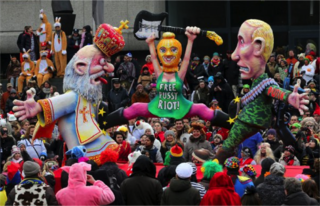
Carnival in the Netherlands is a festival held mainly in the Southern and Eastern regions of the Netherlands with an emphasis on role-reversal and the suspension of social norms, as part of celebrations of Carnival. The feast was assimilated by the Catholic Church, taking elements from ancient pagan spring festivals and is celebrated in the three days preceding the Christian holidays of Ash Wednesday and Lent.
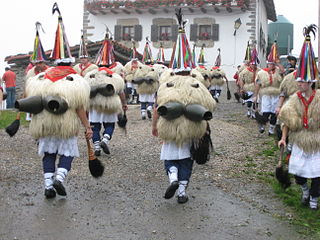
Joaldun is a traditional carnival character in the Basque culture of Navarre, especially in two small villages in the north of the province, Ituren and Zubieta. His function is to shake cowbells to alert people to the beginning of the carnival, which is celebrated annually on the last weekend of January.

Lantz carnivals are the traditional carnivals of Lantz, Navarre, Spain. This traditional celebration it's made the day before Ash Wednesday. Monday and Tuesday of Carnival, streets are filled by people who dress up of different character. The aim is to capture the thief, Miel Otxin.
Carnival is the most important and well-known festivity celebrated in Tarazona de la Mancha, in the Spanish province of Albacete.

Slavic carnivals are known under different names in various Slavic countries: Bulgarian: Сирни заговезни, Прошка, Поклади, romanized: Sirni zagovezni, Proshka, Pokladi; Macedonian: Прочка, romanized: Pročka; Russian: Масленица, Мясопуст, romanized: Maslenitsa, Myasopust; Polish: Ostatki, Mięsopust, Zapusty; Czech: Masopust, Šibřinky, Ostatky; Slovak: Fašiangy; Slovene: Mesopȗst, Pust, Pustni teden, Fašnk; Serbian: Покладе, Проћка / Poklade, Proćka; Croatian: Pust, Poklade, Mesopust, Fašnik. They are traditional Slavic festivals related to the period of carnival.

The Carnival of Cayenne is an annual event held in Cayenne, French Guiana. Alongside the Kourou Carnival and the Saint-Laurent Carnival, it is one of the most significant carnivals in the region.

