
George MacDonald was a Scottish author, poet and Christian Congregational minister. He became a pioneering figure in the field of modern fantasy literature and the mentor of fellow-writer Lewis Carroll. In addition to his fairy tales, MacDonald wrote several works of Christian theology, including several collections of sermons.

Vittorio Veneto is a city and comune situated in the Province of Treviso, in the region of Veneto, Italy, in the northeast of Italy, between the Piave and the Livenza rivers, borders with the following municipalities:
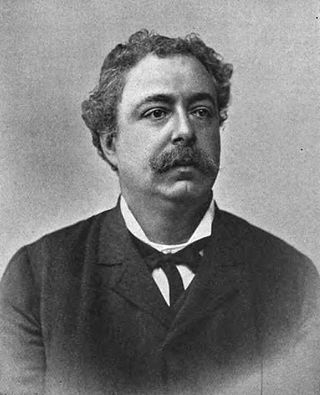
Edmondo De Amicis was an Italian novelist, journalist, poet, and short-story writer. His best-known book is Cuore, a children's novel translated into English as Heart.

Jean-Louis Charles Garnier was a French architect, perhaps best known as the architect of the Palais Garnier and the Opéra de Monte-Carlo.
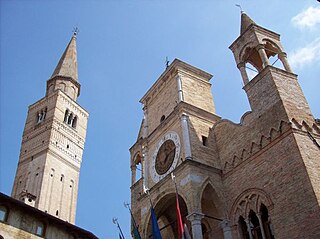
Pordenone is a city and comune (municipality) in the Italian region of Friuli-Venezia Giulia, the capital of the Regional decentralization entity of Pordenone.

Vittorio Veneto was the second member of the Littorio-class battleship that served in the Italian Regia Marina during World War II. The ship's keel was laid down in October 1934, launched in July 1937, and readied for service with the Italian fleet by August 1940. She was named after the Italian victory at Vittorio Veneto during World War I, and she had three sister ships: Littorio, Roma, and Impero, though only Littorio and Roma were completed during the war. She was armed with a main battery of nine 381-millimeter (15.0 in) guns in three triple turrets, and could steam at a speed of 30 knots.

The Littorio class, also known as the Vittorio Veneto class, was a class of battleship of the Regia Marina, the Italian navy. The class was composed of four ships—Littorio, Vittorio Veneto, Roma, and Impero—but only the first three ships of the class were completed. Built between 1934 and 1942, they were the most modern battleships used by Italy during World War II. They were developed in response to the French Dunkerque-class battleships, and were armed with 381-millimeter (15.0 in) guns and had a top speed of 30 knots. The class's design was considered by the Spanish Navy, but the outbreak of World War II interrupted construction plans.

Ludovisi is the 16th rione of Rome, Italy, identified by the initials R. XVI and located within the Municipio I.

Bordighera is a town and comune in the Province of Imperia, Liguria (Italy).

Prince Amedeo of Savoy-Aosta, 5th Duke of Aosta was a claimant to the headship of the House of Savoy, the family which ruled Italy from 1861 to 1946. Until 7 July 2006, Amedeo was styled Duke of Aosta; on that date he declared himself Duke of Savoy, a title that was disputed between him and his third cousin, Vittorio Emanuele, Prince of Naples, only son of King Umberto II of Italy.

Via Vittorio Veneto, colloquially called Via Veneto, is one of the most famous, elegant, and expensive streets of Rome, Italy. The street is named after the Battle of Vittorio Veneto (1918), a decisive Italian victory of World War I. Federico Fellini's classic 1960 film La Dolce Vita was mostly centered on the Via Veneto area.
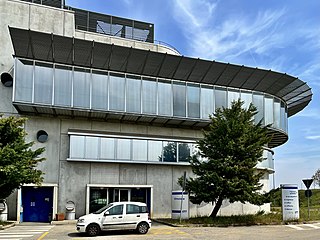
The Gruppo Torinese Trasporti (GTT) is a public benefit corporation responsible for public transportation in the provinces of Alessandria, Cuneo, Asti and the Metropolitan City of Turin. It was created in 2003 from the merge of ATM and SATTI, the latter responsible for railway connection in the province of Turin as well as for the Turin metro. GTT is now wholly owned by the Turin City Hall.

Carlo Piaggia was an Italian explorer of the region of Uganda and the Southern Nile river.
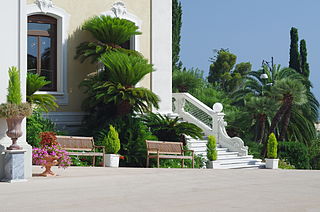
The Villa Regina Margherita di Savoia is a museum site on the via Romana of Bordighera in Riviera in province of Imperia.

The 'Waldensian Evangelical Church' is a religious building in Via Vittorio Veneto in Bordighera on the Riviera, province of Imperia.

The Anglican Church was a religious building of the Church of England in via Regina Vittoria in Bordighera on the Riviera, Province of Imperia. Purchased by the City of Bordighera, and then restored, the former church is now a multi-cultural centre and venue for exhibitions, concerts, lectures and performances. The church, its gardens and Villa Rosa are part of the properties protected by the Superintendent of Ministry of Cultural Heritage and Activities and Tourism (Italy).
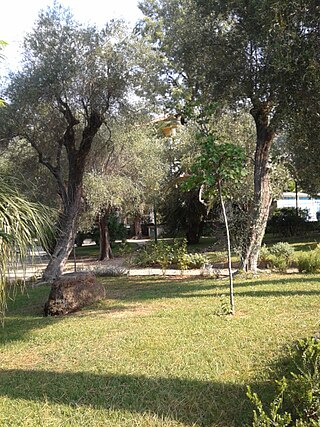
The Lowe gardens are located at 54 Via Vittorio Veneto, in Bordighera, Liguria.

Hotel Bristol Palace is a 4-star Luxury hotel in Genoa, Italy on Via XX Settembre.
Libero Cecchini was an Italian architect. He specialized in restoration of monuments and the design of residential complexes.

Alessandro Mazzucotelli was an Italian craftsman, particularly known as a master ironworker and decorator. A specialist in wrought iron, Mazzucotelli linked his fame to the decorations of the works of the major exponents of Art Nouveau in Italy and abroad.

